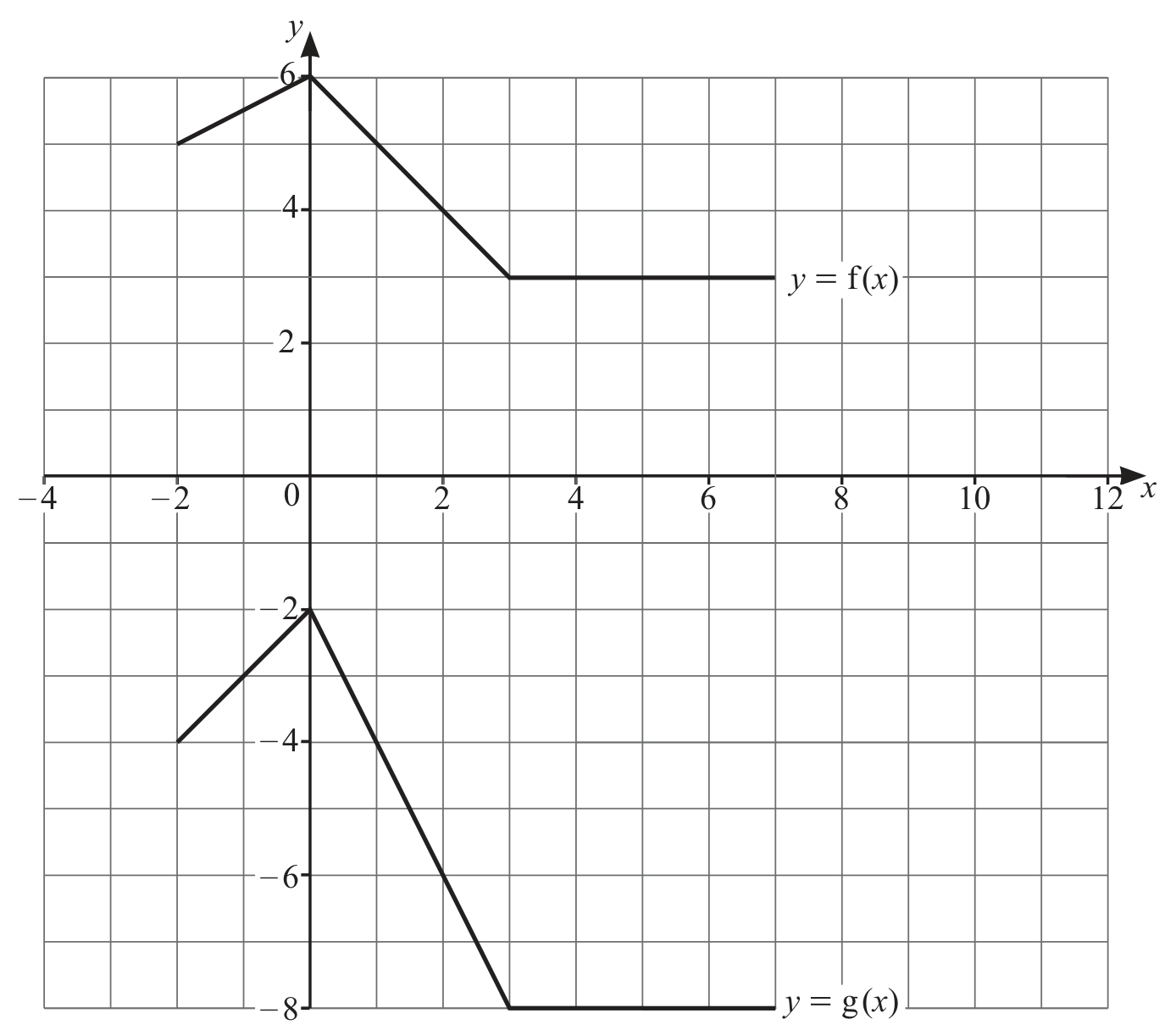
The diagram shows the graphs with equations $y = \mathrm{f}(x)$ and $y = \mathrm{g}(x)$.
Describe fully a sequence of two transformations which transforms the graph of $y = \mathrm{f}(x)$ to the graph of $y = \mathrm{g}(x)$. Make clear the order in which the transformations should be applied.
A point $P$ is moving along the curve with equation $y = ax^{\frac{3}{2}} - 12x$ in such a way that the $x$-coordinate of $P$ is increasing at a constant rate of 5 units per second.
**(a)** Find the rate at which the $y$-coordinate of $P$ is changing when $x = 9$. Give your answer in terms of the constant $a$.
A point $P$ is moving along the curve with equation $y = ax^{\frac{3}{2}} - 12x$ in such a way that the $x$-coordinate of $P$ is increasing at a constant rate of 5 units per second.
**(b)** Given that the curve has a minimum point when $x = \frac{1}{4}$, find the value of $a$.
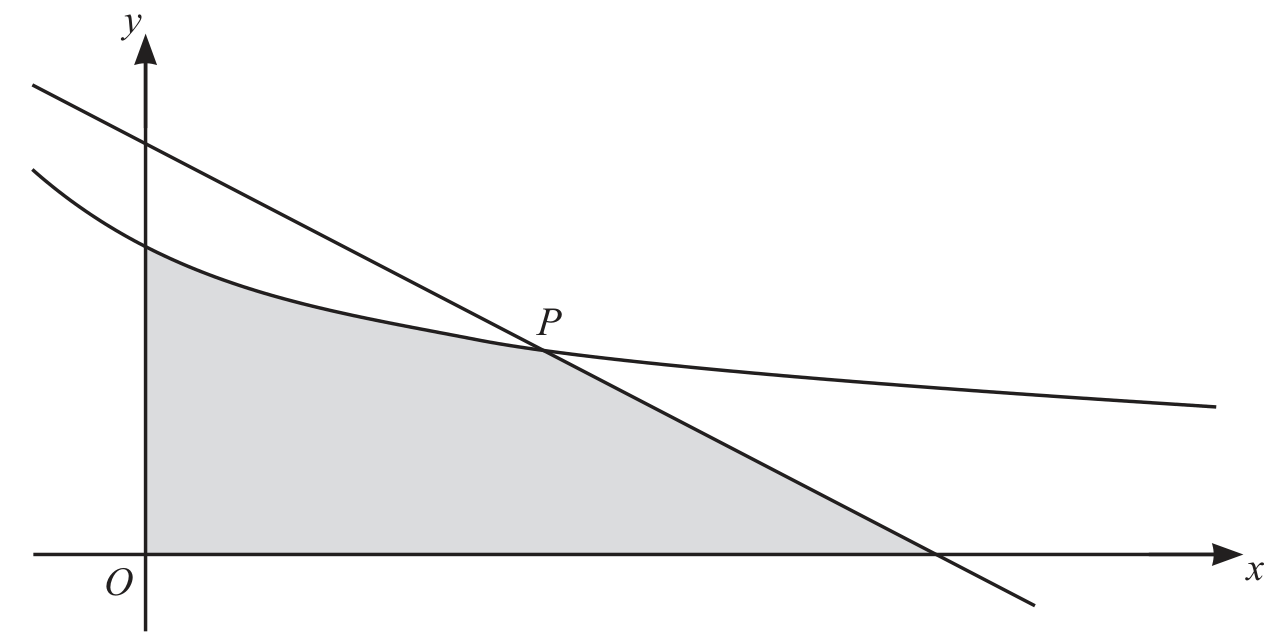
The diagram shows the curve with equation $y = \dfrac{9}{(5x+4)^{\frac{1}{2}}}$ and the line $y = 6 - 3x$. The line and the curve intersect at the point $P$ which has $y$-coordinate 3.
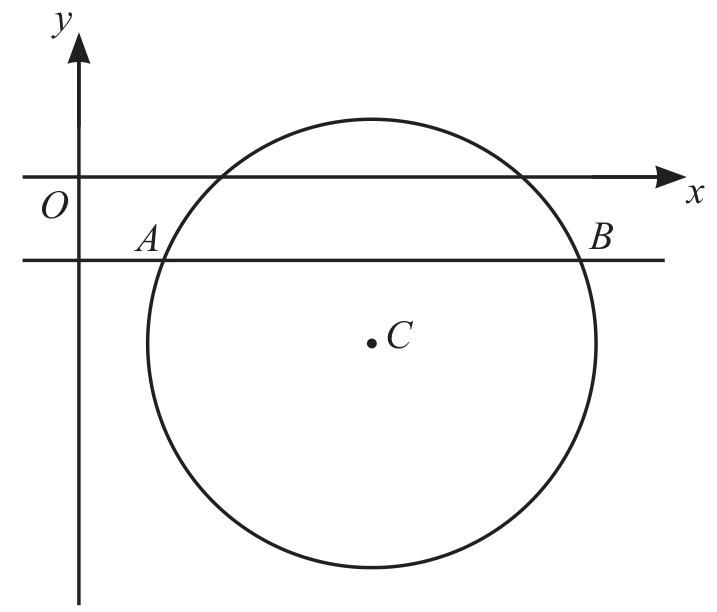
The diagram shows the circle with equation $x^2 + y^2 - 14x + 8y + 36 = 0$ and the line $y = -2$. The line intersects the circle at the points $A$ and $B$. The centre of the circle is $C$.
The diagram shows the circle with equation $x^2 + y^2 - 14x + 8y + 36 = 0$ and the line $y = -2$. The line intersects the circle at the points $A$ and $B$. The centre of the circle is $C$.
**(b)** Find the angle $ACB$ in radians. Give your answer correct to 3 significant figures. (In part (a) you found $A(2, -2)$, $B(12, -2)$ and $C(7, -4)$.)
The diagram shows the circle with equation $x^2 + y^2 - 14x + 8y + 36 = 0$ and the line $y = -2$. The line intersects the circle at the points $A$ and $B$. The centre of the circle is $C$.
**(c)** The chord $AB$ divides the circle into two segments.
Find the area of the larger segment. (In part (a) you found $A(2, -2)$, $B(12, -2)$ and $C(7, -4)$.) (In part (b) you found angle $ACB = 2.38$ radians, to 3 significant figures.)
The equation of a curve is such that $\dfrac{d^2y}{dx^2} = -\dfrac{24}{x^3}$. It is given that the curve has a stationary point at $(-2, 19)$.
**(d)** Find the equation of the normal to the curve at the point where $\dfrac{dy}{dx} = -\dfrac{9}{4}$ and $x$ is positive. Express your answer in the form $px + qy + r = 0$, where $p$, $q$ and $r$ are integers.
(In parts (a) and (c) you found $\dfrac{dy}{dx} = \dfrac{12}{x^2} - 3$ and $y = -\dfrac{12}{x} - 3x + 7$.)