Work in pairs. Put on your safety goggles and gloves.
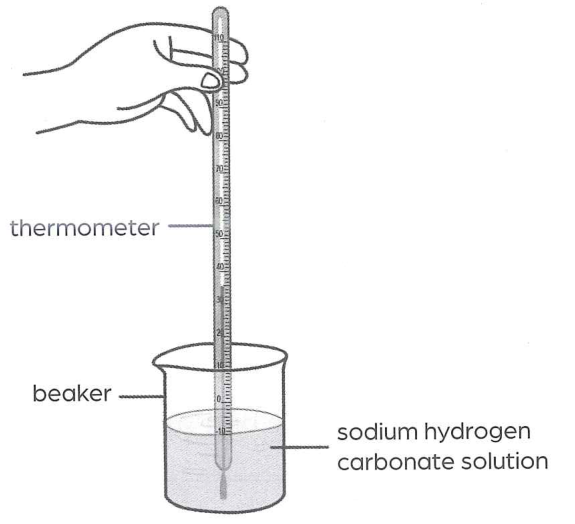
Dissolve 10 cm³ sodium hydrogen carbonate in 80 cm³ water. Stir until no more sodium hydrogen carbonate dissolves. Place 20 cm³ of the sodium hydrogen carbonate solution into a small beaker. Record the initial temperature of the solution in the table. Leave the thermometer in the beaker. Add 5 cm³ of calcium chloride to the solution in the beaker.
Record the final temperature. Work out the temperature change.
| Initial temperature (°C) | Final temperature (°C) | Temperature change (°C) |
|---|---|---|
| | | |
Avoid chemicals in your eyes; if exposed, rinse with water for 15 minutes and tell your teacher. Wash calcium chloride off skin immediately. Work under teacher supervision.
Sodium hydrogen carbonate solution is prepared by stirring 10 cm³ sodium hydrogen carbonate into 80 cm³ water until no more dissolves. Place 20 cm³ of the solution in a small beaker, measure its initial temperature, then add 5 cm³ calcium chloride. What do you observe from the results?
Sodium hydrogen carbonate solution is prepared by stirring 10 cm³ sodium hydrogen carbonate into 80 cm³ water until no more dissolves. Place 20 cm³ of the solution in a small beaker, measure its initial temperature, then add 5 cm³ calcium chloride. Is the reaction between sodium hydrogen carbonate and calcium chloride endothermic or exothermic? Give a reason for your answer.
Sodium hydrogen carbonate solution is prepared by stirring 10 cm³ sodium hydrogen carbonate into 80 cm³ water until no more dissolves. Place 20 cm³ of the solution in a small beaker, measure its initial temperature, then add 5 cm³ calcium chloride. State how you know that a chemical reaction took place.
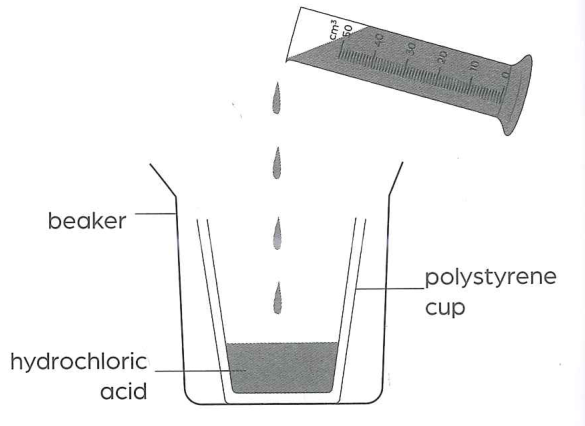
Work in pairs. Put on your safety goggles and gloves. Put the polystyrene cup in the beaker. Pour 30 cm³ dilute hydrochloric acid into the 50 cm³ measuring cylinder. Pour the acid into the polystyrene cup. Measure and record the temperature of the acid as the initial temperature in the table.
Add a few drops of Universal Indicator. Record the colour and pH using the pH colour chart. Use a 10 cm³ cylinder to measure 5 cm³ of sodium hydroxide solution. Pour the measured sodium hydroxide solution into the cup. Stir gently with a stirring rod. Observe and record the pH of the solution in the table. Place the thermometer in the cup and wait two minutes until the temperature stops increasing. Measure and record the temperature in the table.
Measure out another 5 cm³ of sodium hydroxide solution and add it to the cup. Note the reading on the thermometer and wait two minutes until the temperature stops increasing. Measure and record the temperature in the table. Continue to add 5 cm³ of sodium hydroxide solution at a time to the cup until you have added a total of 30 cm³. After each addition of sodium hydroxide solution, measure and record the temperature once it stops increasing. Measure the pH of the final solution.
Hydrochloric acid and sodium hydroxide solution are corrosive. Avoid skin contact; rinse affected skin immediately and tell your teacher. Work under teacher supervision. Dashes indicate the shaded pH cells in the source table.
In this investigation, 30 cm³ dilute hydrochloric acid in a polystyrene cup is mixed with sodium hydroxide solution in 5 cm³ portions, up to a total of 30 cm³. Temperature and pH are measured. Write down the word equation for this reaction.
In this investigation, 30 cm³ dilute hydrochloric acid in a polystyrene cup is mixed with sodium hydroxide solution in 5 cm³ portions, up to a total of 30 cm³. Temperature and pH are measured. Explain how you know a neutralisation reaction took place.
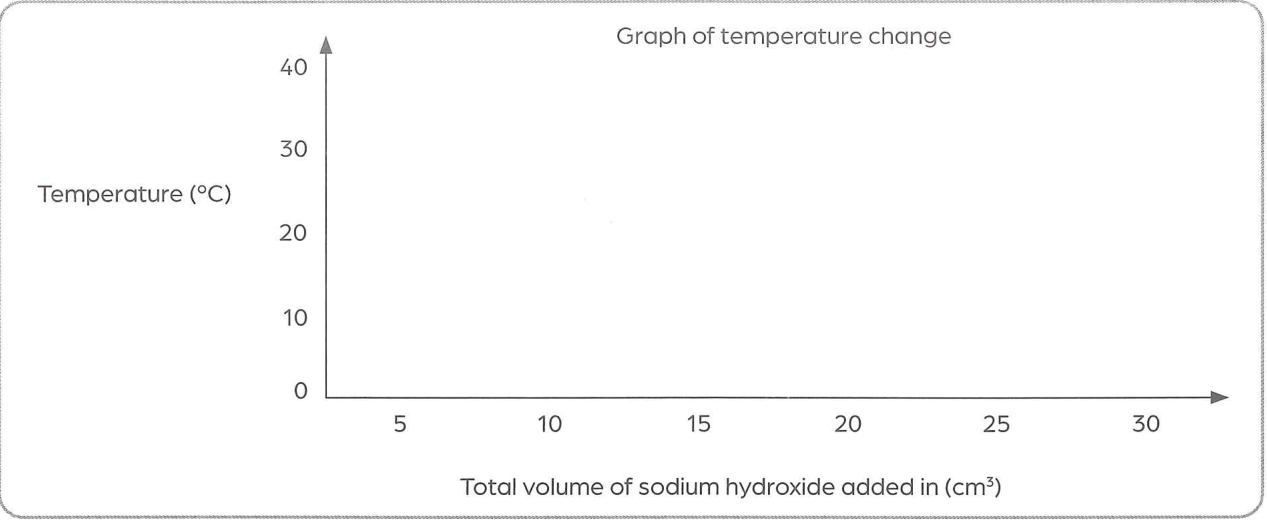
In this investigation, 30 cm³ dilute hydrochloric acid in a polystyrene cup is mixed with sodium hydroxide solution in 5 cm³ portions, up to a total of 30 cm³. Temperature and pH are measured. Draw a graph of the temperature changes observed. Use your measured table from 0 to 30 cm³.
In this investigation, 30 cm³ dilute hydrochloric acid in a polystyrene cup is mixed with sodium hydroxide solution in 5 cm³ portions, up to a total of 30 cm³. Temperature and pH are measured. Explain why this reaction is considered an exothermic reaction.
In this investigation, 30 cm³ dilute hydrochloric acid in a polystyrene cup is mixed with sodium hydroxide solution in 5 cm³ portions, up to a total of 30 cm³. Temperature and pH are measured. Why is it important to measure the volumes of the reactants accurately?
In this investigation, 30 cm³ dilute hydrochloric acid in a polystyrene cup is mixed with sodium hydroxide solution in 5 cm³ portions, up to a total of 30 cm³. Temperature and pH are measured. Describe one way you could improve the experiment to make the results more accurate.
In this investigation, 30 cm³ dilute hydrochloric acid in a polystyrene cup is mixed with sodium hydroxide solution in 5 cm³ portions, up to a total of 30 cm³. Temperature and pH are measured. Are your results reliable? Suggest two ways to find out.
In this investigation, 2 g each of calcium chloride (A), sodium carbonate (B), magnesium chloride (C) and potassium chloride (D) are placed in separate polystyrene cups. Add 10 cm³ water to each salt, stir gently and record initial and final temperatures. Keep a fifth cup with water only. Rinse the thermometer before each test. Work in groups. Put on your safety goggles and gloves. Use a spoon or spatula to avoid direct contact with chemicals. Add 50 cm³ of water to the unlabelled cup. Measure and record its initial temperature. Add 10 cm³ of this water to cup A, stir gently and place the thermometer in the solution. When the temperature stops changing, record the final temperature. Repeat for B and C. For D, add 10 cm³ water, stir and wait two minutes for the temperature to stop changing; record the final temperature. Measure and record the final temperature of the water in the unlabelled cup. Complete the table.
| Type of salt | Initial temperature (°C) | Final temperature (°C) | Temperature change (°C) |
|---|---|---|---|
| – (water only) | | | |
| Calcium chloride | | | |
| Sodium carbonate | | | |
| Magnesium chloride | | | |
| Potassium chloride | | | |
In this investigation, 2 g each of calcium chloride (A), sodium carbonate (B), magnesium chloride (C) and potassium chloride (D) are placed in separate polystyrene cups. Add 10 cm³ water to each salt, stir gently and record initial and final temperatures. Keep a fifth cup with water only. Rinse the thermometer before each test. After testing cups A, B and C, what trend can you see?
In this investigation, 2 g each of calcium chloride (A), sodium carbonate (B), magnesium chloride (C) and potassium chloride (D) are placed in separate polystyrene cups. Add 10 cm³ water to each salt, stir gently and record initial and final temperatures. Keep a fifth cup with water only. Rinse the thermometer before each test. Predict the temperature change when you dissolve the potassium chloride in water.
In this investigation, 2 g each of calcium chloride (A), sodium carbonate (B), magnesium chloride (C) and potassium chloride (D) are placed in separate polystyrene cups. Add 10 cm³ water to each salt, stir gently and record initial and final temperatures. Keep a fifth cup with water only. Rinse the thermometer before each test. What variable did you measure?
In this investigation, 2 g each of calcium chloride (A), sodium carbonate (B), magnesium chloride (C) and potassium chloride (D) are placed in separate polystyrene cups. Add 10 cm³ water to each salt, stir gently and record initial and final temperatures. Keep a fifth cup with water only. Rinse the thermometer before each test. What variable did you change?
In this investigation, 2 g each of calcium chloride (A), sodium carbonate (B), magnesium chloride (C) and potassium chloride (D) are placed in separate polystyrene cups. Add 10 cm³ water to each salt, stir gently and record initial and final temperatures. Keep a fifth cup with water only. Rinse the thermometer before each test. What general trend or pattern did you observe in your results?
In this investigation, 2 g each of calcium chloride (A), sodium carbonate (B), magnesium chloride (C) and potassium chloride (D) are placed in separate polystyrene cups. Add 10 cm³ water to each salt, stir gently and record initial and final temperatures. Keep a fifth cup with water only. Rinse the thermometer before each test. Were there any results that did not fit the pattern? Use your results to support your answer.
In this investigation, 2 g each of calcium chloride (A), sodium carbonate (B), magnesium chloride (C) and potassium chloride (D) are placed in separate polystyrene cups. Add 10 cm³ water to each salt, stir gently and record initial and final temperatures. Keep a fifth cup with water only. Rinse the thermometer before each test. How can you test if your observation is valid?