Question 5
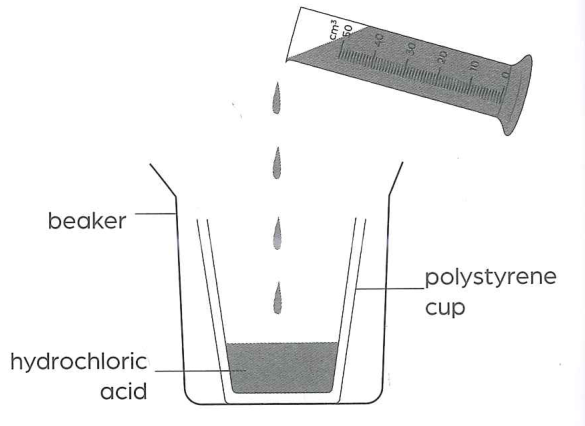
Work in pairs. Put on your safety goggles and gloves. Put the polystyrene cup in the beaker. Pour 30 cm³ dilute hydrochloric acid into the 50 cm³ measuring cylinder. Pour the acid into the polystyrene cup. Measure and record the temperature of the acid as the initial temperature in the table.
Add a few drops of Universal Indicator. Record the colour and pH using the pH colour chart. Use a 10 cm³ cylinder to measure 5 cm³ of sodium hydroxide solution. Pour the measured sodium hydroxide solution into the cup. Stir gently with a stirring rod. Observe and record the pH of the solution in the table. Place the thermometer in the cup and wait two minutes until the temperature stops increasing. Measure and record the temperature in the table.
Measure out another 5 cm³ of sodium hydroxide solution and add it to the cup. Note the reading on the thermometer and wait two minutes until the temperature stops increasing. Measure and record the temperature in the table. Continue to add 5 cm³ of sodium hydroxide solution at a time to the cup until you have added a total of 30 cm³. After each addition of sodium hydroxide solution, measure and record the temperature once it stops increasing. Measure the pH of the final solution.
Initial indicator colour: ______
| Total volume of sodium hydroxide solution added (cm³) | Maximum temperature (°C) | pH |
|---|---|---|
| 0 | | |
| 5 | | |
| 10 | | — |
| 15 | | — |
| 20 | | — |
| 25 | | — |
| 30 | | |
Hydrochloric acid and sodium hydroxide solution are corrosive. Avoid skin contact; rinse affected skin immediately and tell your teacher. Work under teacher supervision. Dashes indicate the shaded pH cells in the source table.
Add a few drops of Universal Indicator. Record the colour and pH using the pH colour chart. Use a 10 cm³ cylinder to measure 5 cm³ of sodium hydroxide solution. Pour the measured sodium hydroxide solution into the cup. Stir gently with a stirring rod. Observe and record the pH of the solution in the table. Place the thermometer in the cup and wait two minutes until the temperature stops increasing. Measure and record the temperature in the table.
Measure out another 5 cm³ of sodium hydroxide solution and add it to the cup. Note the reading on the thermometer and wait two minutes until the temperature stops increasing. Measure and record the temperature in the table. Continue to add 5 cm³ of sodium hydroxide solution at a time to the cup until you have added a total of 30 cm³. After each addition of sodium hydroxide solution, measure and record the temperature once it stops increasing. Measure the pH of the final solution.
Initial indicator colour: ______
| Total volume of sodium hydroxide solution added (cm³) | Maximum temperature (°C) | pH |
|---|---|---|
| 0 | | |
| 5 | | |
| 10 | | — |
| 15 | | — |
| 20 | | — |
| 25 | | — |
| 30 | | |
Hydrochloric acid and sodium hydroxide solution are corrosive. Avoid skin contact; rinse affected skin immediately and tell your teacher. Work under teacher supervision. Dashes indicate the shaded pH cells in the source table.
