Skip to content / Đến nội dung
SachHeCam.com

Cambridge Secondary (7-9). Stage 7. MCE Science. Student Book - Unit 10: Forces

Question 2

When you ride a bicycle, different forces work together to keep you moving. You exert a force on the pedals, and this pushes the bicycle forward. Friction between the wheels and the road prevents the bicycle from skidding. As you cycle faster, you feel more air resistance against your face and body.

Why must cyclists pedal harder when they ride into the wind?

Question 3

What would happen if gravity wasn’t keeping a cyclist on the road?

Question 4

How does knowing about forces help us to design more energy-efficient vehicles or machines?

Question 5

What do you remember about forces from previous years’ science lessons?

Question 6

Which forces act only when objects touch each other?

Question 11

Is gravitational force (gravity) the same everywhere on Earth?

Hint: Think about high mountains and deep caves.

Question 12

This table shows the sizes of the planets in the Solar System. Write numbers 1–8 in the empty column to rank the planets in order of increasing gravitational force. One has been done for you. (Hint: Recall the link between mass and gravitational force.)

| Planet | Diameter (km) | Rank |
|:-|--:|:-:|
| Mercury | 4,879 | 1 |
| Venus | 12,104 | |
| Earth | 12,756 | |
| Mars | 6,794 | |
| Jupiter | 142,980 | |
| Saturn | 120,540 | |
| Uranus | 51,120 | |
| Neptune | 49,530 | |

Question 13

What force prevents us from flying off the face of the Earth?

Question 14

Would you weigh more or less on the Moon or on Earth? Explain why.

Question 15

What would happen to an object’s gravitational force if it gained mass?

Question 16

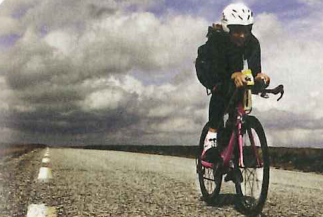
During bicycle races, cyclists lean forward over the handlebars, as shown in the photograph above. Why do they do this?

Question illustration

Question 17

Lift and air resistance are produced when an object is in contact with the air. So, what happens if there is no air?

Question 18

What will happen if you drop a feather and a bowling ball in a vacuum?

Question 19

Both Aristotle and Galileo studied the movements of falling objects, but it was Brahmagupta who first described gravity. Brahmagupta was a mathematician and astronomer in India. He wrote that every object would fall to the ground due to Earth’s force of attraction. About 1000 years later, in 1687, Sir Isaac Newton (Figure 10.11) published the Law of Universal Gravitation. “If I have seen further,” Isaac Newton wrote, “it is by standing on the shoulders of giants.” What did he mean by this?

Question 20

In groups, plan and carry out an investigation to find out whether heavier objects fall faster than lighter ones.

Begin by making a hypothesis. Remember to be specific and make sure your hypothesis can be tested.
0
0
GIỎ HÀNG
Empty CartGIỎ CHƯA CÓ GÌQUAY LẠI SHOP