Everyone needs energy to stay alive and to do things. They get their energy from the food that they eat. Think about the answers to these two questions on your own. Then turn to your partner and discuss your answers. Be ready to share your ideas with the rest of the class.
Which kinds of food are best for giving you energy?
Everyone needs energy to stay alive and to do things. They get their energy from the food that they eat. Think about the answers to these two questions on your own. Then turn to your partner and discuss your answers. Be ready to share your ideas with the rest of the class.
What happens to your food after you have swallowed it, before it gives you energy?
Work with a partner for this activity.
Think about what both of you have eaten so far today. Make a list.
Which foods do you think contain a lot of protein?
In your list, draw a green circle around each one.
Which foods do you think contain a lot of carbohydrate?
In your list, draw a blue circle around each one.
Use the internet or a reference book to see if you are right. Make changes to your list if you were not correct.
This is an extension activity.
You are going to try to find out which types of food contain starch.
You can use iodine solution to find out if a food contains starch.
Iodine solution is orange-brown. When it mixes with starch, it becomes very dark blue-black.
You will need:
• at least six different kinds of food
• some paper plates or other plates to put the pieces of food on, keeping them separate
• white tile
• bottle of iodine solution with a dropper
Method
1 Collect six different kinds of food. Try to include some foods that come from plants, and some that come from animals. Make sure you keep them completely separate from one another.
2 Draw a results table like this:
| Food | Colour of iodine solution after adding to the food | Does the food contain starch? |
|---|---|---|
| | | |
| | | |
3 Take a small piece of the first food. Put it onto a white tile.
4 Add a few drops of iodine solution. Record the colour that you see in your results table.
5 Clean the white tile. Now repeat steps 3 and 4 for the other foods, making sure to clean the tile each time.
6 Complete the last column in your results table.
| Nutrient | Examples of foods that contain a lot of this nutrient | Why the body needs this nutrient |
|---|---|---|
| Protein | | |
| Carbohydrate | | |
| Fat | | |
Work in a group of three for this activity.
You will need a big piece of paper, and some coloured pens or pencils.
Divide the sheet of paper into three equal areas labelled Vitamin A, Vitamin C and Vitamin D.
Use the information in this book, the internet and/or the library to find out which foods contain a lot of each vitamin.
Draw pictures of the foods in each space. If you like, you could also cut out some pictures of foods from packaging or magazines, and stick the pictures onto your poster.
Look back at question 1. Draw a similar table, but include vitamin A, vitamin C, vitamin D, calcium and iron instead of protein, carbohydrate and fats.
Then complete your table.
Reference table headings: Nutrient; Examples of foods that contain a lot of this nutrient; Why the body needs this nutrient.
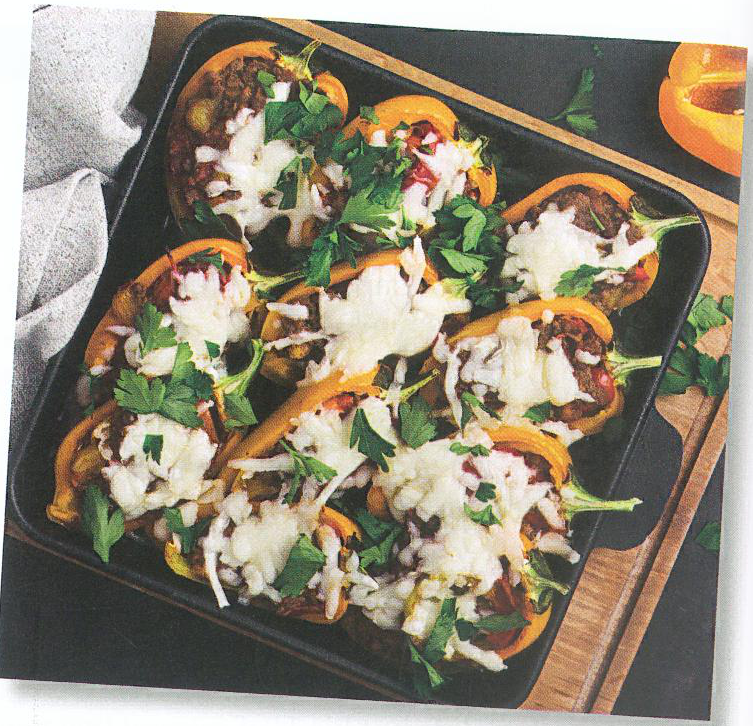
These bell peppers are stuffed with lentils and vegetables, and topped with cheese. They contain a lot of iron and calcium.
What other nutrients do you think this meal contains? Explain your answer.