In this task you will burn some magnesium and produce a new product.
You will need: safety glasses, a Bunsen burner, a heat-proof mat, tongs, a piece of magnesium ribbon.
Safety
Wear safety glasses. While the magnesium ribbon is burning, do not look directly at the flame. Magnesium burns very brightly and the bright light could harm your eyes.
1. Set up the Bunsen burner on the heat-proof mat.
2. Take a small piece of magnesium ribbon and place it in the tongs.
3. Hold the tongs at arm’s length and place the magnesium ribbon in the Bunsen flame.
4. Once the magnesium ribbon has caught fire, remove it from the flame.
Additional safety guidance: Carry out this classroom experiment only under the teacher’s supervision. Keep clear of hot equipment and let the tongs cool before touching them.
List all the safety precautions you need to take while carrying out this experiment.
Not all metals have the same chemical properties as magnesium. They may not burn in the same way. You could try holding pieces of other metals, such as copper, zinc or iron, in the Bunsen flame and record what happens.
Additional safety guidance: Only use small samples chosen by your teacher in a supervised classroom. Wear safety glasses, use tongs at arm’s length and a heat-proof mat, avoid breathing fumes, and allow hot apparatus to cool.
The table compares the reactants and product when magnesium burns.
| Property | Magnesium | Oxygen | Magnesium oxide |
|---|---|---|---|
| Element or compound? | element | element | compound |
| State at room temperature | solid | gas | solid |
| Appearance | soft, shiny, malleable | colourless, has no smell | white, powdery |
| Conducts electricity? | yes | no | no |
| Melting point in °C | 651 | −214 | 2800 |
Compare the melting points of magnesium, oxygen and magnesium oxide.
The table compares the reactants and product when magnesium burns.
| Property | Magnesium | Oxygen | Magnesium oxide |
|---|---|---|---|
| Element or compound? | element | element | compound |
| State at room temperature | solid | gas | solid |
| Appearance | soft, shiny, malleable | colourless, has no smell | white, powdery |
| Conducts electricity? | yes | no | no |
| Melting point in °C | 651 | −214 | 2800 |
Find one similarity between magnesium oxide and one of the reactants.
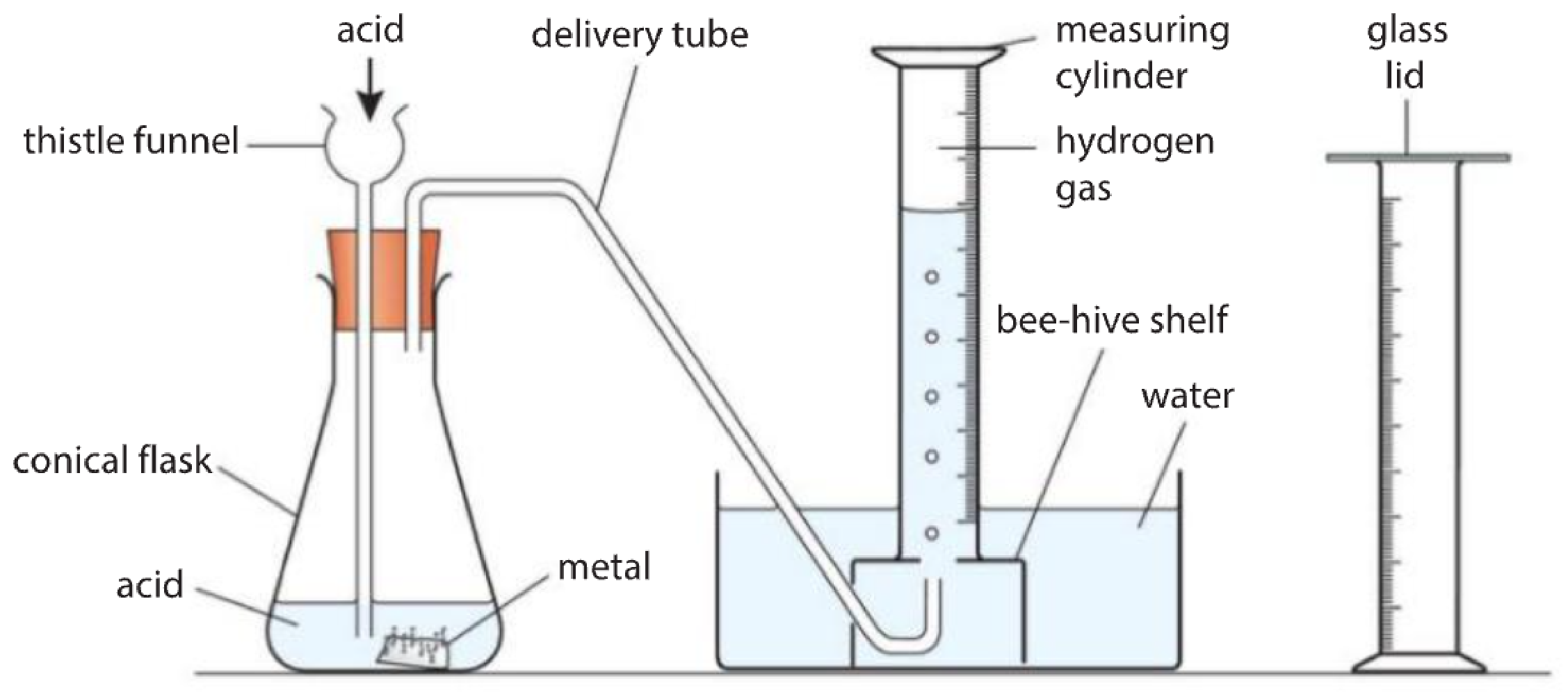
Hydrogen can be produced on a larger scale by collecting the gas produced in the reaction over water, as shown in the diagram on the next page. You could try this for yourself.
Additional safety guidance: Treat this as a teacher-supervised classroom collection demonstration, not a home experiment. The teacher selects a small scale and dilute acid. Wear safety glasses. Keep the delivery path open, never seal a gas-producing system, and keep flames away from the generator and collected gas.
You will need: safety glasses, test tubes, a test tube rack, water, hydrochloric acid, small pieces of a selection of metals such as magnesium, iron, copper, zinc.
Safety
Wear safety glasses. Remember to pay attention to hazard warning labels when you use chemicals.
Additional safety guidance: Work only with teacher supervision and the small quantities and dilute acid provided. Point tubes away from people, avoid overfilling and never seal reacting tubes. Only test a small gas sample as directed by your teacher, away from the gas generator.
Part 1: Reactions with water
1. Place a small piece of each of the metals into a different test tube.
2. Take one tube at a time and add water, so that the test tube is half full.
3. Record your observations and findings in a table.
You will need: safety glasses, test tubes, a test tube rack, water, hydrochloric acid, small pieces of a selection of metals such as magnesium, iron, copper, zinc.
Safety
Wear safety glasses. Remember to pay attention to hazard warning labels when you use chemicals.
Additional safety guidance: Work only with teacher supervision and the small quantities and dilute acid provided. Point tubes away from people, avoid overfilling and never seal reacting tubes. Only test a small gas sample as directed by your teacher, away from the gas generator.
Part 2: Reactions with acid
1. Place a small piece of each of the metals into a different test tube.
2. Take one tube at a time and add hydrochloric acid, so that the test tube is half full.
3. If you see bubbles given off, test for hydrogen gas.
4. Record your observations and findings in a table.
You will need: safety glasses, test tubes, a test tube rack, water, hydrochloric acid, small pieces of a selection of metals such as magnesium, iron, copper, zinc.
Safety
Wear safety glasses. Remember to pay attention to hazard warning labels when you use chemicals.
Additional safety guidance: Work only with teacher supervision and the small quantities and dilute acid provided. Point tubes away from people, avoid overfilling and never seal reacting tubes. Only test a small gas sample as directed by your teacher, away from the gas generator.
For each reaction with acid, write down the reactants and the products.