The first two terms of a geometric progression are
$4\sin^2\theta,\quad 8\sin^3\theta,$
where $\theta$ is an angle such that $0 \lt \theta \lt \frac{1}{6}\pi$.
Given that the sum to infinity of the progression is $\frac{1}{2}$, find the value of $\theta$. Give your answer in the form $\sin^{-1}k$, where $k$ is a rational number.
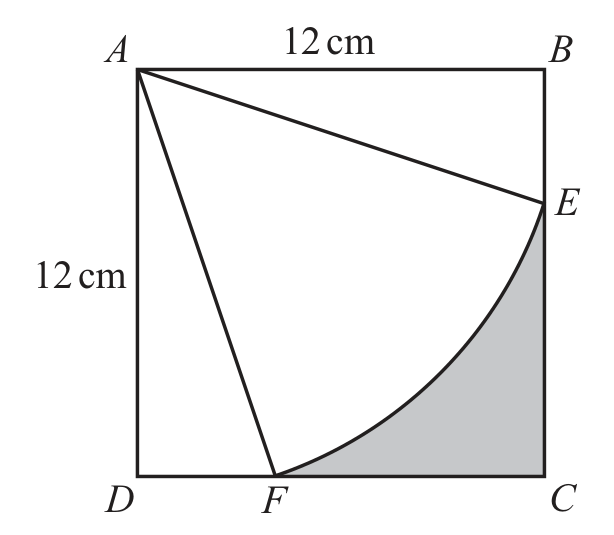
The diagram shows a square $ABCD$ where each side has length 12 cm. Points $E$ and $F$ lie on the sides $BC$ and $CD$ respectively and are such that $BE = \frac{1}{3}BC$ and $DF = \frac{1}{3}DC$. The arc $EF$ is part of a circle with centre $A$. The shaded region is bounded by the arc $EF$ and the line segments $EC$ and $FC$.
**(a)** Show that the size of angle $EAF$ is 0.9273 radians, correct to 4 significant figures.
The diagram shows a square $ABCD$ where each side has length 12 cm. Points $E$ and $F$ lie on the sides $BC$ and $CD$ respectively and are such that $BE = \frac{1}{3}BC$ and $DF = \frac{1}{3}DC$. The arc $EF$ is part of a circle with centre $A$. The shaded region is bounded by the arc $EF$ and the line segments $EC$ and $FC$.
**(b)** (In part (a) you showed that angle $EAF = 0.9273$ radians.)
The diagram shows a square $ABCD$ where each side has length 12 cm. Points $E$ and $F$ lie on the sides $BC$ and $CD$ respectively and are such that $BE = \frac{1}{3}BC$ and $DF = \frac{1}{3}DC$. The arc $EF$ is part of a circle with centre $A$. The shaded region is bounded by the arc $EF$ and the line segments $EC$ and $FC$.
**(c)** (In part (a) you showed that angle $EAF = 0.9273$ radians.)
Three points $P$, $Q$ and $R$ have coordinates $P(-13, 5)$, $Q(5, 1)$ and $R(2, k)$, where $k$ is a constant. It is given that the angle $PRQ$ is a right angle.
**(a)** Show that one of the possible values of $k$ is 10, and find the other possible value.
Three points $P$, $Q$ and $R$ have coordinates $P(-13, 5)$, $Q(5, 1)$ and $R(2, k)$, where $k$ is a constant. It is given that the angle $PRQ$ is a right angle.
**(b)** It is now given that $k = 10$. A circle passes through the points $P$, $Q$ and $R$.
Find the equation of the tangent to the circle at $R$. Give your answer in the form $ax + by + c = 0$, where $a$, $b$ and $c$ are integers.
A curve $C$ has equation $y = \dfrac{9}{2x - 5} + 2x - 5$.
**(c)** The curve $C$ is transformed to the curve $C_1$ using a translation of $\begin{pmatrix} -3 \\ 7 \end{pmatrix}$ followed by reflection in the $x$-axis.
(The stationary points of $C$ are the maximum $(1, -6)$ and the minimum $(4, 6)$.)
**(i)** State the coordinates of the maximum point of $C_1$.
A curve $C$ has equation $y = \dfrac{9}{2x - 5} + 2x - 5$.
**(c)** The curve $C$ is transformed to the curve $C_1$ using a translation of $\begin{pmatrix} -3 \\ 7 \end{pmatrix}$ followed by reflection in the $x$-axis.
**(ii)** Find the equation of $C_1$ in the form $y = \dfrac{a}{bx + c} + dx + e$, where $a$, $b$, $c$, $d$ and $e$ are integers.