Skip to content / Đến nội dung
SachHeCam.com

Cambridge AS & A Level. 2025. Mathematics (9709). May/June - Paper 1 (11) · Pure Mathematics 1

Question 1

Solve the equation $6\sin\theta = 1 + \dfrac{2}{\sin\theta}$ for $-180^\circ < \theta < 180^\circ$.

Question 2

The equation of a curve is such that $\dfrac{dy}{dx} = 4(2x-5)^3 - 9x^{\frac{1}{2}}$. The curve passes through the point $A\left(4, -\frac{11}{2}\right)$.

**(a)** Find the gradient of the normal to the curve at the point *A*.

Question 3

The equation of a curve is such that $\dfrac{dy}{dx} = 4(2x-5)^3 - 9x^{\frac{1}{2}}$. The curve passes through the point $A\left(4, -\frac{11}{2}\right)$.

**(b)** Find the equation of the curve.

Question 4

The third term of a geometric progression is 18 and the sum of the first three terms is 26. It is given that the common ratio is negative.

**(a)** Find the tenth term of the progression. Give your answer correct to 3 significant figures.

Question 5

The third term of a geometric progression is 18 and the sum of the first three terms is 26. It is given that the common ratio is negative.

**(b)** Find the exact value of the sum to infinity of the progression.

(In part (a) you found $a = 32$ and $r = -\frac{3}{4}$.)

Question 6

Question illustration

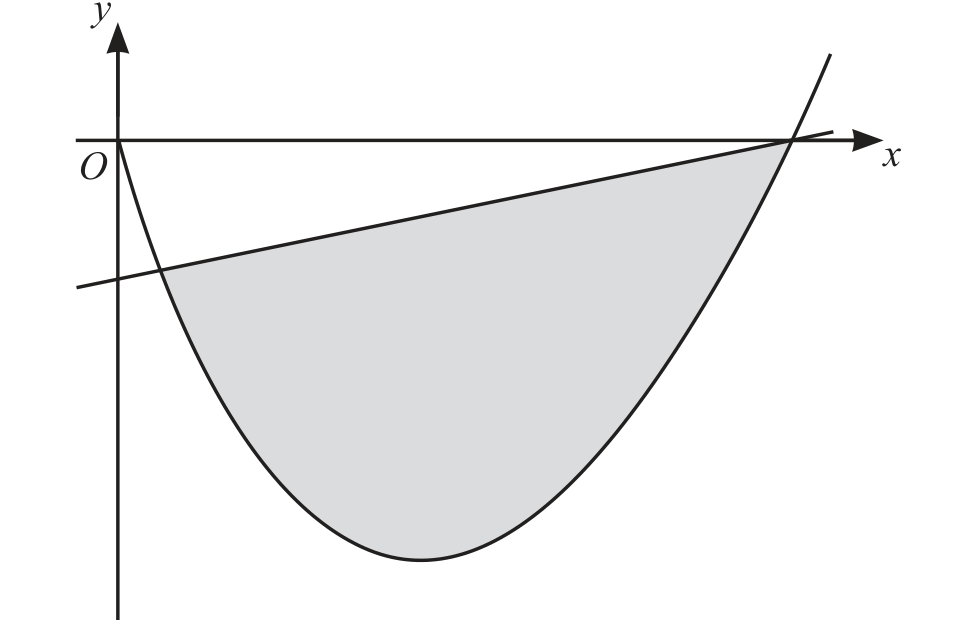
The diagram shows the curve with equation $y = 5x^{\frac{3}{2}} - 20x$ and the line with equation $y = x - 16$. The $x$-coordinates of the points of intersection of the curve and line are 1 and 16.

Find the area of the shaded region between the curve and the line.

Question 7

**(a)** Find the first three terms, in ascending powers of $x$, in the expansion of each of the following expressions.

**(i)** $(2 - px)^5$

Question 8

**(a)** Find the first three terms, in ascending powers of $x$, in the expansion of each of the following expressions.

**(ii)** $\left(1 - \frac{1}{2}x\right)^4$

Question 9

**(a)** Find the first three terms, in ascending powers of $x$, in the expansion of each of the following expressions.

**(b)** Given that the coefficient of $x^2$ in the expansion of $(2 - px)^5\left(1 - \frac{1}{2}x\right)^4$ is 93, find the possible values of the constant $p$.

(In part (a) you found $(2 - px)^5 = 32 - 80px + 80p^2x^2 + \ldots$ and $\left(1 - \frac{1}{2}x\right)^4 = 1 - 2x + \frac{3}{2}x^2 + \ldots$)

Question 10

The equation of a curve is $2x^2 - kxy + 2 = 0$ and the equation of a line is $y = px + 3$, where $k$ and $p$ are constants.

**(a)** Given that $k = 2$ and $p = 11$, find the coordinates of the points of intersection of the curve and the line.

Question 11

The equation of a curve is $2x^2 - kxy + 2 = 0$ and the equation of a line is $y = px + 3$, where $k$ and $p$ are constants.

**(b)** Given instead that $p = 4$, find the set of values of $k$ for which the curve and the line do not intersect.

Question 12

The equation of a curve is $y = 4x^2 + \dfrac{9}{x^2} - 8$.

**(a)** A point $P$ is moving along the curve in such a way that its $y$-coordinate is decreasing at 5 units per second.

Find the rate at which the $x$-coordinate of point $P$ is changing when $x = 2$.

Question 13

The equation of a curve is $y = 4x^2 + \dfrac{9}{x^2} - 8$.

**(b)** Find the coordinates of the stationary points of the curve and determine their nature.

Question 14

The circle with equation $x^2 + y^2 - 6x + 10y - 27 = 0$ intersects the line $x = -2$ at the points $P$ and $Q$.

Find the area of the triangle formed by the tangents to the circle at $P$ and $Q$, and the line $x = -2$.

Question 15

Question illustration

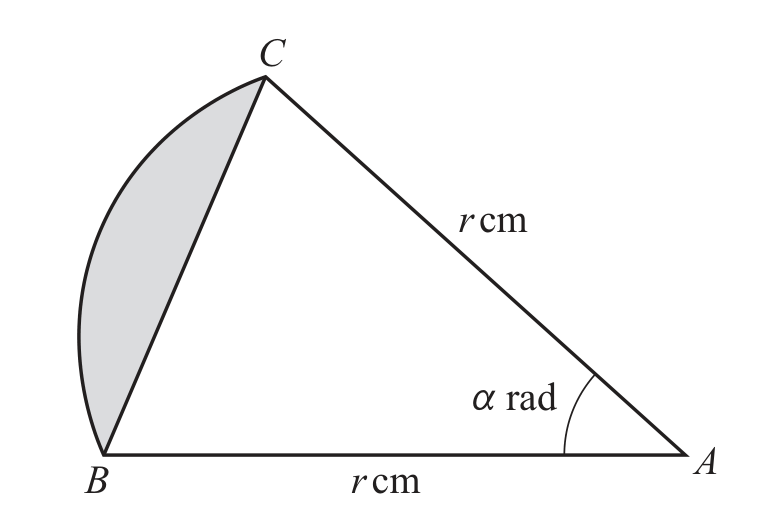
The diagram shows a sector $ABC$ of a circle with centre $A$ and radius $r$ cm. The angle $BAC$ is $\alpha$ radians, where $0 < \alpha < \frac{1}{2}\pi$.

**(a)** It is given that the area of the triangle $ABC$ is $4\ \text{cm}^2$ and the area of the sector $ABC$ is $8\alpha\ \text{cm}^2$.

Find the exact area of the shaded segment.

Question 16

Question illustration

The diagram shows a sector $ABC$ of a circle with centre $A$ and radius $r$ cm. The angle $BAC$ is $\alpha$ radians, where $0 < \alpha < \frac{1}{2}\pi$.

**(b)** It is given instead that the length of the chord $BC$ is $\dfrac{1}{\sqrt{2}}r$ cm but the area of the triangle $ABC$ is still $4\ \text{cm}^2$.

Find the area of the shaded segment. Give your answer correct to 3 significant figures.

Question 17

The functions f and g are defined by

$\mathrm{f}(x) = \sqrt{x}$ for $x \geqslant 0$,

$\mathrm{g}(x) = 3\sqrt{x + 2} - 5$ for $x \geqslant -2$.

**(a)** Describe fully a sequence of transformations which transforms the graph of $y = \mathrm{f}(x)$ to the graph of $y = \mathrm{g}(x)$. You should make clear the order in which the transformations are applied.
Question 18

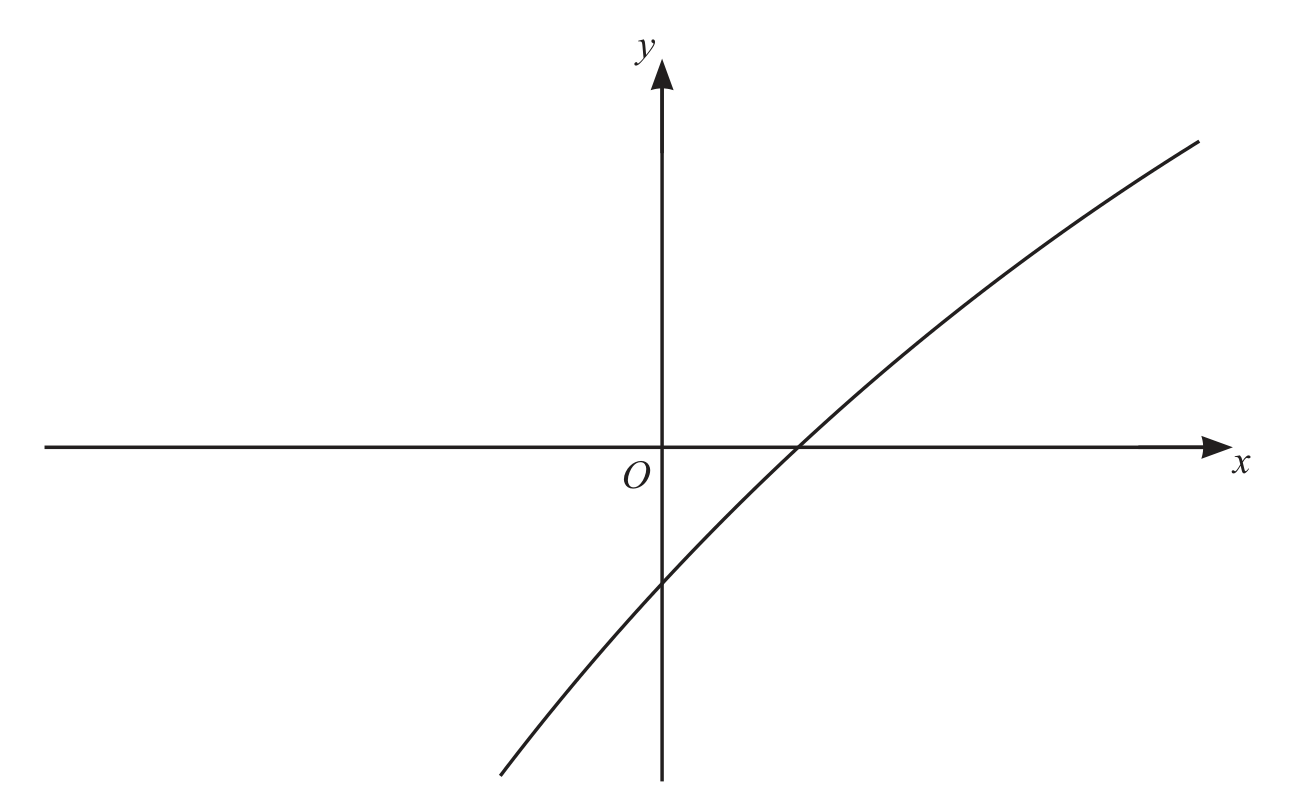
The functions f and g are defined by

$\mathrm{f}(x) = \sqrt{x}$ for $x \geqslant 0$,

$\mathrm{g}(x) = 3\sqrt{x + 2} - 5$ for $x \geqslant -2$.

Question illustration

The diagram shows the graph of $y = \mathrm{g}(x)$.

**(b)** On the diagram sketch the graph of $y = \mathrm{g}^{-1}(x)$ together with any relevant mirror line.

Question 19

The functions f and g are defined by

$\mathrm{f}(x) = \sqrt{x}$ for $x \geqslant 0$,

$\mathrm{g}(x) = 3\sqrt{x + 2} - 5$ for $x \geqslant -2$.

**(c)** Find an expression for $\mathrm{g}^{-1}(x)$.

Question 20

The functions f and g are defined by

$\mathrm{f}(x) = \sqrt{x}$ for $x \geqslant 0$,

$\mathrm{g}(x) = 3\sqrt{x + 2} - 5$ for $x \geqslant -2$.

**(d)** State the range of $\mathrm{g}^{-1}$.
0
0
GIỎ HÀNG
Empty CartGIỎ CHƯA CÓ GÌQUAY LẠI SHOP