In this conservation-of-mass experiment, 100 ml of calcium chloride solution is placed in a conical flask and 20 ml of sodium sulfate solution in a test tube inside it. The flask is stoppered. The entire sealed set-up is weighed, then the test tube is tipped to mix the solutions without opening the flask. The entire set-up is weighed again after reaction. Wear safety goggles and gloves.
Record your results in the table.
| Mass at the start of the reaction | Mass at the end of the reaction |
|---|---|
| … | … |
In this conservation-of-mass experiment, 100 ml of calcium chloride solution is placed in a conical flask and 20 ml of sodium sulfate solution in a test tube inside it. The flask is stoppered. The entire sealed set-up is weighed, then the test tube is tipped to mix the solutions without opening the flask. The entire set-up is weighed again after reaction. Wear safety goggles and gloves.
In this conservation-of-mass experiment, 100 ml of calcium chloride solution is placed in a conical flask and 20 ml of sodium sulfate solution in a test tube inside it. The flask is stoppered. The entire sealed set-up is weighed, then the test tube is tipped to mix the solutions without opening the flask. The entire set-up is weighed again after reaction. Wear safety goggles and gloves.
Why is it important to record the mass of the flask with the reactants before and after the reaction?
In this conservation-of-mass experiment, 100 ml of calcium chloride solution is placed in a conical flask and 20 ml of sodium sulfate solution in a test tube inside it. The flask is stoppered. The entire sealed set-up is weighed, then the test tube is tipped to mix the solutions without opening the flask. The entire set-up is weighed again after reaction. Wear safety goggles and gloves.
Calcium chloride and sodium sulfate react to form calcium sulfate and another salt. Write the word equation for the reaction.
In this conservation-of-mass experiment, 100 ml of calcium chloride solution is placed in a conical flask and 20 ml of sodium sulfate solution in a test tube inside it. The flask is stoppered. The entire sealed set-up is weighed, then the test tube is tipped to mix the solutions without opening the flask. The entire set-up is weighed again after reaction. Wear safety goggles and gloves.
What were some problems that could have affected the results of the experiment?
In this conservation-of-mass experiment, 100 ml of calcium chloride solution is placed in a conical flask and 20 ml of sodium sulfate solution in a test tube inside it. The flask is stoppered. The entire sealed set-up is weighed, then the test tube is tipped to mix the solutions without opening the flask. The entire set-up is weighed again after reaction. Wear safety goggles and gloves.
How does this experiment demonstrate the conservation of mass?
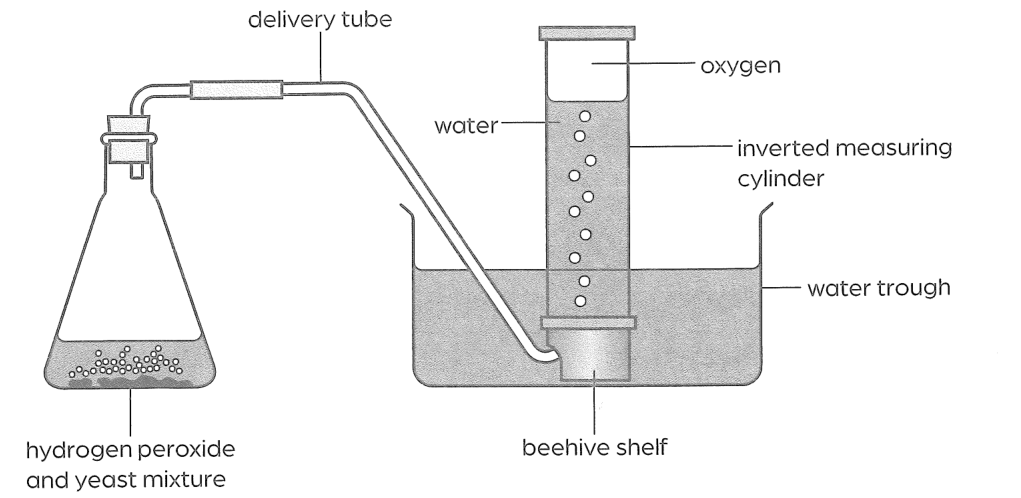
In this experiment, add 50 ml of dilute hydrogen peroxide (1.5 M) to a conical flask, then add 1 g of yeast. Quickly fit a stopper connected by a delivery tube to an inverted, water-filled measuring cylinder in a water trough. Collect oxygen over water and record its volume every 30 seconds. Wear safety goggles and gloves.
Explain why it is necessary to put on safety goggles and gloves before starting the experiment.
In this experiment, add 50 ml of dilute hydrogen peroxide (1.5 M) to a conical flask, then add 1 g of yeast. Quickly fit a stopper connected by a delivery tube to an inverted, water-filled measuring cylinder in a water trough. Collect oxygen over water and record its volume every 30 seconds. Wear safety goggles and gloves.
In this experiment, add 50 ml of dilute hydrogen peroxide (1.5 M) to a conical flask, then add 1 g of yeast. Quickly fit a stopper connected by a delivery tube to an inverted, water-filled measuring cylinder in a water trough. Collect oxygen over water and record its volume every 30 seconds. Wear safety goggles and gloves.
Record the volume of oxygen gas collected in the measuring cylinder at regular intervals (for example, every 30 seconds). Complete the table.
In this experiment, add 50 ml of dilute hydrogen peroxide (1.5 M) to a conical flask, then add 1 g of yeast. Quickly fit a stopper connected by a delivery tube to an inverted, water-filled measuring cylinder in a water trough. Collect oxygen over water and record its volume every 30 seconds. Wear safety goggles and gloves.
Plot the volume of oxygen gas against time on graph paper. Use your measured volumes at 0, 30, 60, 90, 120, 150, 180 and 210 seconds.
In this experiment, add 50 ml of dilute hydrogen peroxide (1.5 M) to a conical flask, then add 1 g of yeast. Quickly fit a stopper connected by a delivery tube to an inverted, water-filled measuring cylinder in a water trough. Collect oxygen over water and record its volume every 30 seconds. Wear safety goggles and gloves.
In this experiment, add 50 ml of dilute hydrogen peroxide (1.5 M) to a conical flask, then add 1 g of yeast. Quickly fit a stopper connected by a delivery tube to an inverted, water-filled measuring cylinder in a water trough. Collect oxygen over water and record its volume every 30 seconds. Wear safety goggles and gloves.
In this experiment, add 50 ml of dilute hydrogen peroxide (1.5 M) to a conical flask, then add 1 g of yeast. Quickly fit a stopper connected by a delivery tube to an inverted, water-filled measuring cylinder in a water trough. Collect oxygen over water and record its volume every 30 seconds. Wear safety goggles and gloves.
Why is it important to measure the volume of oxygen gas produced at regular intervals?
In this experiment, add 50 ml of dilute hydrogen peroxide (1.5 M) to a conical flask, then add 1 g of yeast. Quickly fit a stopper connected by a delivery tube to an inverted, water-filled measuring cylinder in a water trough. Collect oxygen over water and record its volume every 30 seconds. Wear safety goggles and gloves.
How does the concentration of hydrogen peroxide affect the rate of reaction?
In this experiment, add 50 ml of dilute hydrogen peroxide (1.5 M) to a conical flask, then add 1 g of yeast. Quickly fit a stopper connected by a delivery tube to an inverted, water-filled measuring cylinder in a water trough. Collect oxygen over water and record its volume every 30 seconds. Wear safety goggles and gloves.
What might happen if the experiment were conducted with hydrogen peroxide that is slightly warm?
In this experiment, add 50 ml of dilute hydrogen peroxide (1.5 M) to a conical flask, then add 1 g of yeast. Quickly fit a stopper connected by a delivery tube to an inverted, water-filled measuring cylinder in a water trough. Collect oxygen over water and record its volume every 30 seconds. Wear safety goggles and gloves.
How can you ensure that the measurements taken are accurate and precise?
In this experiment, add 50 ml of dilute hydrogen peroxide (1.5 M) to a conical flask, then add 1 g of yeast. Quickly fit a stopper connected by a delivery tube to an inverted, water-filled measuring cylinder in a water trough. Collect oxygen over water and record its volume every 30 seconds. Wear safety goggles and gloves.
In this experiment, add 50 ml of dilute hydrogen peroxide (1.5 M) to a conical flask, then add 1 g of yeast. Quickly fit a stopper connected by a delivery tube to an inverted, water-filled measuring cylinder in a water trough. Collect oxygen over water and record its volume every 30 seconds. Wear safety goggles and gloves.
Explain why the rate of reaction changed over time.
Attach one hook piece and one loop piece of fastening strip (each 2 cm long) to different spots on each of two tennis balls using adhesive tape. Gently roll or toss the balls towards each other 10 times. Record whether they stick together and whether the strips meet with the correct orientation.
Predict what will happen when the balls collide on sides without fastening strips.
Attach one hook piece and one loop piece of fastening strip (each 2 cm long) to different spots on each of two tennis balls using adhesive tape. Gently roll or toss the balls towards each other 10 times. Record whether they stick together and whether the strips meet with the correct orientation.
Predict what will happen when the balls collide with the fastening strips aligned correctly (hook sides meet loop sides).