Work in small groups. Construct the molecules in these symbol equations using the model kit or coloured balls. Choose a colour to represent each element (for example, red for oxygen, white for hydrogen and black for carbon).
Work in small groups. Construct the molecules in these symbol equations using the model kit or coloured balls. Choose a colour to represent each element (for example, red for oxygen, white for hydrogen and black for carbon).
Work in small groups. Construct the molecules in these symbol equations using the model kit or coloured balls. Choose a colour to represent each element (for example, red for oxygen, white for hydrogen and black for carbon).
Work in small groups. Construct the molecules in these symbol equations using the model kit or coloured balls. Choose a colour to represent each element (for example, red for oxygen, white for hydrogen and black for carbon).
Using the same materials, make a model to represent the symbol equation of your chosen chemical reaction. Use a molecular model kit or coloured balls and sticks, with cards or blocks showing arrows and ‘+’ signs.
Present your molecular models and their symbol equations to the class. Focus on key concepts, such as how atoms rearrange during chemical reactions and the importance of conserving atoms (even if balancing is not the focus).
When baking, baking soda is often added to ethanoic acid to help dough rise.
Write a word equation and a symbol equation for this reaction. Focusing on the products of this reaction, explain why this reaction causes dough to rise. You may use the Internet to help you.
In this investigation, clean a small piece of zinc and a copper wire with sandpaper to remove oxide layers. Put zinc in test tube A and copper in test tube B; each contains 10 cm³ of dilute hydrochloric acid. Wear safety goggles and work in groups.
Based on your understanding of the reactivity series, which metal do you think will react with dilute hydrochloric acid? State a hypothesis.
In this investigation, clean a small piece of zinc and a copper wire with sandpaper to remove oxide layers. Put zinc in test tube A and copper in test tube B; each contains 10 cm³ of dilute hydrochloric acid. Wear safety goggles and work in groups.
Predict the outcome of placing zinc and copper in dilute hydrochloric acid.
In this investigation, clean a small piece of zinc and a copper wire with sandpaper to remove oxide layers. Put zinc in test tube A and copper in test tube B; each contains 10 cm³ of dilute hydrochloric acid. Wear safety goggles and work in groups.
Procedure: label the test tubes A and B; use a measuring cylinder to add 10 cm³ of dilute hydrochloric acid to each, then add the cleaned zinc to A and copper wire to B. Observe and record the reactions immediately and again after 5 minutes. Record your observations in this table.
| Test tube | Metal | Initial reaction | Reaction after 5 minutes |
|---|---|---|---|
| A | zinc | ____ | ____ |
| B | copper | ____ | ____ |
In this investigation, clean a small piece of zinc and a copper wire with sandpaper to remove oxide layers. Put zinc in test tube A and copper in test tube B; each contains 10 cm³ of dilute hydrochloric acid. Wear safety goggles and work in groups.
Based on your observations, how would you classify the reactivity of these two metals with dilute hydrochloric acid? Complete: Reactive metal: ____; Non-reactive metal: ____.
In this investigation, clean a small piece of zinc and a copper wire with sandpaper to remove oxide layers. Put zinc in test tube A and copper in test tube B; each contains 10 cm³ of dilute hydrochloric acid. Wear safety goggles and work in groups.
Explain your observation when copper was added to dilute hydrochloric acid.
In this investigation, clean a small piece of zinc and a copper wire with sandpaper to remove oxide layers. Put zinc in test tube A and copper in test tube B; each contains 10 cm³ of dilute hydrochloric acid. Wear safety goggles and work in groups.
In your opinion, what are the strengths and limitations of using dilute hydrochloric acid to test metal reactivity?
In this investigation, clean a small piece of zinc and a copper wire with sandpaper to remove oxide layers. Put zinc in test tube A and copper in test tube B; each contains 10 cm³ of dilute hydrochloric acid. Wear safety goggles and work in groups.
How could you change this experiment to confirm your results or to get more detailed results?
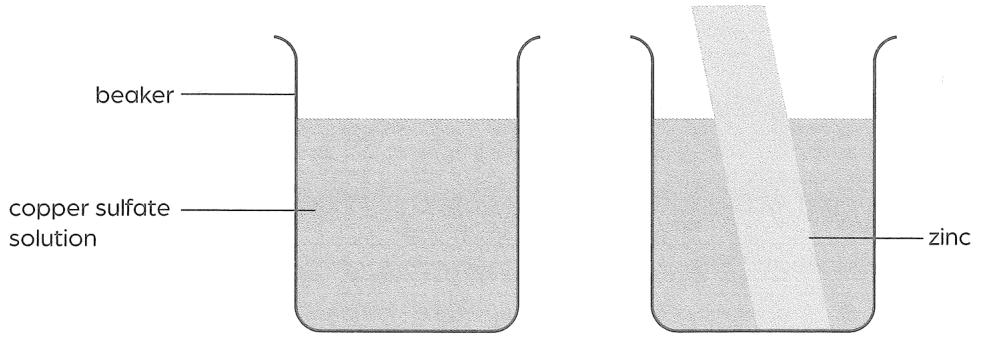
Work in pairs. Put on your safety goggles and gloves. Using a measuring cylinder, add 50 cm³ copper sulfate solution each into two beakers. Note the appearance of the copper sulfate solution. It should be a clear blue solution. Note the appearance of the zinc strip. It should have a metallic, shiny surface. Using tongs or tweezers, carefully place the zinc strip into one of the beakers containing the copper sulfate solution. Start the timer immediately. Leave the beakers for 10 minutes. After 10 minutes, use tongs or tweezers to remove the zinc strip from the solution. Observe and record any changes in the zinc strip and the solution.
Caution: always wear gloves and safety goggles to protect against chemical splashes. Handle zinc strips with tongs or tweezers to avoid direct contact. Do not touch or ingest any chemicals.
In this investigation, a zinc strip is placed in 50 cm³ of copper sulfate solution for 10 minutes; a second beaker of 50 cm³ of the same solution has no zinc. What changes did you observe in the copper sulfate solution and the zinc strip?
In this investigation, a zinc strip is placed in 50 cm³ of copper sulfate solution for 10 minutes; a second beaker of 50 cm³ of the same solution has no zinc. What type of reaction is taking place between zinc and copper sulfate? Explain.
In this investigation, a zinc strip is placed in 50 cm³ of copper sulfate solution for 10 minutes; a second beaker of 50 cm³ of the same solution has no zinc. Write the word and symbol equations for the reaction.