Work in pairs. Read the extract below. Then answer the question.
Imagine a glass jar holding 118 types of building blocks. Every type is a slightly different colour, size and shape. Each represents an atom of a different element of the Periodic Table. With enough jars, you can use the blocks to build anything if you follow a few simple rules.
A combination of different types of blocks is called a compound. Within the compound, chemical bonds are what ‘glue’ each block together.
Bonds also determine the structures and properties of all substances. We look at a material’s bonds if we want to know whether a material dissolves in water, whether a material conducts electricity, or whether we can use a material as a lubricant.
What are the building blocks of matter that are mentioned in the extract?
Work in pairs. Read the extract below. Then answer the question.
Imagine a glass jar holding 118 types of building blocks. Every type is a slightly different colour, size and shape. Each represents an atom of a different element of the Periodic Table. With enough jars, you can use the blocks to build anything if you follow a few simple rules.
A combination of different types of blocks is called a compound. Within the compound, chemical bonds are what ‘glue’ each block together.
Bonds also determine the structures and properties of all substances. We look at a material’s bonds if we want to know whether a material dissolves in water, whether a material conducts electricity, or whether we can use a material as a lubricant.
When different types of building blocks of matter are combined, what do they form?
Work in pairs. Read the extract below. Then answer the question.
Imagine a glass jar holding 118 types of building blocks. Every type is a slightly different colour, size and shape. Each represents an atom of a different element of the Periodic Table. With enough jars, you can use the blocks to build anything if you follow a few simple rules.
A combination of different types of blocks is called a compound. Within the compound, chemical bonds are what ‘glue’ each block together.
Bonds also determine the structures and properties of all substances. We look at a material’s bonds if we want to know whether a material dissolves in water, whether a material conducts electricity, or whether we can use a material as a lubricant.
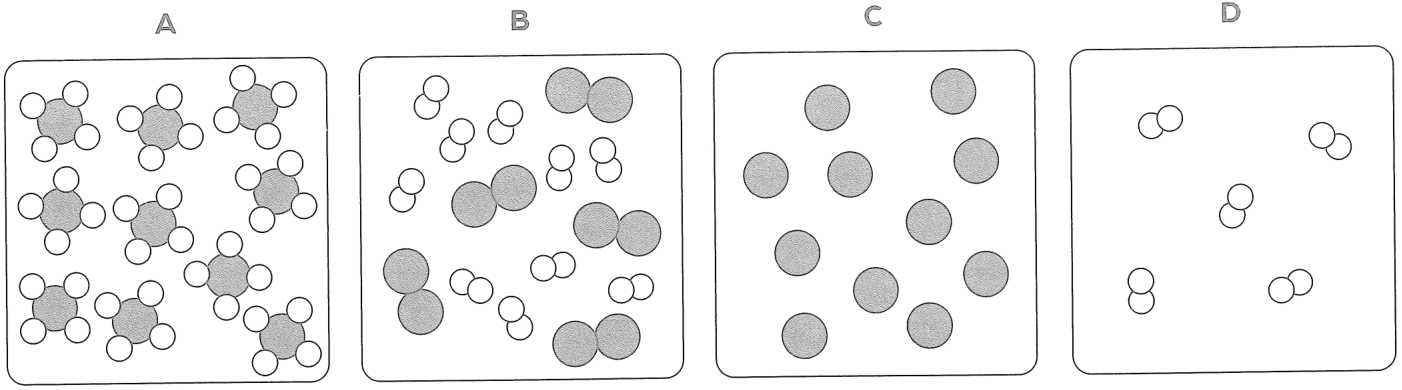
In diagram A, the grey circles represent carbon (C) atoms and the white circles represent hydrogen (H) atoms. Write the chemical formula for one molecule in diagram A.
Carbon, nitrogen, oxygen and fluorine are found in the second period of the Periodic Table. Use the Periodic Table to help you complete this table.
| Element | Number of outer electrons in one atom | Number of electrons that must be shared to obtain a stable electronic configuration |
|---|---|---|
| carbon | ____ | ____ |
| nitrogen | ____ | ____ |
| oxygen | ____ | ____ |
| fluorine | ____ | ____ |
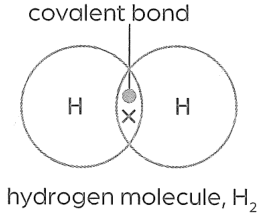
The hydrogen atom has ____ outer electron. The hydrogen atom forms covalent bonds with other ____ atoms. One hydrogen atom shares ____ electron with other atoms to obtain a stable electronic configuration. In a hydrogen ____, two hydrogen atoms combine to obtain a stable electronic configuration as shown in the dot-and-cross diagram below.
One carbon atom forms ____ covalent bonds with ____ hydrogen atoms to obtain a stable electronic configuration.
One nitrogen atom forms ____ covalent bonds with ____ hydrogen atoms to obtain a stable electronic configuration.
One oxygen atom forms ____ covalent bonds with ____ hydrogen atoms to obtain a stable electronic configuration.
Lithium, beryllium, oxygen and fluorine are found in the second period of the Periodic Table. Use the Periodic Table to help you complete this table.
| Element | Symbol of atom | Number of outer electrons in one atom |
|---|---|---|
| lithium | ___ | ___ |
| beryllium | ___ | ___ |
| oxygen | ___ | ___ |
| fluorine | ___ | ___ |
When a metal and a non-metal react, the metal atoms become positively charged ions and the non-metal atoms become negatively charged ions. The oppositely charged ions are attracted to each other forming stable ionic compounds.
Using dot-and-cross diagrams, illustrate the ionic bonding in beryllium oxide. Show all the electrons.
Aim: To study and compare the properties of solids with a simple molecular structure and solids with a giant ionic structure.
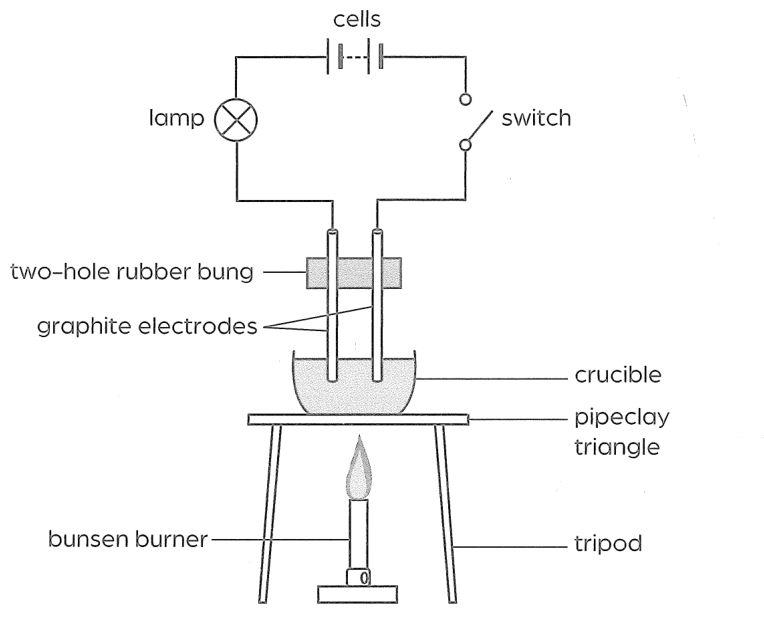
Materials: Safety goggles, crucible containing wax, crucible containing potassium iodide, crucible containing zinc chloride, crucible containing sulfur, tripod, pipeclay triangle, Bunsen burner, 2 graphite electrodes fitted in a large rubber bung with two holes, retort stand and clamp, 6V cells, 6V lamp, switch, connecting leads and crocodile clips, tongs, heat-resistant mat, pieces of emery paper, fume cupboard.
Your teacher will demonstrate this activity.
1. Put on your safety goggles.
2. Set up the apparatus as shown in the diagram below.
3. First start with the crucible containing wax. (Do not immerse the electrodes yet.) Gently heat the sample until it just melts, then turn off the Bunsen burner. Record the time required to melt the sample in the table below.
4. Now immerse the graphite electrodes (fitted in a rubber bung) into the melted sample. Clamp the electrodes in position.
5. Turn the switch on. Observe whether the lamp lights up. Record your observations in the table below.
6. Turn the switch off.
7. Raise the electrodes from the crucible and allow them to cool.
8. Clean the electrodes using small pieces of emery paper.
9. Repeat steps 3 to 8 with crucibles containing other substances, one at a time. For the crucible containing sulfur, these steps must be carried out in a fume cupboard.
| Substance | Time taken to melt the solid | Does the lamp light up after the substance has melted? |
|---|---|---|
| wax | … | … |
| potassium iodide | … | … |
| zinc chloride | … | … |
| sulfur | … | … |
Caution: Potassium iodide causes damage to organs through prolonged or repeated exposure. Wash exposed skin thoroughly after handling it. Zinc chloride is harmful when swallowed and is corrosive. Wear gloves. Wash exposed skin thoroughly after handling it. Sulfur causes irritation. Wash exposed skin thoroughly after handling it. When heated, sulfur dioxide which is toxic may be given off. Experiments involving heating sulfur must be done in a fume cupboard.
The teacher demonstrates heating wax, potassium iodide, zinc chloride and sulfur separately, then testing each molten sample with graphite electrodes, a lamp and cells. Record your own observations; no measured results are supplied.
Based on the data you recorded, arrange the solid substance in increasing melting point.
The teacher demonstrates heating wax, potassium iodide, zinc chloride and sulfur separately, then testing each molten sample with graphite electrodes, a lamp and cells. Record your own observations; no measured results are supplied.
The teacher demonstrates heating wax, potassium iodide, zinc chloride and sulfur separately, then testing each molten sample with graphite electrodes, a lamp and cells. Record your own observations; no measured results are supplied.
Wax is a compound with a simple molecular structure. Sulfur is an element with a simple molecular structure. Zinc chloride and potassium iodide are ionic compounds.
Based on your observations, describe the differences between solids with a simple molecular structure and those with a giant ionic structure.