Skip to content / Đến nội dung
SachHeCam.com

Cambridge Secondary (7-9). Stage 9. MCE Science. Workbook - Unit 4: The Structure of the Atom and the Periodic Table

Question 2

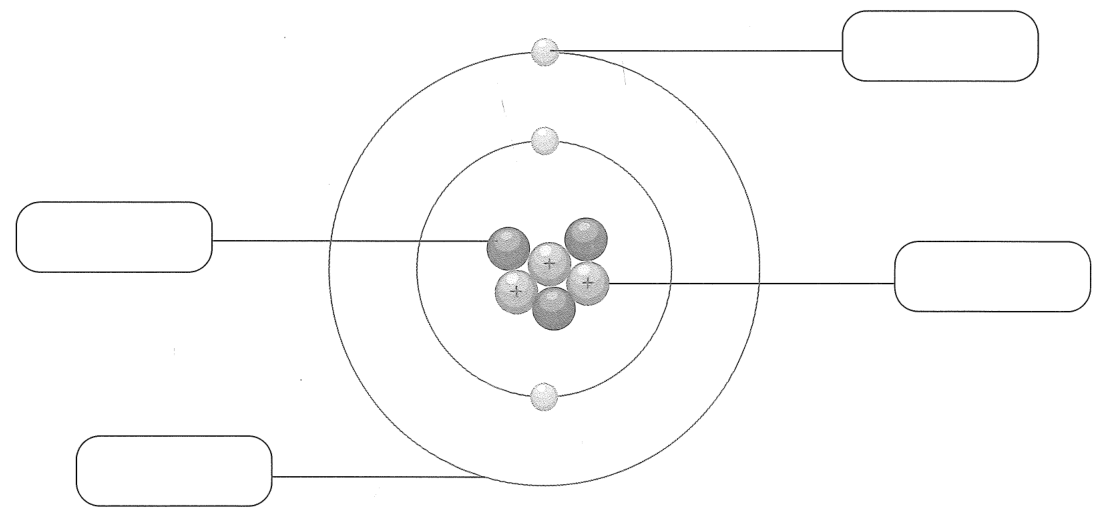
Look at the diagram of the atom shown below. Label the diagram using the words in the box.

Words: electron; neutron; shell; proton.

Question illustration

Question 3

Refer to the Periodic table. Write down the chemical name and symbol of the atom shown in the diagram.

Lookup extract (atomic number — name — symbol): 1 — hydrogen — H; 2 — helium — He; 3 — lithium — Li; 4 — beryllium — Be.

Chemical name: ____
Symbol: ____

Question illustration

Question 4

Use the words in the box to complete the paragraph about the Periodic Table. Some words may be used more than once.

Words: elements; atomic number; symbol; nucleus; mass number; nucleons; protons; neutrons; electrons.

There are over 100 different ____ that occur naturally on Earth. They are organised in some way in the Periodic Table. If you look closely at the Periodic Table, you will see that all the elements are written in a similar way. They each have an atomic ____ and a name. Each element has an ____, which shows how many protons are in the ____ of that atom. Each element also has a ____, which shows how many ____ and ____ are in the nucleus of that atom. Together, protons and neutrons are known as ____. An atom is electrically balanced. This means that it has an equal number of ____ (positively charged) and ____ (negatively charged).

Question 5

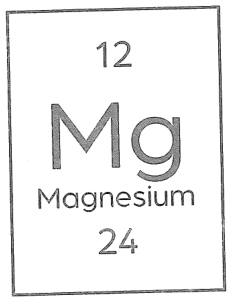
This diagram is taken from the Periodic Table. It represents magnesium. Use it to answer the question.

How many protons are there in an atom of magnesium?

Question illustration

Question 6

This diagram is taken from the Periodic Table. It represents magnesium. Use it to answer the question.

How many electrons are there in an atom of magnesium?

Question illustration

Question 7

This diagram is taken from the Periodic Table. It represents magnesium. Use it to answer the question.

How many neutrons are there in an atom of magnesium?

Question illustration

Question 8

This diagram is taken from the Periodic Table. It represents magnesium. Use it to answer the question.

What is the mass number of magnesium?

Question illustration

Question 9

Complete the diagram to show the arrangement of electrons in an atom of argon. Include the following labels: electrons, nucleus, shell. Use the Periodic Table to help you.

Periodic Table lookup: argon, Ar; atomic number 18; the mass value used for this exercise is 40.

Question illustration

Question 10

The arrangement of electrons can be displayed without the use of diagrams. This is the electronic structure. What is the electronic structure of argon?

Periodic Table lookup: argon, Ar; atomic number 18; the mass value used for this exercise is 40.

Question 11

What is the mass number of argon?

Periodic Table lookup: argon, Ar; atomic number 18; the mass value used for this exercise is 40.

Question 12

| Element | Symbol | Atomic number | Mass number | Density (g/cm³) | Melting point (°C) | Boiling point (°C) |
|---|---|---:|---:|---:|---:|---:|
| lithium | Li | 3 | 7 | 0.53 | 180 | 1342 |
| sodium | Na | 11 | 23 | 0.97 | 98 | 883 |
| potassium | K | 19 | 39 | 0.89 | 63 | 759 |

Look at the table and answer the question. In which group of the Periodic Table can you find the above elements?

Question 13

| Element | Symbol | Atomic number | Mass number | Density (g/cm³) | Melting point (°C) | Boiling point (°C) |
|---|---|---:|---:|---:|---:|---:|
| lithium | Li | 3 | 7 | 0.53 | 180 | 1342 |
| sodium | Na | 11 | 23 | 0.97 | 98 | 883 |
| potassium | K | 19 | 39 | 0.89 | 63 | 759 |

Look at the table. What is the electronic structure of sodium?

Question 14

| Element | Symbol | Atomic number | Mass number | Density (g/cm³) | Melting point (°C) | Boiling point (°C) |
|---|---|---:|---:|---:|---:|---:|
| lithium | Li | 3 | 7 | 0.53 | 180 | 1342 |
| sodium | Na | 11 | 23 | 0.97 | 98 | 883 |
| potassium | K | 19 | 39 | 0.89 | 63 | 759 |

Look at the table. Explain why all these elements are placed in the same group of the Periodic Table.

Question 15

The elements lithium, sodium and potassium react with water according to this general word equation: metal + water → metal hydroxide + hydrogen. Write the word equation for the reaction between lithium and water.

Question 16

The elements lithium, sodium and potassium react with water according to this general word equation: metal + water → metal hydroxide + hydrogen. The elements are also called alkali metals. Explain why.

Question 17

| Element | Symbol | Atomic number | Mass number | Density (g/cm³) | Melting point (°C) | Boiling point (°C) |
|---|---|---:|---:|---:|---:|---:|
| lithium | Li | 3 | 7 | 0.53 | 180 | 1342 |
| sodium | Na | 11 | 23 | 0.97 | 98 | 883 |
| potassium | K | 19 | 39 | 0.89 | 63 | 759 |

Rubidium, Rb, is an element in the same group of the Periodic Table. The atomic number of rubidium is 37. Predict the melting point of rubidium and explain your answer.

Question 18

Caesium, Cs, is also an element in the same group of the Periodic Table as lithium (Group 1). The atomic number of caesium is 55. Explain why caesium reacts with ice but lithium does not.
Question 19

What concepts are you unsure of? What would you like to know more about in this chapter? Write them down.

Question 20

Which phrase best describes an atom? Tick (✓) the correct answer.
  1. A neutral particle found in the nucleus
  2. The smallest part of an element that keeps its chemical properties
  3. A positively charged particle found in the nucleus
  4. Something that can be found on the Periodic Table
0
0
GIỎ HÀNG
Empty CartGIỎ CHƯA CÓ GÌQUAY LẠI SHOP