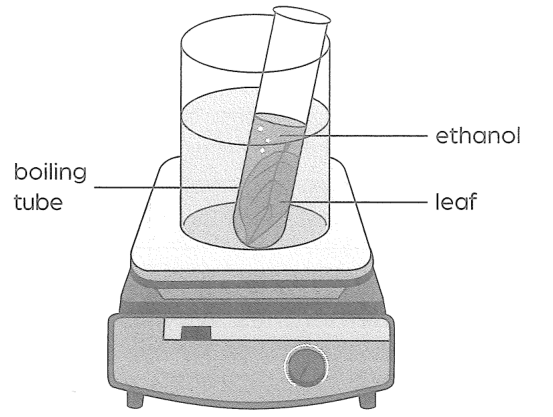
Aim: To test a leaf for starch. Materials: Safety goggles, water, two beakers, hot plate, leaf from a plant that has been left in sunlight for several hours, ethanol, boiling tube, pair of forceps, white tile, dropper, iodine solution.
1 Work in pairs. Put on your safety goggles.
2 Pour some water into a beaker. Stand the beaker on a hot plate and heat it till the water starts to boil.
3 Drop the leaf in the boiling water for one or two minutes.
4 Turn off the hot plate.
5 Pour ethanol into a boiling tube. Use as little as possible, just enough to cover the leaf. Use forceps to remove the leaf from the water, and carefully put it into the ethanol.
6 Stand the boiling tube in hot water. What do you observe about the ethanol? Explain what happens.
7 When the leaf is mostly white, gently remove the leaf from the boiling tube with the forceps. Wash the leaf with warm water to soften it.
8 Spread the leaf out onto a white tile. Use a dropper to add some iodine solution onto the leaf. Observe what happens.
Caution: Put on your safety goggles when heating substances. Ethanol is a flammable liquid. Use the smallest volume possible and keep it away from naked flames.
A leaf from a plant left in sunlight for several hours was boiled in water, decolourised in ethanol, rinsed and tested with iodine solution. Did the leaf contain starch? Explain your answer.
In steps 5 and 6 of a leaf starch test, the boiled leaf is put into ethanol in a boiling tube, which is then stood in hot water. Suggest why steps 5 and 6 were important to carry out before doing the starch test.
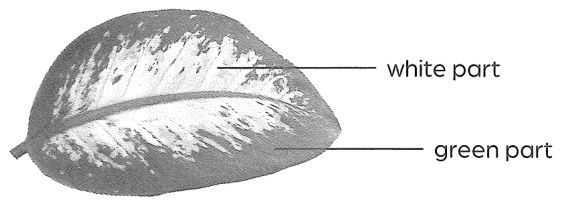
Imagine that you carried out the starch test on a leaf that had green and white parts as shown in the picture. Draw what you would observe after the leaf has been tested for starch.
Imagine that you carried out the starch test on a leaf that had green and white parts as shown in the picture. Explain your answer: explain your predicted observations after the leaf has been tested for starch.
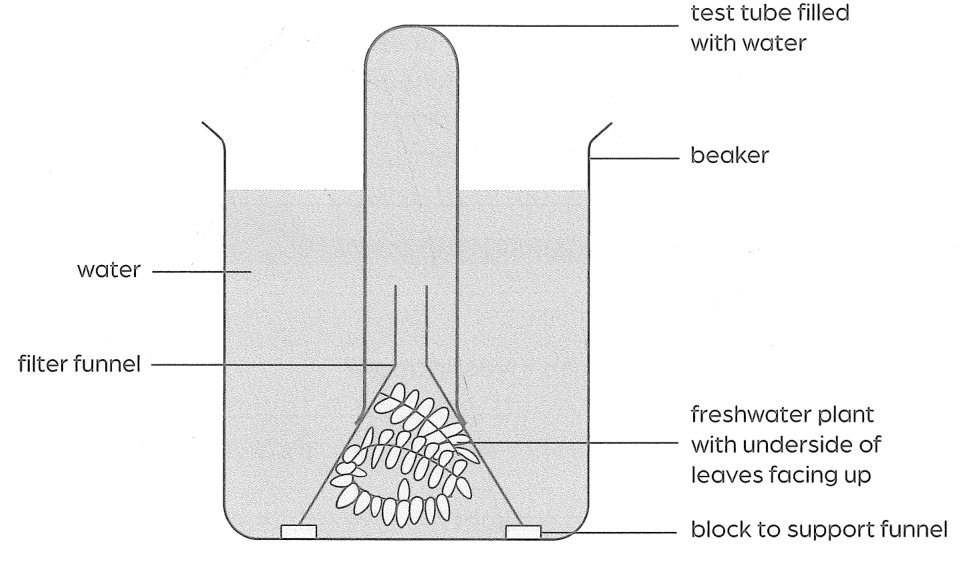
Aim: To investigate the gas produced during photosynthesis. Materials: Large beaker, test tube, filter funnel, small blocks, water (preferably pond water), freshwater plant (such as elodea, cabomba or hydrilla), stopper, splint, lighter or a box of matches, safety goggles.
1 Work in pairs. Set up the experiment as shown.
2 Leave the set-up in a well-lit area for at least one day.
3 When plenty of gas has been collected in the test tube, carefully remove the tube from the top of the funnel. Make sure to keep the mouth of the test tube under water so that no gas may escape.
4 With the tube still upside down, use your thumb to cover the mouth of the test tube to ensure that no water or gas escapes. Keep the test tube in this position as you remove it from the water.
5 Remove your thumb carefully to create a small opening for the water to run out while keeping the gas inside.
6 Use a stopper to cover the mouth of the test tube. Place the test tube, the right way up, in a test-tube rack.
7 Light a splint and then blow it out. Ensure that it is still glowing but not burning.
8 Take the stopper out of the test tube and hold the splint near the mouth of the test tube.
9 Record what happens to the glowing splint.
Caution: Put on safety goggles when carrying out the splint-test step.
A freshwater plant is placed under a funnel in water, with an inverted water-filled test tube above the funnel to collect gas during photosynthesis. Why is it best to use a freshwater plant in this investigation?
A freshwater plant is placed under a funnel in water, with an inverted water-filled test tube above the funnel to collect gas during photosynthesis. Why was it important to leave the set-up in sunlight?
A freshwater plant is placed under a funnel in water, with an inverted water-filled test tube above the funnel to collect gas during photosynthesis. What is the function of the blocks that support the funnel?
A freshwater plant is placed under a funnel in water, with an inverted water-filled test tube above the funnel to collect gas during photosynthesis. The collected gas is tested using a glowing splint. Which gas was collected in this investigation? Explain your answer.
A freshwater plant is placed under a funnel in water, with an inverted water-filled test tube above the funnel to collect gas during photosynthesis. The collected gas is tested using a glowing splint. What is the conclusion of this investigation?
Investigate how light intensity, varied by the distance of a freshwater plant from a light source, affects the rate of photosynthesis. Materials: freshwater plant (such as elodea, cabomba or hydrilla), beaker, test tube, water, ruler, light source such as a lamp, timer or stopwatch. Work in groups. Plan and carry out a fair test using the given materials. Write the steps you will follow to carry out your investigation. Use a separate sheet of paper.
• How will you set up the equipment? Decide on your actions.
• What observations will you make? How many measurements do you need? The results table provides five rows, with three repeat readings and a mean at each distance.
• What will you do to stay safe during the practical?
Ask your teacher to check your plan. Then carry it out.
Investigate how light intensity, varied by the distance of a freshwater plant from a light source, affects the rate of photosynthesis. Materials: freshwater plant (such as elodea, cabomba or hydrilla), beaker, test tube, water, ruler, light source such as a lamp, timer or stopwatch. Identify the variables in your investigation. The independent variable (what you will change) is:
Investigate how light intensity, varied by the distance of a freshwater plant from a light source, affects the rate of photosynthesis. Materials: freshwater plant (such as elodea, cabomba or hydrilla), beaker, test tube, water, ruler, light source such as a lamp, timer or stopwatch. Identify the variables in your investigation. The dependent variable (what you will be measuring) is:
Investigate how light intensity, varied by the distance of a freshwater plant from a light source, affects the rate of photosynthesis. Materials: freshwater plant (such as elodea, cabomba or hydrilla), beaker, test tube, water, ruler, light source such as a lamp, timer or stopwatch. Identify the variables in your investigation. The control variables (what you will keep the same) are:
Investigate how light intensity, varied by the distance of a freshwater plant from a light source, affects the rate of photosynthesis. Materials: freshwater plant (such as elodea, cabomba or hydrilla), beaker, test tube, water, ruler, light source such as a lamp, timer or stopwatch. Draw your investigation set-up.
Investigate how light intensity, varied by the distance of a freshwater plant from a light source, affects the rate of photosynthesis. Materials: freshwater plant (such as elodea, cabomba or hydrilla), beaker, test tube, water, ruler, light source such as a lamp, timer or stopwatch. Use the table to record your results.
Investigate how light intensity, varied by the distance of a freshwater plant from a light source, affects the rate of photosynthesis. Materials: freshwater plant (such as elodea, cabomba or hydrilla), beaker, test tube, water, ruler, light source such as a lamp, timer or stopwatch. Plot a graph to show your results.
• Label the horizontal and vertical axes, including any units.
• Plot the points on the graph.
• Draw a line to connect the points.
Investigate how light intensity, varied by the distance of a freshwater plant from a light source, affects the rate of photosynthesis. Materials: freshwater plant (such as elodea, cabomba or hydrilla), beaker, test tube, water, ruler, light source such as a lamp, timer or stopwatch. How did you ensure that your results were precise?