Work in pairs. You are given a hard tape measure and a 30 cm rule. Choose a suitable instrument to measure each quantity below. Record your measurements.
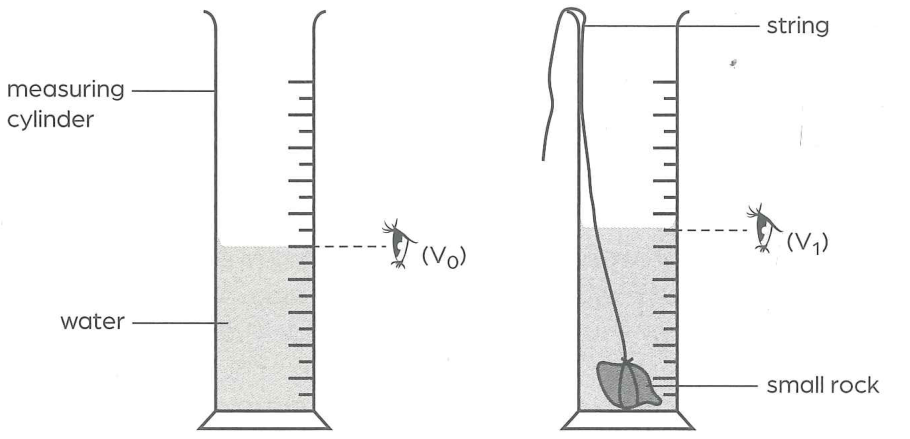
Materials: 100 cm³ measuring cylinder, 50 cm³ water, small rock, string.
1. Work in pairs. Place a measuring cylinder on the table so that it is level and stable.
2. Fill the measuring cylinder with 50 cm³ of water. Record the initial water level (V₀) in the table below.
3. Make sure your rock will fit in the measuring cylinder. Tie the rock to a piece of string. Then carefully lower the rock into the measuring cylinder. Make sure that no water spills out.
4. Record the final water level (V₁) in the table below.
Note: Make sure you read the volume of the water at the bottom of the meniscus.
5. Remove the rock from the water. Then repeat your measurements until you have at least two similar calculated volumes to ensure your result is reliable.
6. Record your measurements in the table. Calculate the average.
| Initial water level (V₀) in cm³ | Final water level (V₁) in cm³ | Volume of rock (V₁ − V₀) in cm³ | Average volume in cm³ |
|---|---|---|---|
| ____ | ____ | ____ | ____ |
| ____ | ____ | ____ | |
| ____ | ____ | ____ | |
Imagine you have a rock that is too big to fit into a measuring cylinder. How could you measure its volume? Write and/or draw your answer in the box below.
Measure the mass in grams of each of the following objects using the electronic balance: coin, pen, eraser, paper clip. Ensure proper use of the electronic balance.
Note: Make sure the electronic balance reads 0.00 g before each object is added.
Present your answers in a suitable format on a separate sheet of paper.
Some medicines must be measured by mass to make sure that patients get the correct dose. Many medicines are effective in doses of a few milligrams, so it is extremely important that these measurements are accurate.
Explain why it is important to take accurate measurements when measuring a medicine’s mass.
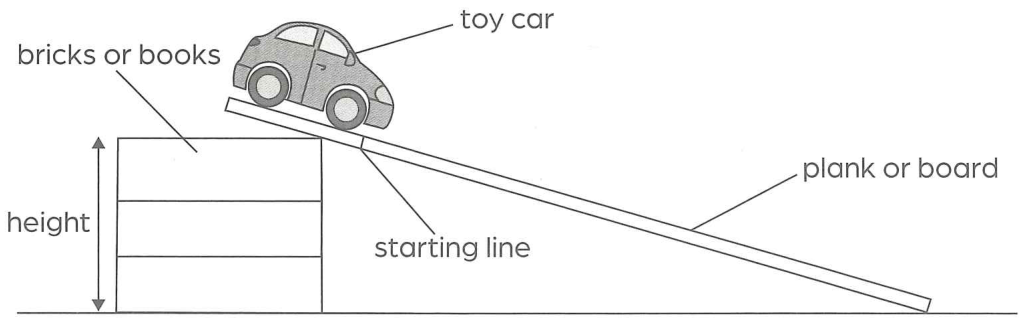
Materials: You need a plank or board of wood (wide enough for the toy car to travel on easily and about 1 m long), five bricks of the same size, a small toy car and a stopwatch. Books can be used if bricks are not easily available, but they must be all the same size.
1. Work in small groups.
2. Stack three bricks or books. Place one end of the plank on the bricks to make a slope.
3. Draw a line near the top of the plank where you will place the front of the car.
4. Place the toy car with the front wheels just behind the line.
5. Release the toy car. Start the stopwatch at the same time.
6. Stop the stopwatch as the car reaches the end of the plank. Record the time taken in the table on the next page.
7. Repeat steps 4 to 6 two more times.
Will the toy car reach the end earlier or later if you use only one brick under the plank? Make a prediction.