Deep within the Earth, there is a lot of heat stored in rocks and water. When this heat builds up and creates high pressure, it can force hot water or steam to rise closer to the surface. This pressure is crucial because it helps to move the geothermal fluids, like water or steam — upwards, where we can capture their energy to generate electricity or heat buildings.
How crucial is pressure to geothermal energy resources?
Deep within the Earth, there is a lot of heat stored in rocks and water. When this heat builds up and creates high pressure, it can force hot water or steam to rise closer to the surface. This pressure is crucial because it helps to move the geothermal fluids, like water or steam — upwards, where we can capture their energy to generate electricity or heat buildings.
In what ways does pressure play a role in developing other renewable energy resources?
1. Your teacher will group your class into two teams.
2. You will investigate the relationship between force and area on pressure through a fun game.
3. You will need two balloons, a sharp pencil, a blunt object (e.g. pen cap), a timer and safety goggles.
4. Inflate both balloons to the same size.
5. Your teacher will determine the starting line.
6. Your teacher will assign the sharp pencil to one team and the blunt object to the other.
7. Assign one player from your team to be the “popper”.
8. The game begins when the teacher or referee says “Go!”.
9. The popper races to your team’s balloon.
10. The popper must burst the balloon using only the assigned object (sharp pencil or blunt object).
11. Record the time it takes for the popper to burst the balloon.
12. Switch roles with the other team and repeat the game.
13. Discuss these questions in your group.
b. Explain your results using the concepts of force, area and pressure.
1. Your teacher will group your class into two teams.
2. You will investigate the relationship between force and area on pressure through a fun game.
3. You will need two balloons, a sharp pencil, a blunt object (e.g. pen cap), a timer and safety goggles.
4. Inflate both balloons to the same size.
5. Your teacher will determine the starting line.
6. Your teacher will assign the sharp pencil to one team and the blunt object to the other.
7. Assign one player from your team to be the “popper”.
8. The game begins when the teacher or referee says “Go!”.
9. The popper races to your team’s balloon.
10. The popper must burst the balloon using only the assigned object (sharp pencil or blunt object).
11. Record the time it takes for the popper to burst the balloon.
12. Switch roles with the other team and repeat the game.
13. Discuss these questions in your group.
c. How can the investigation be improved so that it is a fair test?
A surfer wants the pressure on their surfboard to be as low as possible, so they should choose a surfboard with a (short length / large area / heavy weight).
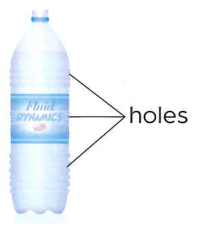
Work in groups to find out how water pressure works. You will need an empty plastic bottle, some sticky tape, a nail and a jug of water. Use the nail to make three holes in the empty plastic bottle, as shown in Figure 9.9. They must be the same distance apart. Cover the holes with sticky tape. Then fill the bottle with water. Make sure the water level is above the three holes. Starting at the top, remove the tape from the holes one by one. Observe how the water exits each hole.
What did you notice about the water pouring out of the holes?
Work in groups to find out how water pressure works. You will need an empty plastic bottle, some sticky tape, a nail and a jug of water. Use the nail to make three holes in the empty plastic bottle, as shown in Figure 9.9. They must be the same distance apart. Cover the holes with sticky tape. Then fill the bottle with water. Make sure the water level is above the three holes. Starting at the top, remove the tape from the holes one by one. Observe how the water exits each hole.
In groups, investigate the changes in air pressure. You need a small beach ball, a basin of warm water and a fridge or freezer. Inflate the beach ball. Squeeze it to feel how hard or soft it feels. Put the beach ball in the fridge or freezer. After 30 minutes, take it out and squeeze it again. Leave the beach ball in a basin of warm water. After a few minutes, take it out and squeeze it again. Discuss your results in your group.
What did you observe about the beach ball after each temperature change?
In groups, investigate the changes in air pressure. You need a small beach ball, a basin of warm water and a fridge or freezer. Inflate the beach ball. Squeeze it to feel how hard or soft it feels. Put the beach ball in the fridge or freezer. After 30 minutes, take it out and squeeze it again. Leave the beach ball in a basin of warm water. After a few minutes, take it out and squeeze it again. Discuss your results in your group.
Was the beach ball softer or harder when it came out of the fridge or freezer?
In groups, investigate the changes in air pressure. You need a small beach ball, a basin of warm water and a fridge or freezer. Inflate the beach ball. Squeeze it to feel how hard or soft it feels. Put the beach ball in the fridge or freezer. After 30 minutes, take it out and squeeze it again. Leave the beach ball in a basin of warm water. After a few minutes, take it out and squeeze it again. Discuss your results in your group.
Was the beach ball softer or harder after it floated in the warm water?