Question 31
In this investigation, 10 cm³ of dilute hydrochloric acid is tested with three drops of Universal Indicator. Sodium hydroxide solution is added in 2 cm³ portions, up to 12 cm³ in total. Use your own observations and the pH chart.
Work in pairs. Put on your safety goggles. Add three drops of Universal Indicator solution to the dilute hydrochloric acid. Observe the colour of the solution. Use the pH chart to identify the pH value of the solution. Record this pH value in the table. Use a coloured pencil to shade the first beaker to show the colour of the solution. Use the dropper pipette to add 2 cm³ of sodium hydroxide solution to the acid. Observe the new colour and identify its pH using the chart. Record the pH and shade the next beaker. Repeat until all the alkali has been added.
| Volume of alkali added / cm³ | 0 | 2 | 4 | 6 | 8 | 10 | 12 |
|---|---|---|---|---|---|---|---|
| pH value | | | | | | | |
| Colour of solution (shade a beaker) | | | | | | | |
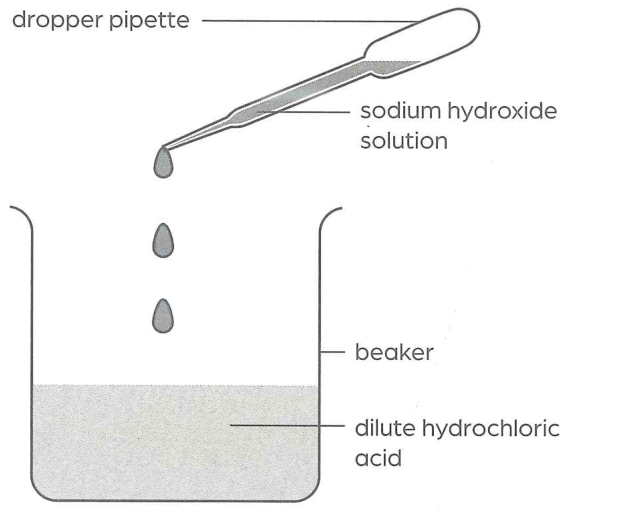
Work in pairs. Put on your safety goggles. Add three drops of Universal Indicator solution to the dilute hydrochloric acid. Observe the colour of the solution. Use the pH chart to identify the pH value of the solution. Record this pH value in the table. Use a coloured pencil to shade the first beaker to show the colour of the solution. Use the dropper pipette to add 2 cm³ of sodium hydroxide solution to the acid. Observe the new colour and identify its pH using the chart. Record the pH and shade the next beaker. Repeat until all the alkali has been added.
| Volume of alkali added / cm³ | 0 | 2 | 4 | 6 | 8 | 10 | 12 |
|---|---|---|---|---|---|---|---|
| pH value | | | | | | | |
| Colour of solution (shade a beaker) | | | | | | | |
