Question 58
Winged loosestrife is a plant with purple flowers. It grows in North America.
Purple loosestrife, shown in the photograph, also has purple flowers. It normally lives in Europe and Asia. It is an introduced species in North America.
Both species of loosestrife are pollinated by insects. After pollination, the flowers produce seeds.
Scientists noticed that numbers of winged loosestrife plants were decreasing in places where purple loosestrife had been introduced.
They did an experiment to test this hypothesis:
When purple loosestrife is present, fewer winged loosestrife flowers are successfully pollinated.
- They grew plants of winged loosestrife in pots. They also grew plants of purple loosestrife in pots.
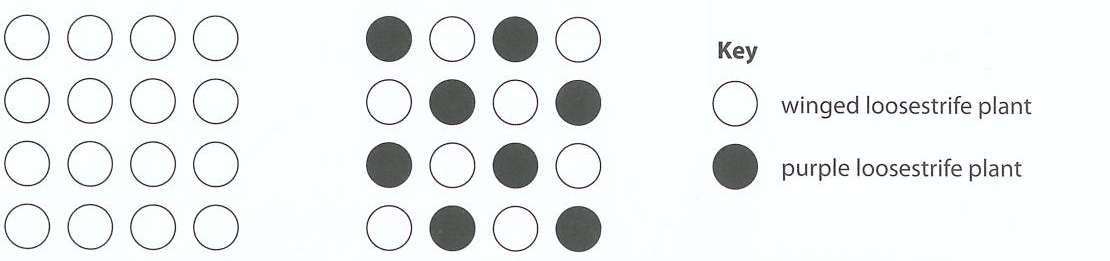
- When all the plants had flowers, the scientists arranged the pots in a field. They used two different patterns.
- The scientists counted how many insects visited the flowers on each winged loosestrife plant over a 15 minute period.
- They left the plants in their pots until they produced seeds. Then they counted how many seeds each plant produced.
Their results are shown in the table.
| Arrangement of plants | Mean number of insect visits to each winged loosestrife plant in 15 minutes | Mean number of seeds produced by each winged loosestrife plant |
|---|---:|---:|
| winged loosestrife alone | 35 | 80 |
| winged loosestrife and purple loosestrife | 26 | 58 |
Suggest two ways the scientists could improve their experiment. Explain each of your suggestions.
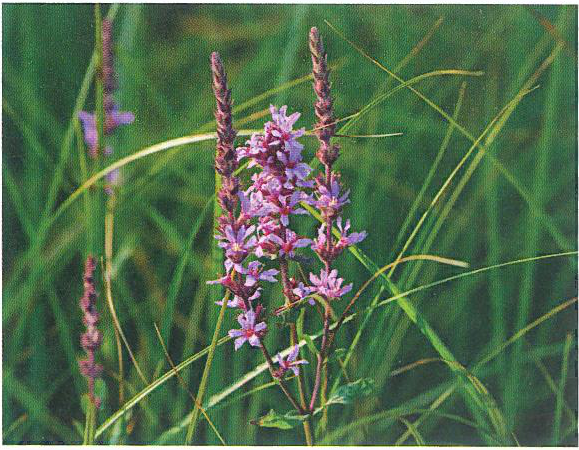
Purple loosestrife, shown in the photograph, also has purple flowers. It normally lives in Europe and Asia. It is an introduced species in North America.
Both species of loosestrife are pollinated by insects. After pollination, the flowers produce seeds.
Scientists noticed that numbers of winged loosestrife plants were decreasing in places where purple loosestrife had been introduced.
They did an experiment to test this hypothesis:
When purple loosestrife is present, fewer winged loosestrife flowers are successfully pollinated.
- They grew plants of winged loosestrife in pots. They also grew plants of purple loosestrife in pots.
- When all the plants had flowers, the scientists arranged the pots in a field. They used two different patterns.
- The scientists counted how many insects visited the flowers on each winged loosestrife plant over a 15 minute period.
- They left the plants in their pots until they produced seeds. Then they counted how many seeds each plant produced.
Their results are shown in the table.
| Arrangement of plants | Mean number of insect visits to each winged loosestrife plant in 15 minutes | Mean number of seeds produced by each winged loosestrife plant |
|---|---:|---:|
| winged loosestrife alone | 35 | 80 |
| winged loosestrife and purple loosestrife | 26 | 58 |
Suggest two ways the scientists could improve their experiment. Explain each of your suggestions.
