Question 15
Work in groups or as a whole class.
You will need:
- a slinky spring for each group (slinky springs made from metal work better than plastic ones), chalk or small pieces of paper
Do not suddenly release a spring that has been stretched.
1 Stretch the spring across a smooth, flat surface such as a long bench or the floor.
2 Use chalk or small pieces of paper to mark positions on the spring. These represent particles.
3 One person holds one end of the spring and keeps it still.
4 Another person holds the opposite end and moves the end of the spring backwards and forwards, as shown in the diagram. This will make a wave in the spring.
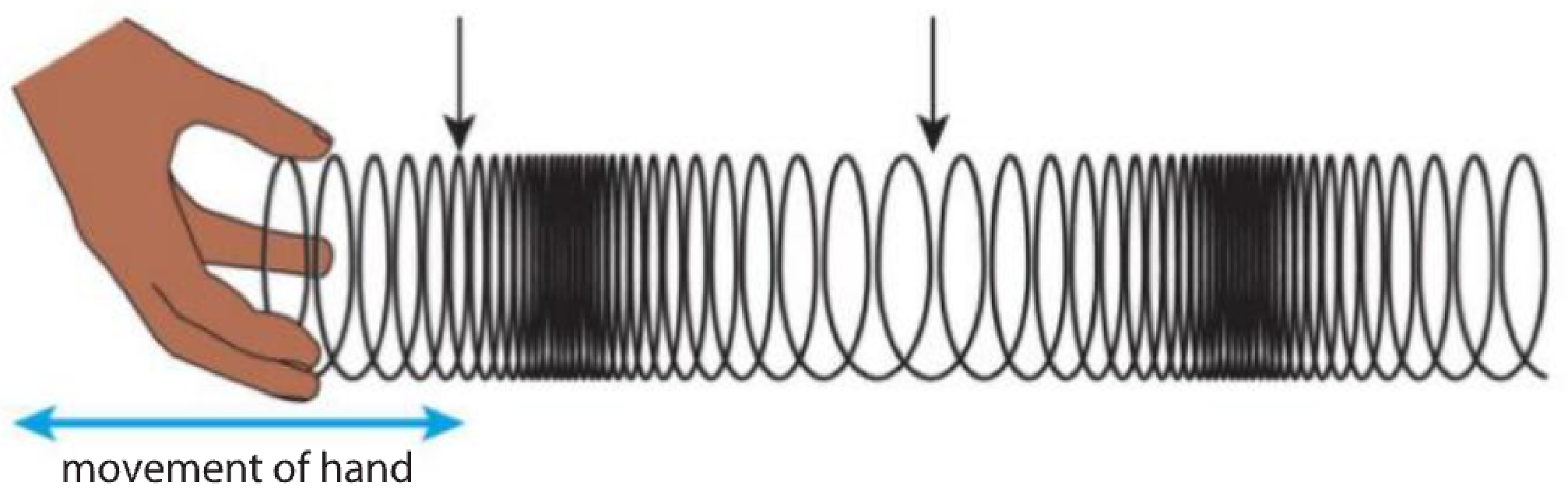
Movement of a slinky spring to show movement in a sound wave. The black arrows show possible positions of the chalk marks on the spring.
In your groups, discuss the answers to these questions.
1 In which direction does the wave in the spring move?
You will need:
- a slinky spring for each group (slinky springs made from metal work better than plastic ones), chalk or small pieces of paper
Do not suddenly release a spring that has been stretched.
1 Stretch the spring across a smooth, flat surface such as a long bench or the floor.
2 Use chalk or small pieces of paper to mark positions on the spring. These represent particles.
3 One person holds one end of the spring and keeps it still.
4 Another person holds the opposite end and moves the end of the spring backwards and forwards, as shown in the diagram. This will make a wave in the spring.
Movement of a slinky spring to show movement in a sound wave. The black arrows show possible positions of the chalk marks on the spring.
In your groups, discuss the answers to these questions.
1 In which direction does the wave in the spring move?
