Question 16
Aim: To study and compare the properties of solids with a simple molecular structure and solids with a giant ionic structure.
Materials: Safety goggles, crucible containing wax, crucible containing potassium iodide, crucible containing zinc chloride, crucible containing sulfur, tripod, pipeclay triangle, Bunsen burner, 2 graphite electrodes fitted in a large rubber bung with two holes, retort stand and clamp, 6V cells, 6V lamp, switch, connecting leads and crocodile clips, tongs, heat-resistant mat, pieces of emery paper, fume cupboard.
Your teacher will demonstrate this activity.
1. Put on your safety goggles.
2. Set up the apparatus as shown in the diagram below.
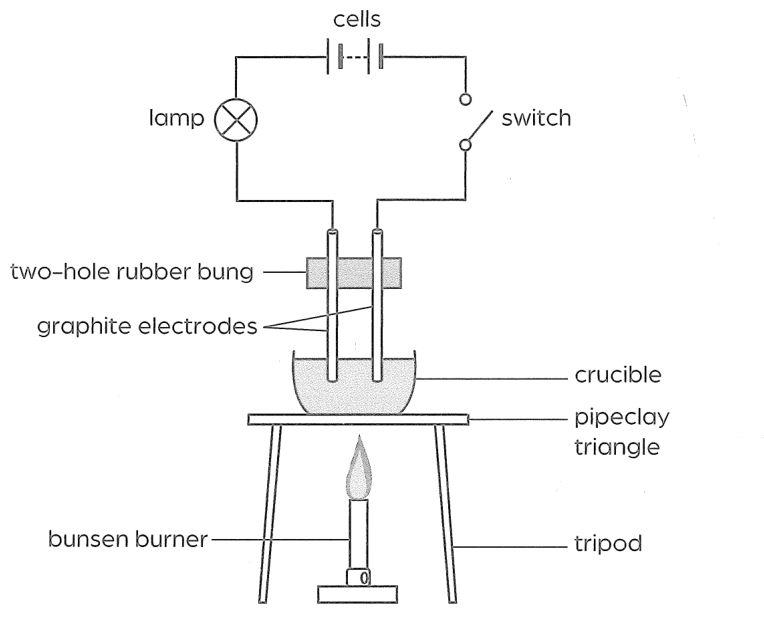
3. First start with the crucible containing wax. (Do not immerse the electrodes yet.) Gently heat the sample until it just melts, then turn off the Bunsen burner. Record the time required to melt the sample in the table below.
4. Now immerse the graphite electrodes (fitted in a rubber bung) into the melted sample. Clamp the electrodes in position.
5. Turn the switch on. Observe whether the lamp lights up. Record your observations in the table below.
6. Turn the switch off.
7. Raise the electrodes from the crucible and allow them to cool.
8. Clean the electrodes using small pieces of emery paper.
9. Repeat steps 3 to 8 with crucibles containing other substances, one at a time. For the crucible containing sulfur, these steps must be carried out in a fume cupboard.
| Substance | Time taken to melt the solid | Does the lamp light up after the substance has melted? |
|---|---|---|
| wax | … | … |
| potassium iodide | … | … |
| zinc chloride | … | … |
| sulfur | … | … |
Caution: Potassium iodide causes damage to organs through prolonged or repeated exposure. Wash exposed skin thoroughly after handling it. Zinc chloride is harmful when swallowed and is corrosive. Wear gloves. Wash exposed skin thoroughly after handling it. Sulfur causes irritation. Wash exposed skin thoroughly after handling it. When heated, sulfur dioxide which is toxic may be given off. Experiments involving heating sulfur must be done in a fume cupboard.
Materials: Safety goggles, crucible containing wax, crucible containing potassium iodide, crucible containing zinc chloride, crucible containing sulfur, tripod, pipeclay triangle, Bunsen burner, 2 graphite electrodes fitted in a large rubber bung with two holes, retort stand and clamp, 6V cells, 6V lamp, switch, connecting leads and crocodile clips, tongs, heat-resistant mat, pieces of emery paper, fume cupboard.
Your teacher will demonstrate this activity.
1. Put on your safety goggles.
2. Set up the apparatus as shown in the diagram below.
3. First start with the crucible containing wax. (Do not immerse the electrodes yet.) Gently heat the sample until it just melts, then turn off the Bunsen burner. Record the time required to melt the sample in the table below.
4. Now immerse the graphite electrodes (fitted in a rubber bung) into the melted sample. Clamp the electrodes in position.
5. Turn the switch on. Observe whether the lamp lights up. Record your observations in the table below.
6. Turn the switch off.
7. Raise the electrodes from the crucible and allow them to cool.
8. Clean the electrodes using small pieces of emery paper.
9. Repeat steps 3 to 8 with crucibles containing other substances, one at a time. For the crucible containing sulfur, these steps must be carried out in a fume cupboard.
| Substance | Time taken to melt the solid | Does the lamp light up after the substance has melted? |
|---|---|---|
| wax | … | … |
| potassium iodide | … | … |
| zinc chloride | … | … |
| sulfur | … | … |
Caution: Potassium iodide causes damage to organs through prolonged or repeated exposure. Wash exposed skin thoroughly after handling it. Zinc chloride is harmful when swallowed and is corrosive. Wear gloves. Wash exposed skin thoroughly after handling it. Sulfur causes irritation. Wash exposed skin thoroughly after handling it. When heated, sulfur dioxide which is toxic may be given off. Experiments involving heating sulfur must be done in a fume cupboard.
