The picture shows a glacier, which contains a large amount of solid ice that has collected over many hundreds of years. Ice melts into liquid water. Liquid water evaporates into a gas that we cannot see, called water vapour.
The picture shows a glacier, which contains a large amount of solid ice that has collected over many hundreds of years. Ice melts into liquid water. Liquid water evaporates into a gas that we cannot see, called water vapour.
What gives the different forms of water their different properties?
Work in small groups. Plan an investigation to compare the properties of solids, liquids and gases. Find out about the following: Can they change shape? Can they expand or be compressed? Can they flow?
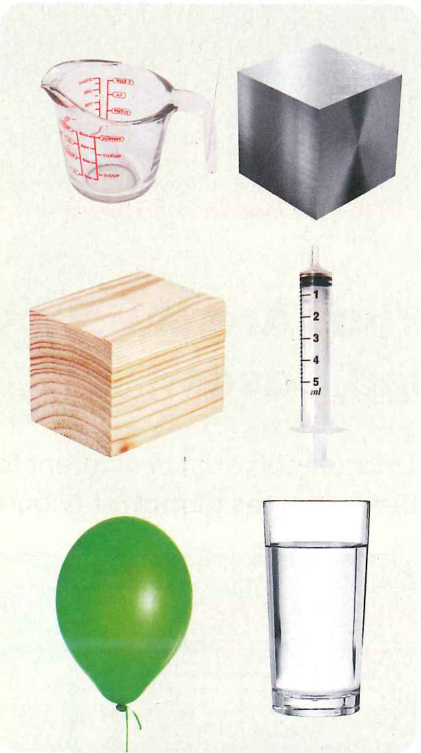
Discuss the following: What items do you need for your test? Figure 6.2 shows some things that might be useful.
Work in small groups. Plan an investigation to compare the properties of solids, liquids and gases. Find out about the following: Can they change shape? Can they expand or be compressed? Can they flow?
How will you test each of these properties?
• Whether the item has a definite shape
• Whether it can flow
• Whether it can be compressed
• Whether it has a definite volume
Work in small groups. Plan an investigation to compare the properties of solids, liquids and gases. Find out about the following: Can they change shape? Can they expand or be compressed? Can they flow?
Work in small groups. Plan an investigation to compare the properties of solids, liquids and gases. Find out about the following: Can they change shape? Can they expand or be compressed? Can they flow?
Work in small groups. Plan an investigation to compare the properties of solids, liquids and gases. Find out about the following: Can they change shape? Can they expand or be compressed? Can they flow?
Write the plan for your investigation. Do you need to do anything to carry out the investigation safely?
Work in small groups. Plan an investigation to compare the properties of solids, liquids and gases. Find out about the following: Can they change shape? Can they expand or be compressed? Can they flow?
Check your plan with your teacher, then carry out your investigation. Record your observations in a suitable form.
Work in small groups. Plan an investigation to compare the properties of solids, liquids and gases. Find out about the following: Can they change shape? Can they expand or be compressed? Can they flow?
Not all investigations run smoothly. What difficulties did you have?
Work in small groups. Plan an investigation to compare the properties of solids, liquids and gases. Find out about the following: Can they change shape? Can they expand or be compressed? Can they flow?
How could you improve your investigation if you had to do it again?
Work in small groups. Plan an investigation to compare the properties of solids, liquids and gases. Find out about the following: Can they change shape? Can they expand or be compressed? Can they flow?
The brakes on a car rub against the wheel to slow it. To operate them, the driver pushes on a pedal inside the car. The ‘pushing’ action on the pedal is transferred to the brakes by a tube full of liquid. What property of liquids allows them to transfer a ‘pushing’ action in this way?