Skip to content / Đến nội dung
SachHeCam.com

Cambridge Secondary (7-9). Stage 9. Science. Learner's Book - Unit 9: Electricity

Question 1

Work in pairs. Draw a circuit diagram with a cell, a lamp and a buzzer in series (all connected end-to-end).

Question 2

Name the component used to measure current in circuits.

Question 3

A cell, a lamp and a buzzer are connected in series. The current flowing through the lamp is 2 A. What is the current flowing through the buzzer? Assume the lamp and buzzer are both working properly. Give your answer in A.

Question 4

A cell, a lamp and a buzzer are connected in series. What will happen to the lamp if the buzzer breaks?

Question 5

A cell, a lamp and a buzzer are connected in series. What will happen to the buzzer if the lamp breaks?

Question 6

Which of these describes the current through the cell in a parallel circuit? Write one letter.
  1. The current through the cell is equal to the current in the first branch.
  2. The current through the cell is equal to the current in the last branch.
  3. The current through the cell is the total of the current in each branch.
  4. The current through the cell does not depend on the current in the branches.

Question 7

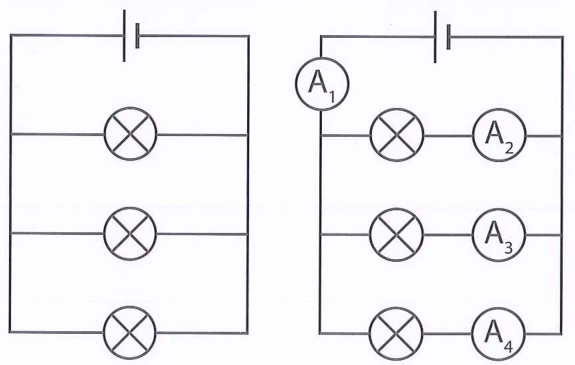
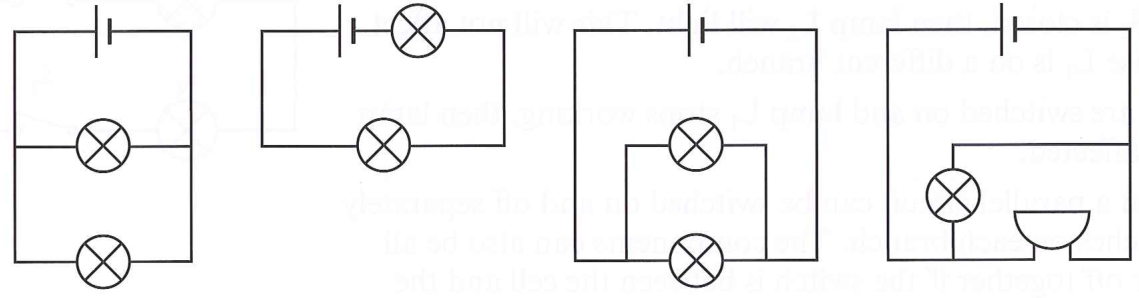
Which of these are parallel circuits? Write the letter or letters that are correct. The diagrams from left to right are A, B, C and D.

Question illustration
  1. Circuit A
  2. Circuit B
  3. Circuit C
  4. Circuit D

Question 8

A circuit is to be designed with a cell and four identical lamps. Draw a circuit diagram with four lamps connected in series with a cell.

Question 9

A circuit is to be designed with a cell and four identical lamps. Draw a circuit diagram with four lamps connected in parallel with a cell.

Question 10

Describe two advantages of connecting four identical lamps in parallel rather than in series with a cell.

Question 11

Four identical lamps are connected in parallel. When all four lamps are working, the current through the cell is 2.0 A. Calculate the current through each lamp, in A.

Question 12

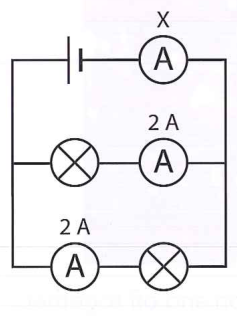
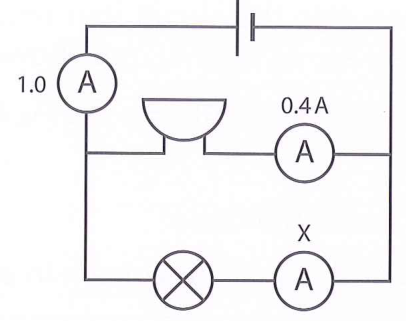
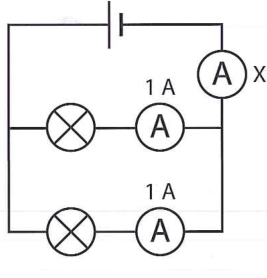
Calculate the missing current, X, in this circuit. Give your answer in A.

Question illustration

Question 13

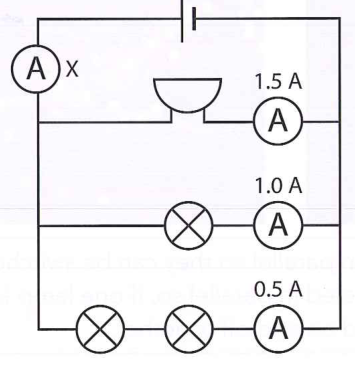
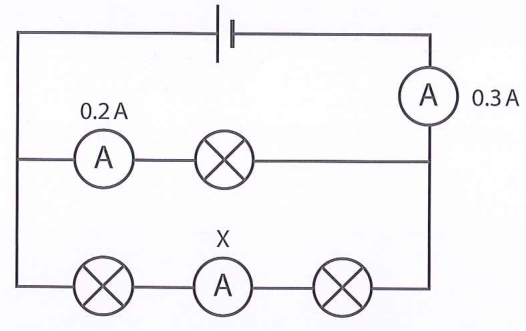
Calculate the missing current, X, in this circuit. Give your answer in A.

Question illustration

Question 14

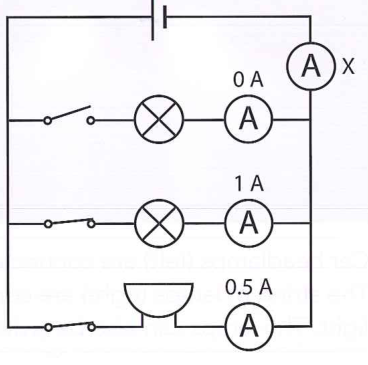
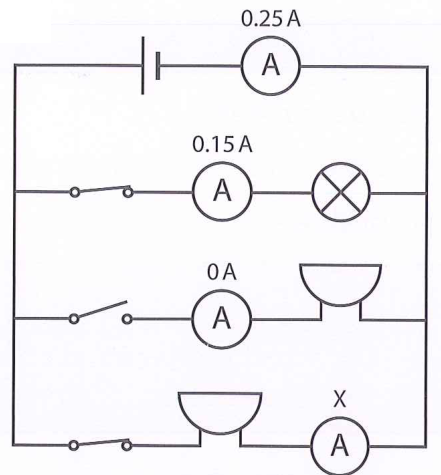
Calculate the missing current, X, in this circuit. Give your answer in A.

Question illustration

Question 15

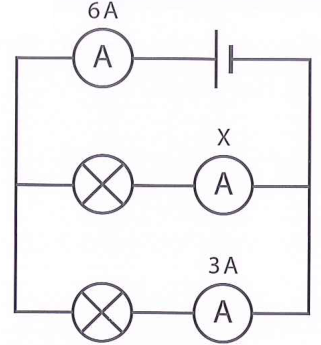
Calculate the missing current, X, in this circuit. Give your answer in A.

Question illustration

Question 16

Calculate the missing current, X, in this circuit. Give your answer in A.

Question illustration

Question 17

Calculate the missing current, X, in this circuit. Give your answer in A.

Question illustration

Question 18

Calculate the missing current, X, in this circuit. Give your answer in A.

Question illustration

Question 19

Calculate the missing current, X, in this circuit. Give your answer in A.

Question illustration

Question 20

Use three lamps, enough low-voltage cells to operate one lamp, wires and an ammeter. The three lamps are connected in parallel; A₁ measures the common-path current and A₂, A₃, A₄ measure the three branch currents. Work in groups of two or three. Set up the first circuit without the ammeter. When all lamps work, insert the ammeter at each of the four positions in turn and measure the current.
Question illustration
0
0
GIỎ HÀNG
Empty CartGIỎ CHƯA CÓ GÌQUAY LẠI SHOP