Atoms and cells both contain a nucleus. Why do you think these very different structures have the same name? Discuss with a partner, then share your ideas.
Making models of chromosomes in a cell. Work in a group of two or three. Choose an animal species and use the internet to find how many chromosomes its cells have. Use any materials, such as string or wool, and a large sheet of paper. Draw a freehand cell outline (not a perfect circle) and a large nucleus. Make two of each kind of chromosome: for example, 32 chromosomes need two sets of 16. Stick them inside the nucleus and write a heading naming your animal species.
All fruit flies have a gene for wing shape, in the same place on their chromosome 2. But some fruit flies have normal wings, and some have very tiny wings – so small that they cannot fly. What can explain this?
All cells have similar features, but most kinds of cell are specialised to perform a particular function. How many different kinds of animal cells can you think of?
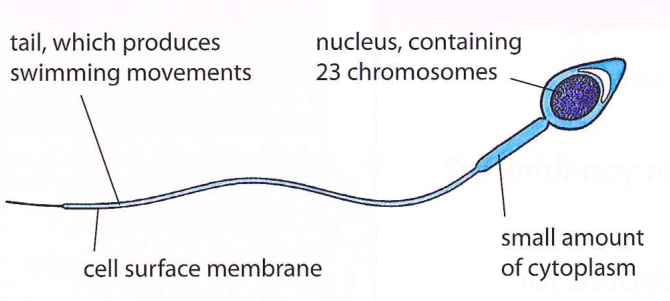
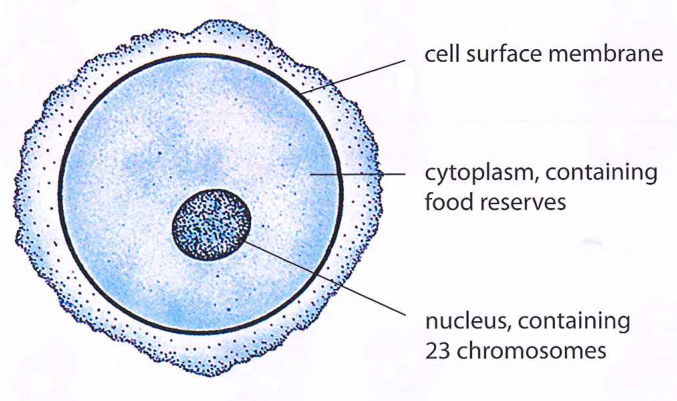
Draw a table with two columns. Write the headings “Sperm cell” and “Egg cell” at the top of the columns. Then make a comparison of these two cells. Try to think of at least three differences between them.
Modelling sex inheritance. Work in pairs with two containers, 45 same-colour pieces of string or wire representing X chromosomes, and 15 equal-sized pieces of a different colour representing Y chromosomes. Put 30 X pieces in the egg container, and 15 X plus 15 Y pieces in the sperm container. Without looking, take one piece from each container to make a zygote. Repeat until all pieces are used.
The egg pot contains 30 X pieces; the sperm pot contains 15 X and 15 Y pieces. Draw one piece blindly from each pot without replacement until all 30 pairs have been used. For each draw in the sex-inheritance model, write down the chromosomes in the zygote (fertilised egg) you have produced. Record the result in a table.
The egg pot contains 30 X pieces; the sperm pot contains 15 X and 15 Y pieces. Draw one piece blindly from each pot without replacement until all 30 pairs have been used. When you have used up all the chromosomes in the sex-inheritance model, add up the total numbers of female and male zygotes you have produced.
The egg pot contains 30 X pieces; the sperm pot contains 15 X and 15 Y pieces. Draw one piece blindly from each pot without replacement until all 30 pairs have been used. From your results in the sex-inheritance model, what can you say about the chance of a baby being a boy or a girl?
In Stage 7, you learnt what a species is. Think of a way to complete this sentence. Try to include some useful scientific information in your sentence. A species is … .