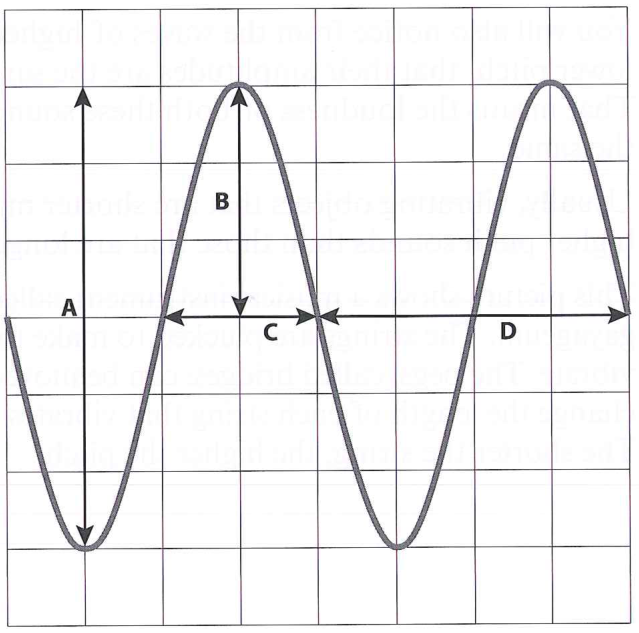
This is the waveform of a sound displayed on an oscilloscope screen. Write down one letter that shows a measurement that depends on the frequency of the wave.
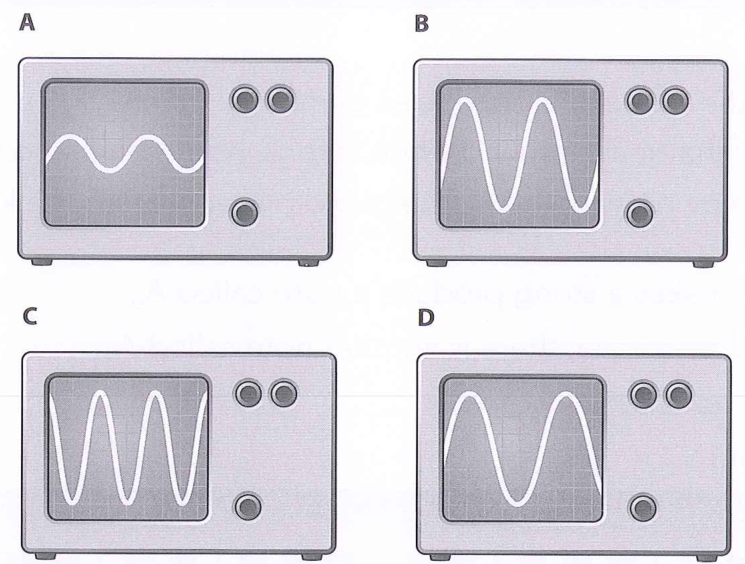
Look at the four sound waveforms, A, B, C and D. Copy and complete the sentence. Choose your answer from the list. When the sound changes from A to B, the amplitude of the wave … .
Look at the four sound waveforms, A, B, C and D. Copy and complete the sentence. Choose your answer from the list. When the sound changes from A to B, the loudness of the sound … .
Look at the four sound waveforms, A, B, C and D. Copy and complete the sentence. Choose your answer from the list. When the sound changes from C to D, the pitch of the sound … .
Look at the four sound waveforms, A, B, C and D. Copy and complete the sentence. Choose your answer from the list. When the sound changes from C to D, the loudness of the sound … .
Look at the four sound waveforms, A, B, C and D. Copy and complete the sentence. Choose your answer from the list. When the sound changes from C to D, the frequency of the wave … .
Many pianos have pedals that can be pressed using the player’s feet. One of the pedals decreases the loudness of the note without changing the pitch. Suggest what this pedal does, if anything, to the amplitude of the string vibration.
Many pianos have pedals that can be pressed using the player’s feet. One of the pedals decreases the loudness of the note without changing the pitch. Suggest what this pedal does, if anything, to the frequency of the string vibration.
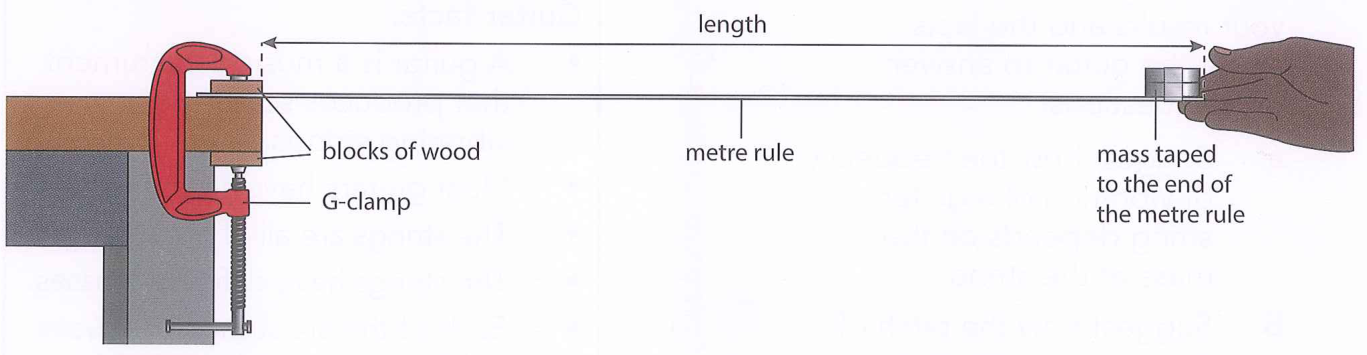
A wooden metre rule or half-metre rule is clamped at a desk edge, with a mass taped to its free end. Keep the free length the same and change the attached mass. Count complete vibrations in 10 seconds, then divide by 10 to obtain frequency in Hz. Set up the equipment as shown. Decide what preliminary measurements are needed to determine the range of masses. Try to use a minimum of five different masses. Carry out the investigation using your selected masses. Do not stand with your feet under the rule; use masses that will not break it and a clamp strong enough to hold it.
A wooden metre rule or half-metre rule is clamped at a desk edge, with a mass taped to its free end. Keep the free length the same and change the attached mass. Count complete vibrations in 10 seconds, then divide by 10 to obtain frequency in Hz. Record your results in a table with the columns: mass; number of vibrations in 10 seconds; frequency. Include units where needed in the column headers and all your repeat measurements.