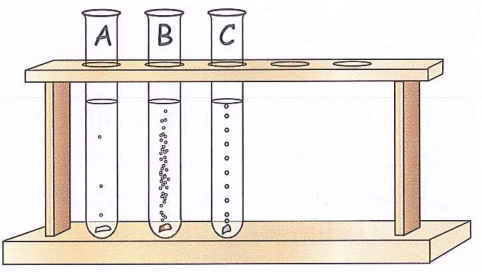
Discuss with a partner how you can tell if a chemical reaction has taken place. Share your ideas with another pair. Be prepared to share your ideas with the class.
The reactivity list, from most to least reactive, is: potassium, sodium, calcium, magnesium, zinc, iron, copper, silver, gold. The metal lithium is missing from the reactivity list; suggest where it should be placed.
The reactivity list, from most to least reactive, is: potassium, sodium, calcium, magnesium, zinc, iron, copper, silver, gold. Platinum is a precious metal that is used for jewellery. Platinum stays shiny for a long time. Where in the list would you place the metal platinum?
Learning the order. Work with a partner. Make up a mnemonic to help you remember the sequence of metals in the reactivity series. You could use the first letters of their names or their symbols. Ask your partner to test you, then test your partner. Write your mnemonic on a poster and share it with the class. The reactivity list, from most to least reactive, is: potassium, sodium, calcium, magnesium, zinc, iron, copper, silver, gold.
Write the names of the metals on individual pieces of card or paper. Try to arrange the cards in the correct order as fast as possible. Who was the most accurate? Who was the fastest? The reactivity list, from most to least reactive, is: potassium, sodium, calcium, magnesium, zinc, iron, copper, silver, gold.
Use the cards from Method 2. Place them face down. One person picks a card and shows it to a partner. The partner must name a more reactive metal and a less reactive metal. If there are no metals more or less reactive than the one on the card, the partner must state that fact. Take turns. The reactivity list, from most to least reactive, is: potassium, sodium, calcium, magnesium, zinc, iron, copper, silver, gold.
The reactivity list, from most to least reactive, is: potassium, sodium, calcium, magnesium, zinc, iron, copper, silver, gold. Which is the more reactive metal: zinc or copper?
The reactivity list, from most to least reactive, is: potassium, sodium, calcium, magnesium, zinc, iron, copper, silver, gold. Can zinc displace the copper in copper sulfate?
The reactivity list, from most to least reactive, is: potassium, sodium, calcium, magnesium, zinc, iron, copper, silver, gold. Which is more reactive: silver or magnesium?
The reactivity list, from most to least reactive, is: potassium, sodium, calcium, magnesium, zinc, iron, copper, silver, gold. Can silver displace the magnesium in magnesium sulfate?
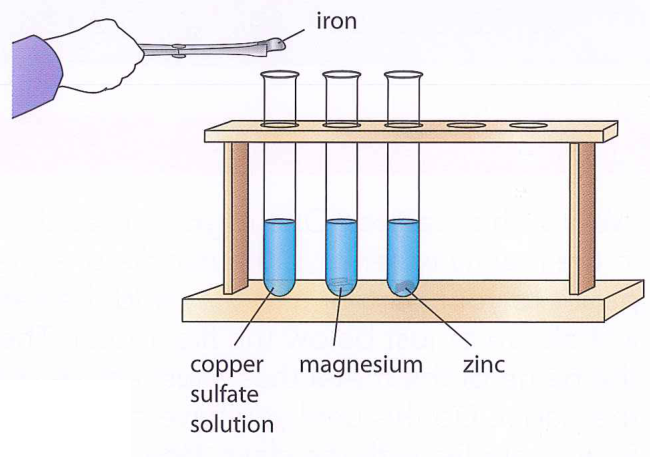
Think like a scientist: Displacing metals. You need solutions of copper sulfate, magnesium sulfate, iron sulfate and zinc sulfate; small pieces of iron, zinc, copper and magnesium; test tubes, a rack, forceps and safety glasses. Read all instructions and prepare a results table. Fill three tubes about one third full with copper sulfate solution. Add iron to one, magnesium to another and zinc to the third. Leave for a few minutes, observe and record. Repeat with magnesium sulfate and copper, iron and zinc; iron sulfate and copper, magnesium and zinc; zinc sulfate and copper, iron and magnesium. Carry out only with teacher supervision and an approved risk assessment.
In the investigation with iron, zinc, copper and magnesium and their sulfate solutions, how do you know that one metal has displaced another from its salt?
Work with a partner. One of you writes a metal in the reactivity series in the middle of a piece of paper. Pass the paper to your partner, who adds the metal just above or below it. Take turns adding a metal just above or below those already written, until the reactivity series is complete. Share your list with the class. How well did you do?