All living things need water to stay alive. For example, living things need water to dissolve chemicals inside their cells, so that chemical reactions (such as respiration) can happen.
With a partner, think of as many sentences as you can that start with: Living things need water ......
Try to include some good scientific information in each of your sentences. When everyone is ready, take turns with other pairs to share one of your sentences with the rest of the class. Build up a collection of all the different ideas on the board.
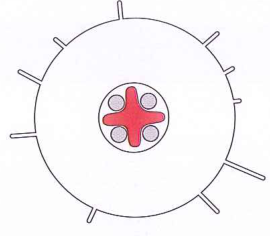
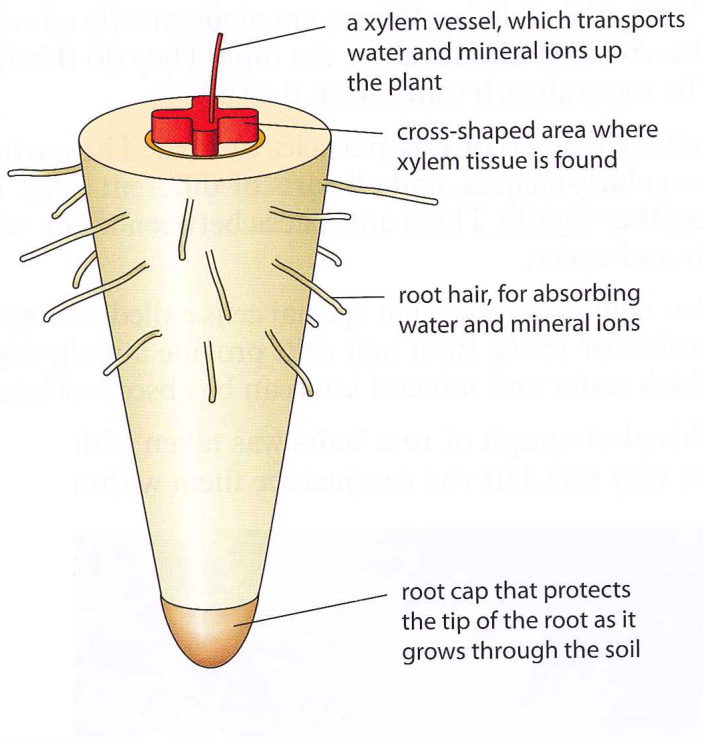
Annotating a diagram. Work with a partner, or in a group of three. On a large sheet of paper, make a big copy of the unlabelled, circular diagram showing the position of xylem vessels in a root. Make sure that you leave enough space around your drawing to add some writing. Use information on the three-dimensional diagram and in the text below to add annotations. The annotations should describe what each part does, so that someone looking at your diagram can understand how water is absorbed by the root, and how it is transported upwards from the root.
Information: root hairs absorb water and mineral ions; water moves from the outside of the root towards its centre and enters the xylem vessels. These form long hollow tubes that carry water up the plant.
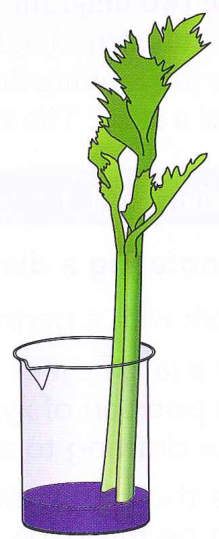
Investigating transport in a celery stalk. Follow the path of water as it moves up through a stalk. You need a stalk of celery, pak choi or another plant with a thick stalk (preferably with leaves at the top), a small beaker or Petri dish, water mixed with coloured dye, and a blade with a cork board or other non-slip cutting surface.
1. Put coloured water in the container, no more than 1 to 2 cm deep.
2. Cut across the lower end of the stalk (not the leaf end), making a clean cut that is not blocked or damaged.
3. Stand the cut end in the coloured water.
4. Every five minutes or so, look for the blue dye moving up the stalk. This can be quick or slow.
5. When the dye reaches the top, take the stalk out and rinse dye off its end with tap water.
6. Put the stalk on a non-slip surface and cut across it about halfway up.
Safety: cut away from yourself so that a slipping blade does not hit your hand. Carry out the investigation and record what you observe.
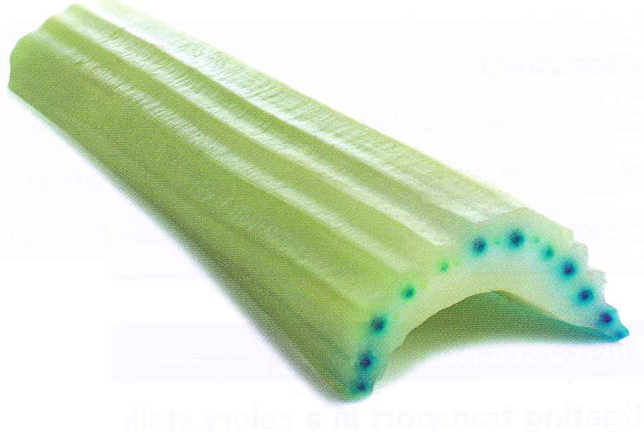
After standing a celery stalk in blue dye and rinsing it, make a drawing of the cut end of the stalk after it has been in the blue dye. The source photograph shows an example.
In a celery stalk that has absorbed blue dye, which kind of cells do you think are found in the places where you can see blue spots? Choose from: palisade cells; root hair cells; xylem cells. Label your drawing with the name of one of these cells.
In your experiment, there were no roots on the plant. Try to imagine how the stalk you used would connect with the roots on a complete plant. Then write a sentence or two to explain how, in a complete plant, water would get to the stalk.
Think about what effect temperature might have on the speed at which the water moves up a stalk. If the temperature increases, do you think the water would move upwards faster, or more slowly? Why do you think that?
Now think about how you could modify the experiment that you did with the stalk, to test your hypothesis. Discuss your ideas with a partner. In the original experiment, a freshly cut celery stalk stands in 1–2 cm of coloured water and the dye is observed as it moves up the stalk.
Write a description of your planned experiment to test the effect of temperature on water movement up a stalk. Make sure that you include:
- a list, or drawings, of the apparatus that you will need
- which variable you will change (your independent variable)
- what you will measure (your dependent variable), how you will measure it and why you will measure it
- which variables you will keep the same
- a risk assessment for your planned investigation: what risks are there, and how will you control them?
When we think of water, we usually think of a liquid. But water can also be a solid and a gas. With a partner, make a drawing to show the arrangement of the particles in liquid water. Then make another drawing to show the arrangement of the particles in water when it is a gas. Write a brief description next to each drawing, to explain what the particles are doing.
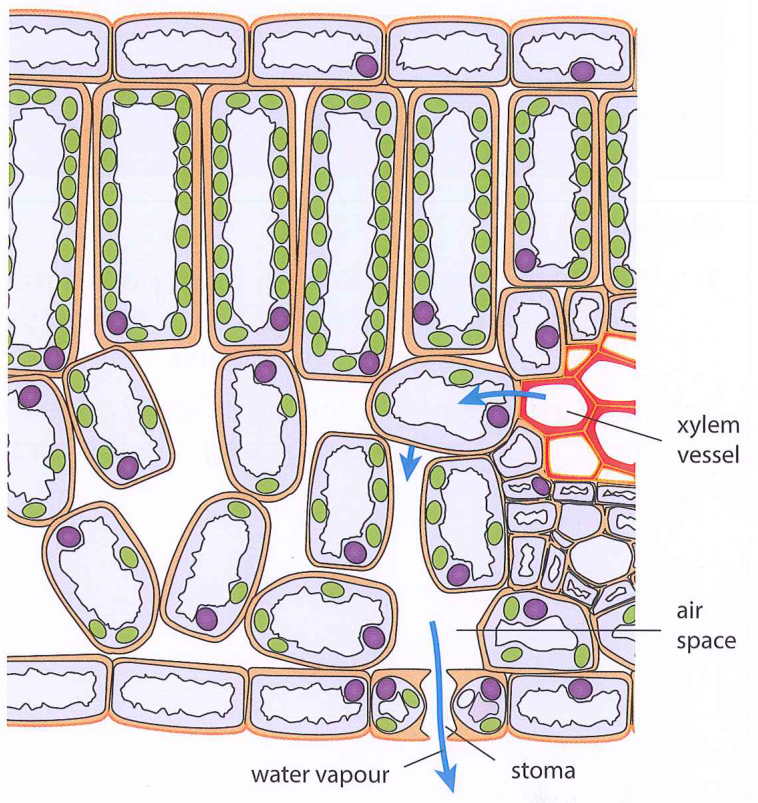
Look at the diagram of the inside of a leaf in Topic 1.2. Use the information on that diagram to identify these parts on the diagram on this page: the upper epidermis; the palisade layer; the spongy layer.
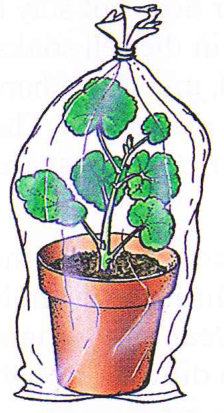
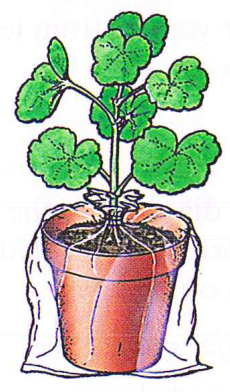
Investigate water loss from a plant growing in a pot. You need two very similar plants in the same size pots, two big transparent polythene bags and a balance. Check that both soils are moist; if not, add the same volume of water and leave for about five minutes so excess water drains away. Two very similar plants in equal-sized pots have moist soil. Plant 1 is completely enclosed, including its pot, in a firmly tied transparent polythene bag. For plant 2, only the pot and soil are sealed in a bag, leaving the leaves exposed. Take care not to damage the stem. Measure and record the masses initially and each day for at least a week. Put the date and the two masses in a results table, with units in the column headings.
Two very similar plants in equal-sized pots have moist soil. Plant 1 is completely enclosed, including its pot, in a firmly tied transparent polythene bag. For plant 2, only the pot and soil are sealed in a bag, leaving the leaves exposed. Use your results to draw a line graph. You can draw two lines on the same graph — one line for each plant.