Skip to content / Đến nội dung
SachHeCam.com

Cambridge Secondary (7-9). Stage 9. Science. Learner's Book - Unit 3: Forces and energy

Question 1

Work in groups to discuss: What is the scientific meaning of the word volume?

Question 2

Which of these has a larger volume?
  1. 1 kg of rock
  2. 1 kg of feathers

Question 3

Which of these has a larger mass?
  1. 1 cm³ of polystyrene
  2. 1 cm³ of iron

Question 4

Look at the densities of these materials: pine wood 0.41 g/cm³; polycarbonate 1.2 g/cm³; polythene 0.95 g/cm³; water 1.0 g/cm³. Which of these materials has the lowest density?

Question 5

Look at the densities of these materials: pine wood 0.41 g/cm³; polycarbonate 1.2 g/cm³; polythene 0.95 g/cm³; water 1.0 g/cm³. Which of these materials will sink in water?

Question 6

Look at the densities of these materials: pine wood 0.41 g/cm³; polycarbonate 1.2 g/cm³; polythene 0.95 g/cm³; water 1.0 g/cm³. Explain why the material will sink in water.

Question 7

Copy and complete the equation for density. Density = …

Question 8

A block of aluminium has a volume of 5.0 cm³ and a mass of 13.5 g. Calculate the density of the aluminium. Give your answer in g/cm³.

Question 9

A block of aluminium has a volume of 5.0 cm³ and a mass of 13.5 g. Explain whether the block of aluminium will float or sink in water.

Question 10

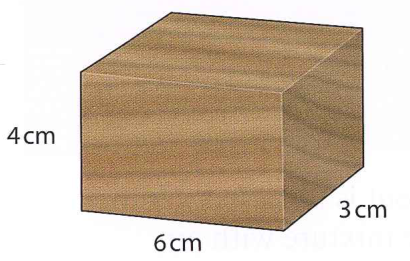
The diagram shows a block of wood. Calculate the volume of the block of wood. Give your answer in cm³.

Question illustration

Question 11

The block of wood in the diagram has a mass of 54 g. Calculate the density of the wood. Give your answer in g/cm³.

Question illustration

Question 12

The block of wood in the diagram has a mass of 54 g. Explain whether the block of wood will float or sink in water.

Question illustration

Question 13

Sea water is placed in a tank. The volume of the sea water is 10 m³. The mass of the sea water is 10 300 kg. Calculate the density of the sea water. Give your answer in kg/m³.

Question 14

Sea water has mass 10 300 kg in 10 m³. Pure water has a density of 1000 kg/m³. Explain what will happen to a block of material with a density of 1020 kg/m³ when placed into sea water.

Question 15

Sea water has mass 10 300 kg in 10 m³. Pure water has a density of 1000 kg/m³. Explain what will happen to a block of material with a density of 1020 kg/m³ when placed into pure water.

Question 16

Copper has a density of 8.96 g/cm³. Calculate the mass of copper that has a volume of 20 cm³.

Question 17

Copper has a density of 8.96 g/cm³. Calculate the volume of copper that has a mass of 4.5 g.

Question 18

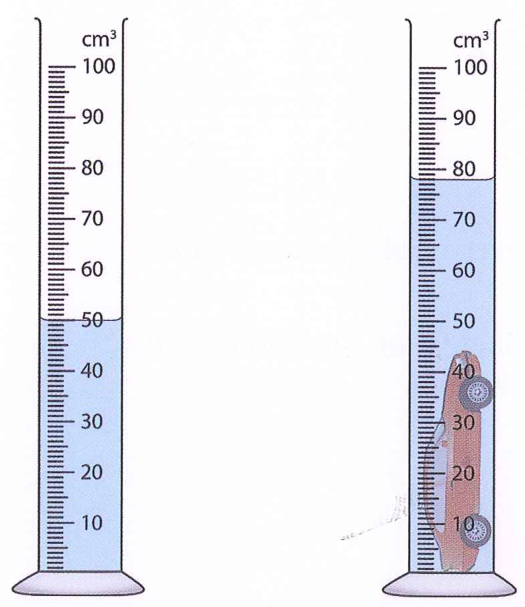
A toy car is placed into a measuring cylinder of water as shown in the diagram. Use the diagram to calculate the volume of the toy car.

Question illustration

Question 19

The toy car in the diagram has a mass of 84 g. Calculate the density of the toy car. Give your answer in g/cm³.

Question illustration

Question 20

The toy car in the diagram is made from steel and plastic. Its mass is 84 g and its displaced volume is 28 cm³. Steel has a density of 7.8 g/cm³. Suggest two reasons for the difference between this value and the density you calculated in part b.
Question illustration
0
0
GIỎ HÀNG
Empty CartGIỎ CHƯA CÓ GÌQUAY LẠI SHOP
