Activity 2.1.1: A model of an atom
In this activity, you will build a model of an element.
You will need: scissors, hole punch, string, glue, card in different colours (white, red, grey, blue and another colour for the shells).
Method
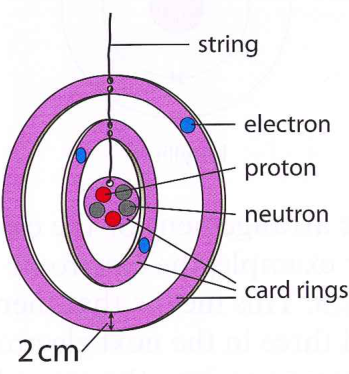
1 Cut a white circle of card about 6 cm diameter. This will act as the base for the nucleus.
2 Cut out small red circles of about 1.5–2 cm diameter to represent the protons in your chosen element, and grey circles of about 1.5–2 cm diameter to represent the neutrons. Stick these onto one side of the nucleus. Repeat this step, but stick the protons and neutrons onto the other side of the nucleus. Make sure you have the correct number on both sides.
3 Cut out concentric rings of card to represent the electron shells. The rings should be about 2 cm wide. Concentric means circles of different radius sharing the same centre.
4 Cut out small blue circles to represent the electrons in your chosen element. Stick these onto one side of the relevant electron shell. Repeat this step, but stick the electrons onto the other side of each shell. Make sure you have the correct number of electrons on both sides.
5 Assemble the model as shown in the diagram.
6 Make a label for your model that gives the name and symbol for your element, and the number of protons, neutrons and electrons. Hang the label from the bottom of your model.
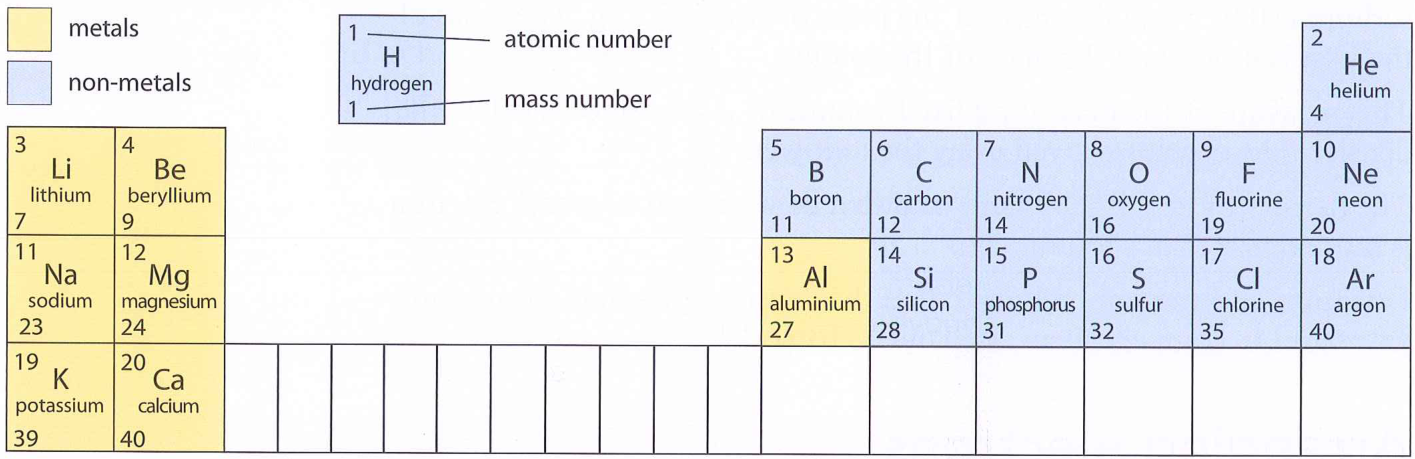
Use a copy of the Periodic Table to find a metal in the same group as magnesium.
Compare your answers with a partner and use both of your answers to include all the elements that apply in each answer.
Use a copy of the Periodic Table to find a metal in the same period as magnesium.
Compare your answers with a partner and use both of your answers to include all the elements that apply in each answer.
Use a copy of the Periodic Table to find a non-metallic solid in the same period as magnesium.
Compare your answers with a partner and use both of your answers to include all the elements that apply in each answer.
Use a copy of the Periodic Table to find a gas in the same period as magnesium.
Compare your answers with a partner and use both of your answers to include all the elements that apply in each answer.
Data: lithium (Li): atomic number 3, mass number 7, melting point 180 °C, boiling point 1360 °C; sodium (Na): 11, 23, 98 °C, 900 °C; potassium (K): 19, 39, 63 °C, 777 °C.
What is the trend in the boiling points of Group 1 elements?
Data: lithium (Li): atomic number 3, mass number 7, melting point 180 °C, boiling point 1360 °C; sodium (Na): 11, 23, 98 °C, 900 °C; potassium (K): 19, 39, 63 °C, 777 °C.
What prediction can you make about the boiling point of rubidium?
Data: lithium (Li): atomic number 3, mass number 7, melting point 180 °C, boiling point 1360 °C; sodium (Na): 11, 23, 98 °C, 900 °C; potassium (K): 19, 39, 63 °C, 777 °C.
How many more electrons than lithium does sodium have?
Think like a scientist: Observation of the reactions of Group 1 metals with water
You will need: safety glasses.
Your teacher needs: safety glasses, large trough of water, white tile, scalpel or knife, large forceps, samples of the three metals – lithium, sodium and potassium – stored in the normal way, safety screen or screens large enough to protect everyone in the class (including the teacher).
Method
Your teacher will demonstrate the reactions of lithium, sodium and potassium with water. The three elements are stored in a particular way and a small piece of the metal will be cut off and placed one at a time in the trough of water to react.
Watch carefully and record your observations.