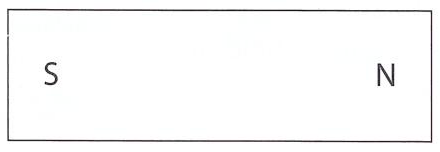
You will need: bar magnet; horseshoe magnet (optional); piece of A4 size paper; piece of thick card, not thicker than the thickness of the magnet; iron filings.
Safety: Be careful not to get the iron filings on your skin. They can be sharp and get stuck in your skin. Be careful not to get the iron filings on the magnet. They are very difficult to remove and other people will get the iron filings on their skin.
Method
1. Cut a hole in the middle of the thick card, just large enough to put the bar magnet in.
2. Put the bar magnet into the hole so it lies flat in the card. The card is to support the paper and keep the paper level.
3. Put the paper on top of the card so the magnet is under the middle of the paper.
4. Gently and evenly sprinkle the iron filings over the paper. Tap the paper gently to allow the iron filings to move into position.
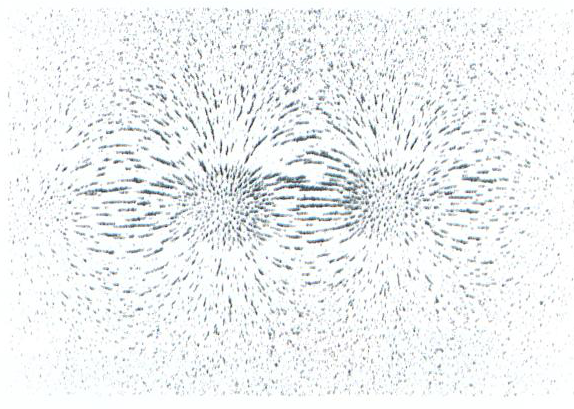
You should see a pattern like the one in the picture.
When you have finished, carefully lift the paper vertically away from the magnet. Bend the paper to form a slight ‘U’ shape and use this as a channel to pour the iron filings back into the container.
If you have time, you could use two magnets, first arranged with like poles facing and then with opposite poles facing. In each case, try to explain the pattern of iron filings.
In this investigation, you will investigate ways of detecting a magnetic field. Work in pairs or groups of three.
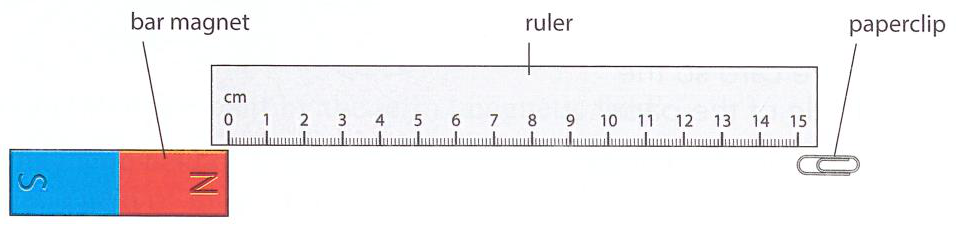
You will need: See the diagram. You could also choose some other different types of magnets to investigate.
Method
1. Set the magnet, ruler and paperclip on a smooth surface as shown in the diagram.
2. Record whether the north or south pole of the magnet is facing the paperclip.
3. Slowly move the paperclip toward the pole of the magnet. If your bar magnet is not marked, can you devise a method to tell which pole is which?
4. Record the distance from the pole of the magnet when the paperclip becomes attracted to the magnet. Call this value d for distance.
5. Repeat another two times and record all your measurements of d.
6. Turn the magnet around so the other pole is facing the paperclip.
7. Repeat steps 3–5 for this pole.
8. If you have time, repeat the investigation with other, different, magnets.