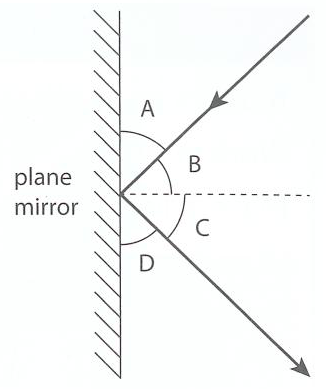
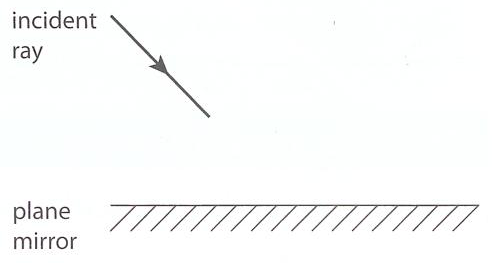
Copy this ray diagram. You do not have to measure angles for making your copy.
a Extend the incident ray to meet the mirror.
b Draw a normal where the incident ray meets the mirror.
c Measure and write down the angle of incidence.
d Draw a reflected ray in the correct place.
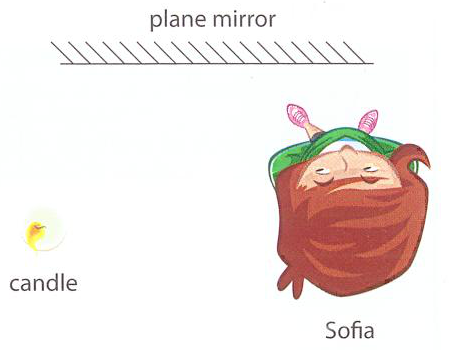
Sofia looks at a candle in the mirror.
Copy and complete the diagram to show how light from the candle reflects from the mirror to Sofia.
You do not have to measure angles.
Draw and label:
• the incident ray
• the normal
• the reflected ray
• the angle of incidence
• the angle of reflection.
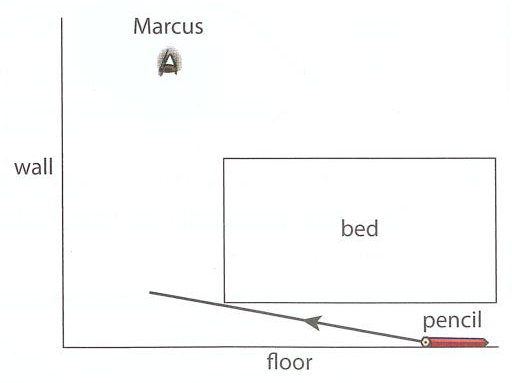
Marcus drops a pencil. The pencil rolls under his bed. Marcus cannot see the pencil.
The diagram shows a light ray coming from the pencil.
Marcus can use a mirror to see the pencil.
Copy and complete the diagram by adding a mirror and a reflected light ray to show how Marcus can see the pencil. You do not have to measure the angles.
Think like a scientist: Measuring angles of incidence and reflection
In this investigation, you will investigate the law of reflection.
Work in pairs or groups of three.
Make the room as dark as possible for this activity.
You will need:
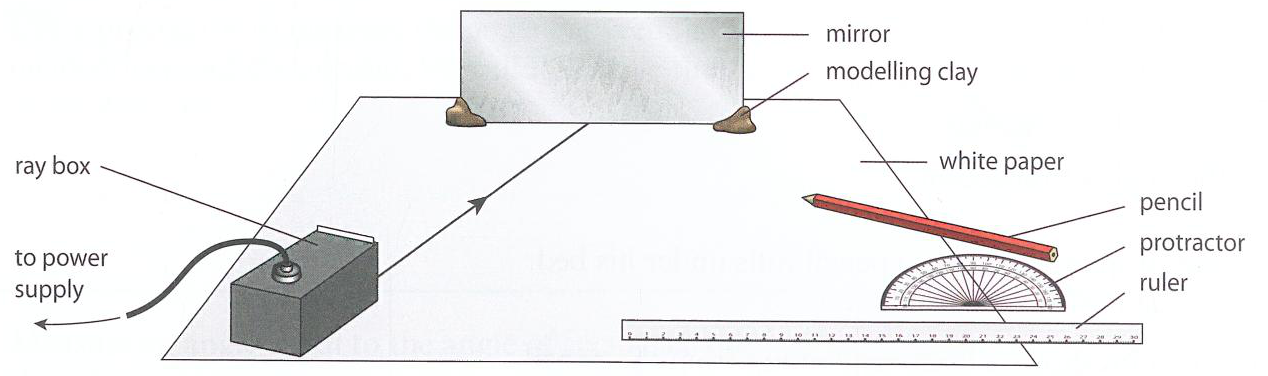
• equipment shown in the diagram
Method
1 Set up the equipment as shown in the diagram.
2 Place the plane mirror vertically at one side of the white paper. Mark the position of the front of the mirror on the paper using a pencil.
3 Use the protractor to draw a normal line at the surface of the mirror.
4 Use the ray box to direct a ray of light onto the mirror where the normal meets the mirror surface.
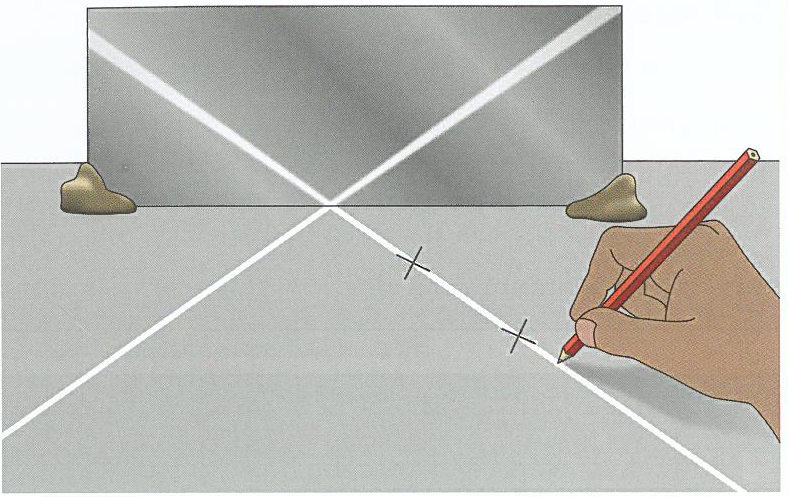
5 Use a pencil to make marks on the paper for the positions of the incident and reflected rays, as shown in the diagram.
6 Turn the ray box off, remove the mirror and use the pencil marks to construct a ray diagram.
7 Measure and record the angle of incidence, i and the angle of reflection, r from your diagram.
8 Repeat this for at least four more different angles of incidence. Use a new piece of paper or a new area on the same piece of paper each time.
Carry out the method and construct the ray diagrams and angle measurements.
Think like a scientist: Measuring angles of incidence and reflection
In this investigation, you will investigate the law of reflection.
Work in pairs or groups of three.
Make the room as dark as possible for this activity.
You will need:
• equipment shown in the diagram
Method
1 Set up the equipment as shown in the diagram.
2 Place the plane mirror vertically at one side of the white paper. Mark the position of the front of the mirror on the paper using a pencil.
3 Use the protractor to draw a normal line at the surface of the mirror.
4 Use the ray box to direct a ray of light onto the mirror where the normal meets the mirror surface.
5 Use a pencil to make marks on the paper for the positions of the incident and reflected rays, as shown in the diagram.
6 Turn the ray box off, remove the mirror and use the pencil marks to construct a ray diagram.
7 Measure and record the angle of incidence, i and the angle of reflection, r from your diagram.
8 Repeat this for at least four more different angles of incidence. Use a new piece of paper or a new area on the same piece of paper each time.
Record your results in a table with two columns: angle of incidence and angle of reflection. Remember to include the unit.
Think like a scientist: Measuring angles of incidence and reflection
In this investigation, you will investigate the law of reflection.
Work in pairs or groups of three.
Make the room as dark as possible for this activity.
You will need:
• equipment shown in the diagram
Method
1 Set up the equipment as shown in the diagram.
2 Place the plane mirror vertically at one side of the white paper. Mark the position of the front of the mirror on the paper using a pencil.
3 Use the protractor to draw a normal line at the surface of the mirror.
4 Use the ray box to direct a ray of light onto the mirror where the normal meets the mirror surface.
5 Use a pencil to make marks on the paper for the positions of the incident and reflected rays, as shown in the diagram.
6 Turn the ray box off, remove the mirror and use the pencil marks to construct a ray diagram.
7 Measure and record the angle of incidence, i and the angle of reflection, r from your diagram.
8 Repeat this for at least four more different angles of incidence. Use a new piece of paper or a new area on the same piece of paper each time.
State the independent variable in this experiment.
Think like a scientist: Measuring angles of incidence and reflection
In this investigation, you will investigate the law of reflection.
Work in pairs or groups of three.
Make the room as dark as possible for this activity.
You will need:
• equipment shown in the diagram
Method
1 Set up the equipment as shown in the diagram.
2 Place the plane mirror vertically at one side of the white paper. Mark the position of the front of the mirror on the paper using a pencil.
3 Use the protractor to draw a normal line at the surface of the mirror.
4 Use the ray box to direct a ray of light onto the mirror where the normal meets the mirror surface.
5 Use a pencil to make marks on the paper for the positions of the incident and reflected rays, as shown in the diagram.
6 Turn the ray box off, remove the mirror and use the pencil marks to construct a ray diagram.
7 Measure and record the angle of incidence, i and the angle of reflection, r from your diagram.
8 Repeat this for at least four more different angles of incidence. Use a new piece of paper or a new area on the same piece of paper each time.
Draw a graph of your results. Put the independent variable on the horizontal axis. Complete your graph with a straight line of best fit.
Think like a scientist: Measuring angles of incidence and reflection
In this investigation, you will investigate the law of reflection.
Work in pairs or groups of three.
Make the room as dark as possible for this activity.
You will need:
• equipment shown in the diagram
Method
1 Set up the equipment as shown in the diagram.
2 Place the plane mirror vertically at one side of the white paper. Mark the position of the front of the mirror on the paper using a pencil.
3 Use the protractor to draw a normal line at the surface of the mirror.
4 Use the ray box to direct a ray of light onto the mirror where the normal meets the mirror surface.
5 Use a pencil to make marks on the paper for the positions of the incident and reflected rays, as shown in the diagram.
6 Turn the ray box off, remove the mirror and use the pencil marks to construct a ray diagram.
7 Measure and record the angle of incidence, i and the angle of reflection, r from your diagram.
8 Repeat this for at least four more different angles of incidence. Use a new piece of paper or a new area on the same piece of paper each time.
Describe some of the things that were difficult to do accurately in this experiment.
Think like a scientist: Measuring angles of incidence and reflection
In this investigation, you will investigate the law of reflection.
Work in pairs or groups of three.
Make the room as dark as possible for this activity.
You will need:
• equipment shown in the diagram
Method
1 Set up the equipment as shown in the diagram.
2 Place the plane mirror vertically at one side of the white paper. Mark the position of the front of the mirror on the paper using a pencil.
3 Use the protractor to draw a normal line at the surface of the mirror.
4 Use the ray box to direct a ray of light onto the mirror where the normal meets the mirror surface.
5 Use a pencil to make marks on the paper for the positions of the incident and reflected rays, as shown in the diagram.
6 Turn the ray box off, remove the mirror and use the pencil marks to construct a ray diagram.
7 Measure and record the angle of incidence, i and the angle of reflection, r from your diagram.
8 Repeat this for at least four more different angles of incidence. Use a new piece of paper or a new area on the same piece of paper each time.
Suggest some ways to improve the accuracy of this experiment.