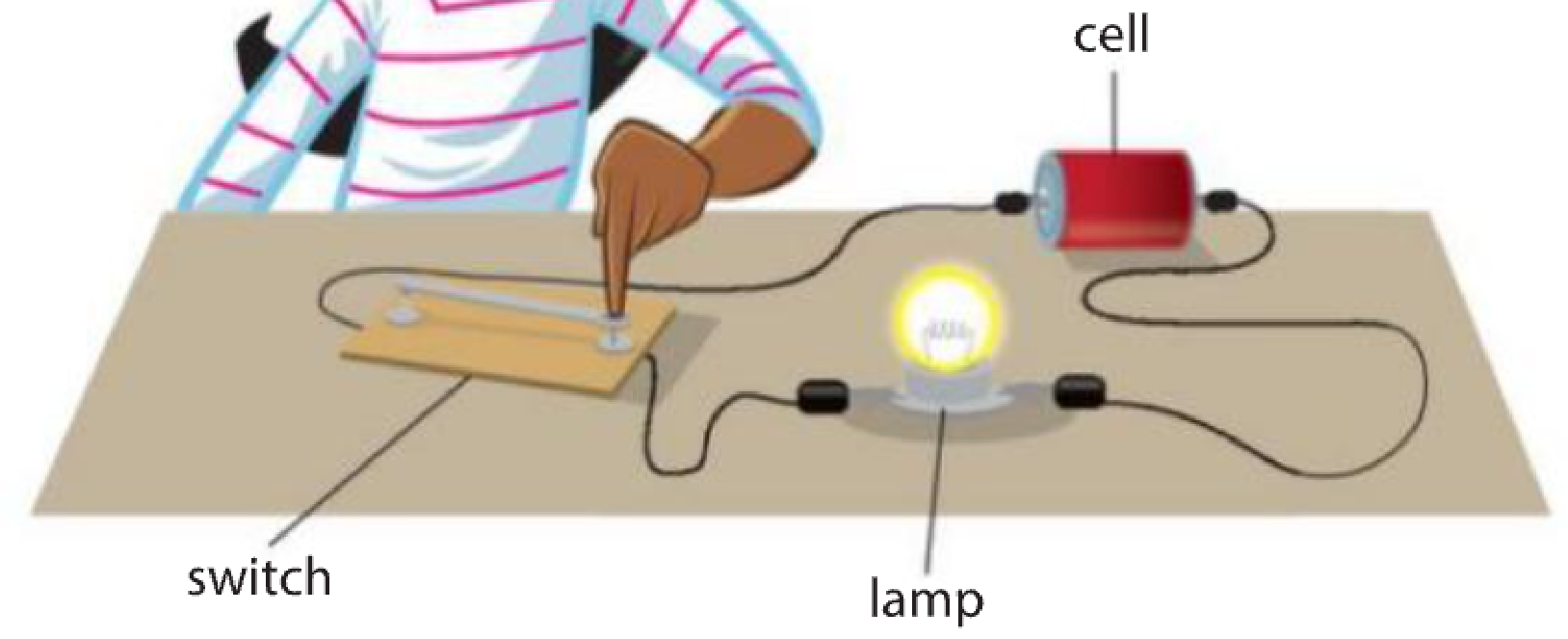
Copy the sentences and use words from the list to complete them. Each word may be used once, more than once or not at all.
attracted repelled positive negative electrons atoms
Current in a circuit is the movement of ........ .
These particles have a ........ charge.
These particles are ........ by the positive terminal of a battery and ........ by the negative terminal of a battery.
In this activity, you will use a model to show how current flows in a circuit.
Work in groups of four to six.
You will need: a ball of string, scissors, coloured tape or coloured marker pen.
Safety: Do not pull string quickly through your hands as it can cause burns.
1 Tie the ends of the string together to form a large loop. The loop must be long enough to be held by all the people in the group. Attach coloured tape or make coloured marks on the string at equally spaced intervals. The intervals should be about 10 cm long.
2 In your group, stand in a circle facing toward the centre of the circle.
3 Each person should hold the loop of string in front of them in both hands, so the string forms a circle. Hold the string so that it is quite tight but can move.
4 The people in the group are the components in the circuit. One person is the cell. The person who is the cell must pull the string around through the hands of the other group members. The other group members can be components such as lamps or buzzers.
5 Watch how the string moves. Use the coloured marks to see the movement of the string.
Discuss these questions in your group.
What part of the circuit made the string move?
In this activity, you will use a model to show how current flows in a circuit.
Work in groups of four to six.
You will need: a ball of string, scissors, coloured tape or coloured marker pen.
Safety: Do not pull string quickly through your hands as it can cause burns.
1 Tie the ends of the string together to form a large loop. The loop must be long enough to be held by all the people in the group. Attach coloured tape or make coloured marks on the string at equally spaced intervals. The intervals should be about 10 cm long.
2 In your group, stand in a circle facing toward the centre of the circle.
3 Each person should hold the loop of string in front of them in both hands, so the string forms a circle. Hold the string so that it is quite tight but can move.
4 The people in the group are the components in the circuit. One person is the cell. The person who is the cell must pull the string around through the hands of the other group members. The other group members can be components such as lamps or buzzers.
5 Watch how the string moves. Use the coloured marks to see the movement of the string.
Discuss these questions in your group.
When the string started to move, was the speed the same all the way around the circuit or different?
In this activity, you will use a model to show how current flows in a circuit.
Work in groups of four to six.
You will need: a ball of string, scissors, coloured tape or coloured marker pen.
Safety: Do not pull string quickly through your hands as it can cause burns.
1 Tie the ends of the string together to form a large loop. The loop must be long enough to be held by all the people in the group. Attach coloured tape or make coloured marks on the string at equally spaced intervals. The intervals should be about 10 cm long.
2 In your group, stand in a circle facing toward the centre of the circle.
3 Each person should hold the loop of string in front of them in both hands, so the string forms a circle. Hold the string so that it is quite tight but can move.
4 The people in the group are the components in the circuit. One person is the cell. The person who is the cell must pull the string around through the hands of the other group members. The other group members can be components such as lamps or buzzers.
5 Watch how the string moves. Use the coloured marks to see the movement of the string.
Discuss these questions in your group.
Was it possible for the string to be moving in one part of the circuit and not moving in another part?
In this activity, you will use a model to show how current flows in a circuit.
Work in groups of four to six.
You will need: a ball of string, scissors, coloured tape or coloured marker pen.
Safety: Do not pull string quickly through your hands as it can cause burns.
1 Tie the ends of the string together to form a large loop. The loop must be long enough to be held by all the people in the group. Attach coloured tape or make coloured marks on the string at equally spaced intervals. The intervals should be about 10 cm long.
2 In your group, stand in a circle facing toward the centre of the circle.
3 Each person should hold the loop of string in front of them in both hands, so the string forms a circle. Hold the string so that it is quite tight but can move.
4 The people in the group are the components in the circuit. One person is the cell. The person who is the cell must pull the string around through the hands of the other group members. The other group members can be components such as lamps or buzzers.
5 Watch how the string moves. Use the coloured marks to see the movement of the string.
Discuss these questions in your group.
Name the particles represented by the coloured marks.
In this activity, you will use a model to show how current flows in a circuit.
Work in groups of four to six.
You will need: a ball of string, scissors, coloured tape or coloured marker pen.
Safety: Do not pull string quickly through your hands as it can cause burns.
1 Tie the ends of the string together to form a large loop. The loop must be long enough to be held by all the people in the group. Attach coloured tape or make coloured marks on the string at equally spaced intervals. The intervals should be about 10 cm long.
2 In your group, stand in a circle facing toward the centre of the circle.
3 Each person should hold the loop of string in front of them in both hands, so the string forms a circle. Hold the string so that it is quite tight but can move.
4 The people in the group are the components in the circuit. One person is the cell. The person who is the cell must pull the string around through the hands of the other group members. The other group members can be components such as lamps or buzzers.
5 Watch how the string moves. Use the coloured marks to see the movement of the string.
Discuss these questions in your group.
In what ways does this model correctly represent what happens in a circuit?
In this activity, you will use a model to show how current flows in a circuit.
Work in groups of four to six.
You will need: a ball of string, scissors, coloured tape or coloured marker pen.
Safety: Do not pull string quickly through your hands as it can cause burns.
1 Tie the ends of the string together to form a large loop. The loop must be long enough to be held by all the people in the group. Attach coloured tape or make coloured marks on the string at equally spaced intervals. The intervals should be about 10 cm long.
2 In your group, stand in a circle facing toward the centre of the circle.
3 Each person should hold the loop of string in front of them in both hands, so the string forms a circle. Hold the string so that it is quite tight but can move.
4 The people in the group are the components in the circuit. One person is the cell. The person who is the cell must pull the string around through the hands of the other group members. The other group members can be components such as lamps or buzzers.
5 Watch how the string moves. Use the coloured marks to see the movement of the string.
Discuss these questions in your group.
In what ways does this model not correctly represent what happens in a circuit?
In this task, you will make and test predictions about the flow of current in a circuit. Work as a whole class.
You will need: a power supply or battery, wires longer than 2 metres, or many short wires that can be connected end to end, 4 identical lamps that can operate in series from the power supply.
1 Make a circuit with one lamp close to the negative terminal of the power supply.
2 Place the next lamp several metres away from the first lamp, and another lamp a similar distance from this lamp.
3 Place the fourth lamp close to the positive terminal of the power supply.
Do not switch on the lamps yet.
Discuss these questions as a whole class.
What will happen when the power supply is switched on?
Will all the lamps come on at the same time?
If not, in what order will they light?
In this task, you will make and test predictions about the flow of current in a circuit. Work as a whole class.
You will need: a power supply or battery, wires longer than 2 metres, or many short wires that can be connected end to end, 4 identical lamps that can operate in series from the power supply.
1 Make a circuit with one lamp close to the negative terminal of the power supply.
2 Place the next lamp several metres away from the first lamp, and another lamp a similar distance from this lamp.
3 Place the fourth lamp close to the positive terminal of the power supply.
Do not switch on the lamps yet.
Discuss these questions as a whole class.
Is this prediction testable?
In this task, you will make and test predictions about the flow of current in a circuit. Work as a whole class.
You will need: a power supply or battery, wires longer than 2 metres, or many short wires that can be connected end to end, 4 identical lamps that can operate in series from the power supply.
1 Make a circuit with one lamp close to the negative terminal of the power supply.
2 Place the next lamp several metres away from the first lamp, and another lamp a similar distance from this lamp.
3 Place the fourth lamp close to the positive terminal of the power supply.
Do not switch on the lamps yet.
Discuss these questions as a whole class.
What name is given to a testable prediction?
In this task, you will make and test predictions about the flow of current in a circuit. Work as a whole class.
You will need: a power supply or battery, wires longer than 2 metres, or many short wires that can be connected end to end, 4 identical lamps that can operate in series from the power supply.
1 Make a circuit with one lamp close to the negative terminal of the power supply.
2 Place the next lamp several metres away from the first lamp, and another lamp a similar distance from this lamp.
3 Place the fourth lamp close to the positive terminal of the power supply.
Do not switch on the lamps yet.
Discuss these questions as a whole class.
Now switch on and see what happens.
Describe what you observed.
In this task, you will make and test predictions about the flow of current in a circuit. Work as a whole class.
You will need: a power supply or battery, wires longer than 2 metres, or many short wires that can be connected end to end, 4 identical lamps that can operate in series from the power supply.
1 Make a circuit with one lamp close to the negative terminal of the power supply.
2 Place the next lamp several metres away from the first lamp, and another lamp a similar distance from this lamp.
3 Place the fourth lamp close to the positive terminal of the power supply.
Do not switch on the lamps yet.
Discuss these questions as a whole class.
Try to explain what happened in terms of the flow of electrons.