Cambridge IGCSE. 2025. Physics (0625). May/June - Paper 2 (22) · Multiple Choice (Extended) Next → Which instrument is most suitable to determine the volume of a small irregularly shaped stone?
30 cm ruler
digital timer
measuring cylinder
tape measure
A steel ball is dropped from the top floor of a building. Air resistance can be ignored.
The ball falls with constant acceleration.
The ball falls with constant speed.
The ball falls with decreasing speed.
The ball falls with increasing acceleration.
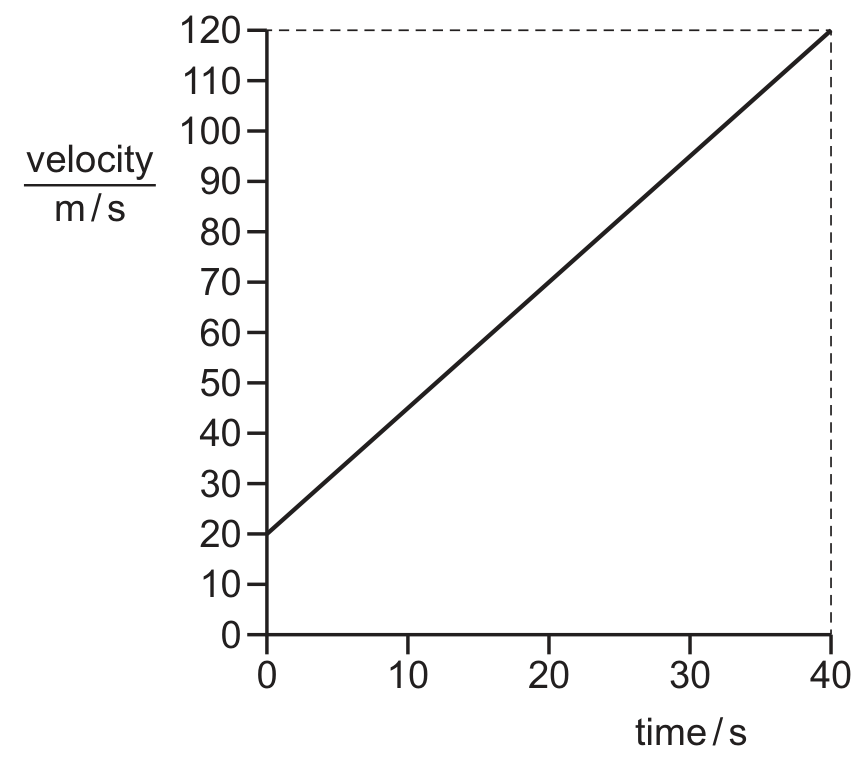
The diagram shows a velocity–time graph for an object which is accelerating.
What is the acceleration of the object?
0.40 m/s²
2.5 m/s²
3.0 m/s²
100 m/s²
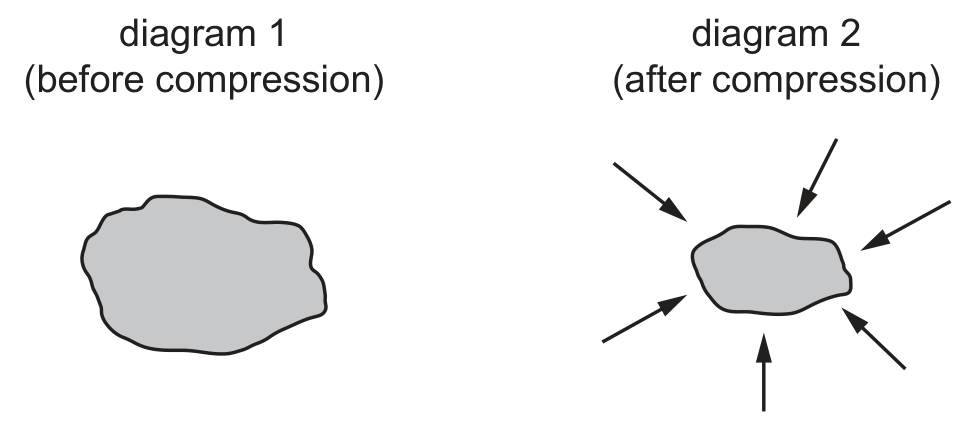
Diagram 1 shows a piece of flexible material that contains many pockets of air. Diagram 2 shows the same piece of flexible material after it has been compressed so that its volume decreases.
What happens to the mass and to the weight of the flexible material when it is compressed?
mass: increases; weight: increases
mass: increases; weight: no change
mass: no change; weight: increases
mass: no change; weight: no change
A student determines the density of copper.
balance ✓, ruler ✓, stop-watch ✓, thermometer ✓
balance ✓, ruler ✓, stop-watch ✓, thermometer ✗
balance ✓, ruler ✓, stop-watch ✗, thermometer ✗
balance ✓, ruler ✗, stop-watch ✗, thermometer ✗
A 0.15 kg mass is suspended from a vertical spring.
14 m/s²
24 m/s²
28 m/s²
34 m/s²
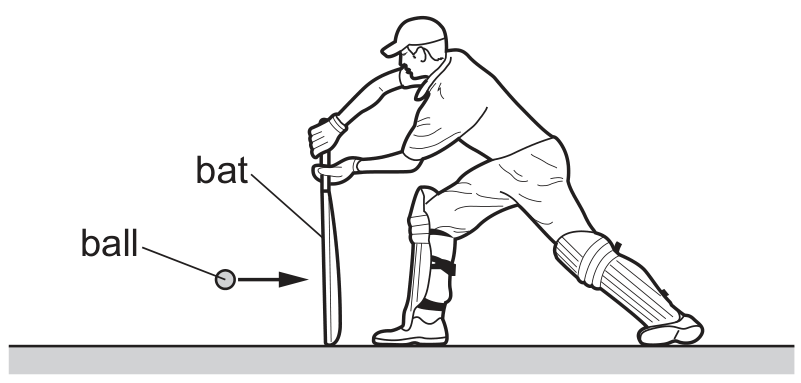
A cricket ball of mass 0.15 kg is moving at a speed of 30 m/s.
The diagram shows a batsman holding a bat stationary as the ball hits the bat and bounces back at the same speed in the opposite direction.
The ball is in contact with the bat for $1.0 \times 10^{-3}$ s.
The table shows the change in momentum of the ball and the magnitude of the force applied to the ball.
Which row is correct?
change of momentum: 4.5 kg m/s; force applied to ball: 4500 N
change of momentum: 4.5 kg m/s; force applied to ball: 9000 N
change of momentum: 9.0 kg m/s; force applied to ball: 4500 N
change of momentum: 9.0 kg m/s; force applied to ball: 9000 N
A stone is thrown vertically upwards at a speed of 5.0 m/s.
$h = \dfrac{9.8}{2 \times 5.0^2}$
$h = \dfrac{5.0^2 \times 2}{9.8}$
$h = \dfrac{5.0^2}{2 \times 9.8}$
$h = \dfrac{2 \times 9.8}{5.0^2}$
Three energy resources are listed.
1, 2 and 3
1 and 2 only
1 only
2 only
A sample of a substance has a shape that is determined by its container.
gas, liquid and solid
gas and liquid only
gas and solid only
solid and liquid only
A stationary smoke particle is hit by a fast-moving nitrogen molecule.
smoke particle: moves; nitrogen molecule: rebounds
smoke particle: moves; nitrogen molecule: stops
smoke particle: remains stationary; nitrogen molecule: rebounds
smoke particle: remains stationary; nitrogen molecule: stops
A bubble of gas rises from the bottom of a lake to the top.
pressure 360 kPa; volume 2.4 cm³
pressure 270 kPa; volume 3.2 cm³
pressure 160 kPa; volume 4.6 cm³
pressure 120 kPa; volume 7.2 cm³
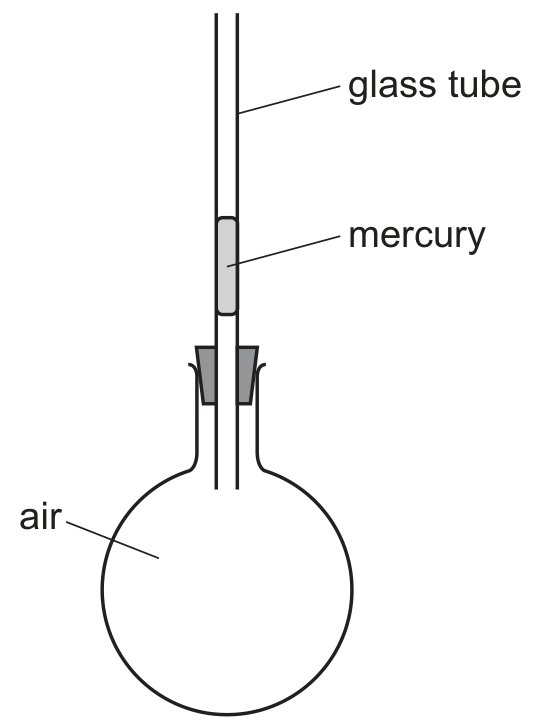
The diagram shows a glass flask sealed with a small volume of mercury in a glass tube. When the flask is gently warmed, the mercury rises up the tube.
What is the main cause of the movement of the mercury?
expansion of air in the flask
expansion of the glass flask
expansion of the glass tube
expansion of the mercury
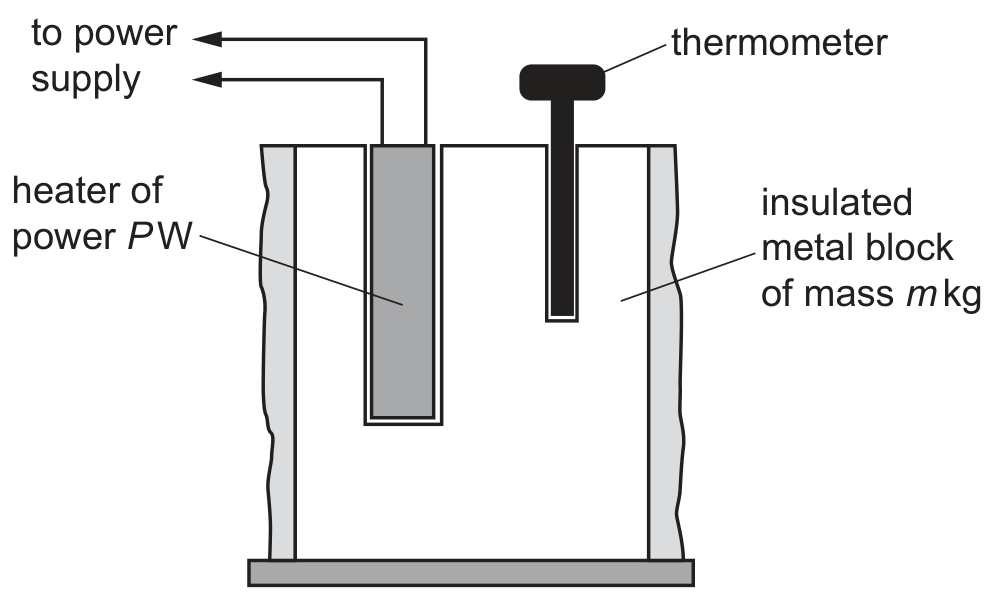
The diagram shows the equipment used in an experiment to determine the specific heat capacity of a metal.
In the experiment, a heater is switched on for $t$ s and the increase in temperature $\Delta\theta$ of a block of the metal is measured in °C.
Which equation gives the specific heat capacity of the metal?
$c = \dfrac{P}{t m \Delta\theta}$
$c = \dfrac{Pt}{m \Delta\theta}$
$c = \dfrac{t m \Delta\theta}{P}$
$c = \dfrac{m \Delta\theta}{Pt}$
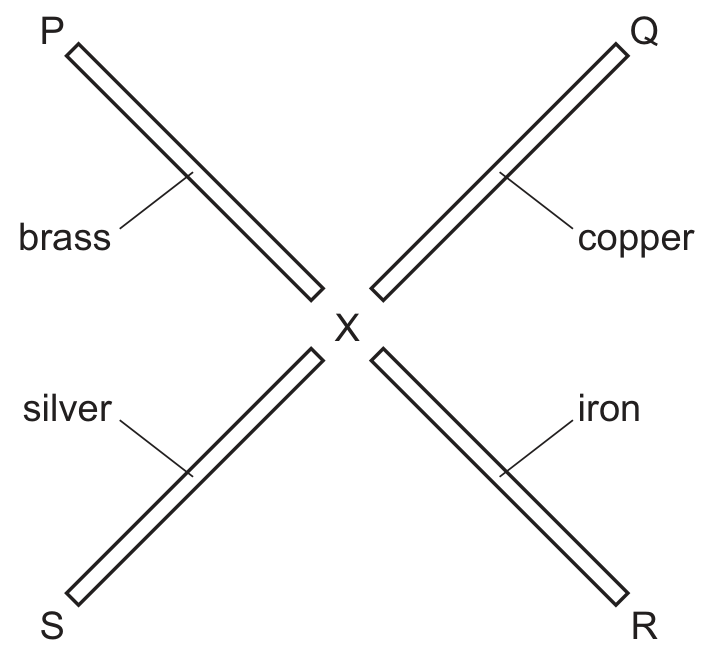
The diagram shows four rods. Each rod is made of a different metal.
Wax is used to attach small metal balls at the rod ends P, Q, R and S.
Each rod is the same size. They are heated uniformly by a Bunsen burner at point X.
As the rods warm up, the wax melts and the balls fall off.
Why does the ball on the silver rod fall first?
Silver is the best conductor of heat.
Silver is the worst conductor of heat.
Silver is the best radiator of heat.
Silver is the worst radiator of heat.
Three solid copper spheres, X, Y and Z, are heated to the same temperature.
highest: X; second highest: Y; lowest: Z
highest: X; second highest: Z; lowest: Y
highest: Z; second highest: X; lowest: Y
highest: Z; second highest: Y; lowest: X
Which wave will diffract the most when passing through a gap that is 0.85 m wide?
wave speed 300 m/s; wave frequency 280 Hz
wave speed 300 m/s; wave frequency 400 Hz
wave speed 350 m/s; wave frequency 280 Hz
wave speed 350 m/s; wave frequency 400 Hz
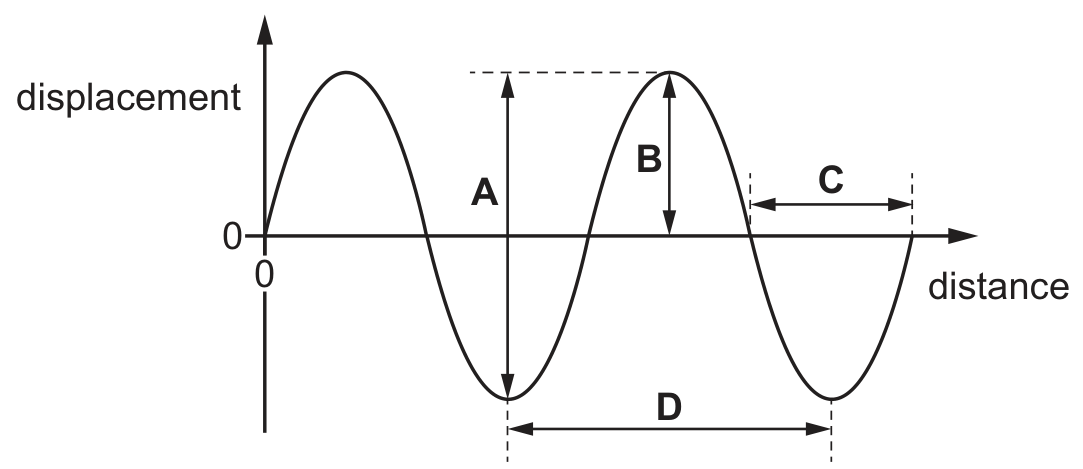
Which arrow on the graph shows the amplitude of the wave?
Arrow A
Arrow B
Arrow C
Arrow D
Which row describes a seismic S-wave?
type of wave: longitudinal; direction of vibration: parallel to the direction of travel of the wavefront
type of wave: longitudinal; direction of vibration: perpendicular to the direction of travel of the wavefront
type of wave: transverse; direction of vibration: parallel to the direction of travel of the wavefront
type of wave: transverse; direction of vibration: perpendicular to the direction of travel of the wavefront
The image of an object is formed by a plane mirror.
real; closer to the mirror than the object
real; the same distance from the mirror as the object
virtual; closer to the mirror than the object
virtual; the same distance from the mirror as the object
Next →