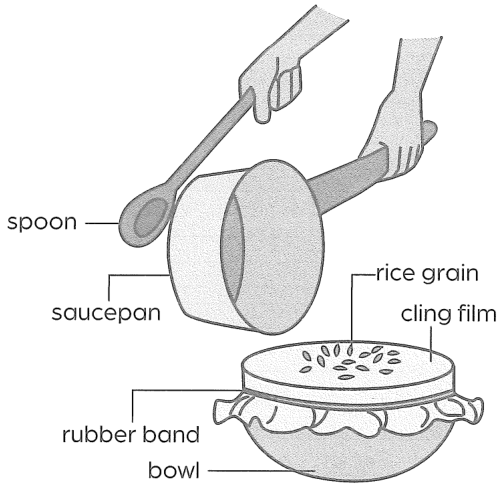
Work in groups. Tightly stretch cling film over a small bowl and secure it with a rubber band to make a flat surface like a drum skin. Sprinkle small grains of rice on the film. Hold a saucepan close to, but not touching, the film. Hit it with a wooden spoon or sturdy stick to produce a loud sound.
Work in groups. Tightly stretch cling film over a small bowl and secure it with a rubber band to make a flat surface like a drum skin. Sprinkle small grains of rice on the film. Hold a saucepan close to, but not touching, the film. Hit it with a wooden spoon or sturdy stick to produce a loud sound.
What do the movements of the rice grains tell us about sound waves?
Work in groups. Tightly stretch cling film over a small bowl and secure it with a rubber band to make a flat surface like a drum skin. Sprinkle small grains of rice on the film. Hold a saucepan close to, but not touching, the film. Hit it with a wooden spoon or sturdy stick to produce a loud sound.
In your groups, discuss whether this experiment provides a good model of sound waves. Explain your answer.
Work in groups. Tightly stretch cling film over a small bowl and secure it with a rubber band to make a flat surface like a drum skin. Sprinkle small grains of rice on the film. Hold a saucepan close to, but not touching, the film. Hit it with a wooden spoon or sturdy stick to produce a loud sound.
What do you think will happen if you hit the saucepan at different intensities? Predict how the rice grains will react.
Work in groups. Tightly stretch cling film over a small bowl and secure it with a rubber band to make a flat surface like a drum skin. Sprinkle small grains of rice on the film. Hold a saucepan close to, but not touching, the film. Hit it with a wooden spoon or sturdy stick to produce a loud sound.
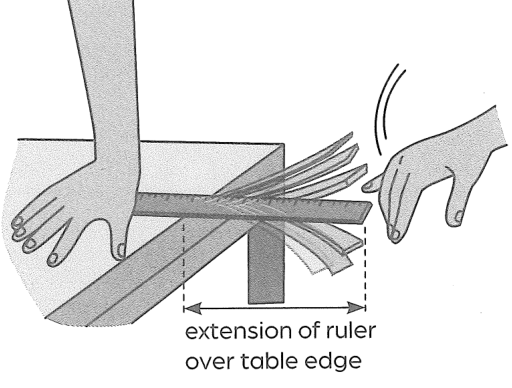
Use a 30 cm plastic ruler and a table. Place the ruler perpendicular to the table edge, with 15 cm extending over it. Hold the ruler firmly flat on the table and flick the free end. Listen to its pitch as the reference (control) test. Repeat with extensions of 5 cm, 10 cm, 20 cm and 25 cm, comparing each pitch with the 15 cm reference.
Compare it with the pitch of the sound produced at 15 cm in step 4. Write down whether the pitch of each new sound is higher, lower or the same.
Use a 30 cm plastic ruler and a table. Place the ruler perpendicular to the table edge, with 15 cm extending over it. Hold the ruler firmly flat on the table and flick the free end. Listen to its pitch as the reference (control) test. Repeat with extensions of 5 cm, 10 cm, 20 cm and 25 cm, comparing each pitch with the 15 cm reference.
Why did the ruler produce a sound when it was flicked?
Use a 30 cm plastic ruler and a table. Place the ruler perpendicular to the table edge, with 15 cm extending over it. Hold the ruler firmly flat on the table and flick the free end. Listen to its pitch as the reference (control) test. Repeat with extensions of 5 cm, 10 cm, 20 cm and 25 cm, comparing each pitch with the 15 cm reference.
What do you notice about the pitch of the sound as the length of the ruler extending over the edge increased? Explain your observation.
Use a 30 cm plastic ruler and a table. Place the ruler perpendicular to the table edge, with 15 cm extending over it. Hold the ruler firmly flat on the table and flick the free end. Listen to its pitch as the reference (control) test. Repeat with extensions of 5 cm, 10 cm, 20 cm and 25 cm, comparing each pitch with the 15 cm reference.
Draw a conclusion on how the length of a vibrating object affects the pitch of the sound it produces. What are the limitations in your conclusion?
Use a 30 cm plastic ruler and a table. Place the ruler perpendicular to the table edge, with 15 cm extending over it. Hold the ruler firmly flat on the table and flick the free end. Listen to its pitch as the reference (control) test. Repeat with extensions of 5 cm, 10 cm, 20 cm and 25 cm, comparing each pitch with the 15 cm reference.
Use a 30 cm plastic ruler and a table. Place the ruler perpendicular to the table edge, with 15 cm extending over it. Hold the ruler firmly flat on the table and flick the free end. Listen to its pitch as the reference (control) test. Repeat with extensions of 5 cm, 10 cm, 20 cm and 25 cm, comparing each pitch with the 15 cm reference.
Predict how a thicker ruler will affect the pitch of the sound it produces.
In the classroom investigation, stand at the front of the room and stay in the same listening position. Your teacher plays a pre-selected music track on a mobile phone or music player with a speaker, first in the centre of the room at a middle volume, then in a corner using the same track and volume setting. Listen to sound quality, clarity and volume.
Discuss how the sound you heard changed between the two locations. Think about the effects of sound waves, reflections and interference.
In the classroom investigation, stand at the front of the room and stay in the same listening position. Your teacher plays a pre-selected music track on a mobile phone or music player with a speaker, first in the centre of the room at a middle volume, then in a corner using the same track and volume setting. Listen to sound quality, clarity and volume.
Centre of the room. Describe the sound quality when the music track was played in the centre of the room.
In the classroom investigation, stand at the front of the room and stay in the same listening position. Your teacher plays a pre-selected music track on a mobile phone or music player with a speaker, first in the centre of the room at a middle volume, then in a corner using the same track and volume setting. Listen to sound quality, clarity and volume.
In the classroom investigation, stand at the front of the room and stay in the same listening position. Your teacher plays a pre-selected music track on a mobile phone or music player with a speaker, first in the centre of the room at a middle volume, then in a corner using the same track and volume setting. Listen to sound quality, clarity and volume.
Centre of the room. Did you notice any echoes or distortions?
In the classroom investigation, stand at the front of the room and stay in the same listening position. Your teacher plays a pre-selected music track on a mobile phone or music player with a speaker, first in the centre of the room at a middle volume, then in a corner using the same track and volume setting. Listen to sound quality, clarity and volume.
Corner of the room (compare with the centre). Describe how the sound quality changed when the music track was played in the corner.
In the classroom investigation, stand at the front of the room and stay in the same listening position. Your teacher plays a pre-selected music track on a mobile phone or music player with a speaker, first in the centre of the room at a middle volume, then in a corner using the same track and volume setting. Listen to sound quality, clarity and volume.
Corner of the room (compare with the centre). Was the music louder or softer? Explain your answer.
In the classroom investigation, stand at the front of the room and stay in the same listening position. Your teacher plays a pre-selected music track on a mobile phone or music player with a speaker, first in the centre of the room at a middle volume, then in a corner using the same track and volume setting. Listen to sound quality, clarity and volume.
Corner of the room (compare with the centre). Did you notice more or less clarity?