Work in small groups to investigate the density of modelling clay. Aim: to investigate whether the density of modelling clay changes as its mass changes. Materials: a pack of modelling clay.
Work in small groups to investigate the density of modelling clay. Aim: to investigate whether the density of modelling clay changes as its mass changes. Materials: a pack of modelling clay.
Decide on how you will do the investigation. List other materials needed based on your method.
Work in small groups to investigate the density of modelling clay. Aim: to investigate whether the density of modelling clay changes as its mass changes. Materials: a pack of modelling clay.
Plan the investigation. Write step-by-step instructions.
Work in small groups to investigate the density of modelling clay. Aim: to investigate whether the density of modelling clay changes as its mass changes. Materials: a pack of modelling clay.
Work in small groups to investigate the density of modelling clay. Aim: to investigate whether the density of modelling clay changes as its mass changes. Materials: a pack of modelling clay.
Plot a suitable graph using the data you have recorded.
Work in small groups to investigate the density of modelling clay. Aim: to investigate whether the density of modelling clay changes as its mass changes. Materials: a pack of modelling clay.
Select two points on your graph representing different mass values. Use these points to predict the volumes of two corresponding modelling clay samples. Then, experimentally measure the volumes of these samples and compare the predicted and measured values. Record your results in the table below.
| Sample | Mass in g | Predicted volume from graph, V₃ in cm³ | Volume from measurement, V₄ in cm³ |
|---|---|---|---|
| 1 | | | |
| 2 | | | |
Work in small groups to investigate the density of modelling clay. Aim: to investigate whether the density of modelling clay changes as its mass changes. Materials: a pack of modelling clay.
Analyse your graph. Does it provide evidence to support your hypothesis? Explain.
Work in small groups to investigate the density of modelling clay. Aim: to investigate whether the density of modelling clay changes as its mass changes. Materials: a pack of modelling clay.
In step 6, two sample volumes were predicted from the mass–volume graph and then measured experimentally for comparison. Explain the purpose of step 6 in the procedure.
Work in small groups to investigate the density of modelling clay. Aim: to investigate whether the density of modelling clay changes as its mass changes. Materials: a pack of modelling clay.
Work in small groups to investigate the density of modelling clay. Aim: to investigate whether the density of modelling clay changes as its mass changes. Materials: a pack of modelling clay.
After determining the density of samples of the same modelling clay with different masses, what does this tell you about the density of a material?
Work in small groups to investigate the density of modelling clay. Aim: to investigate whether the density of modelling clay changes as its mass changes. Materials: a pack of modelling clay.
How would you increase the reliability and accuracy of the experimental results?
A lava lamp uses the difference in density between paraffin wax and a surrounding liquid. When heated, the wax becomes less dense and rises. As it cools, it becomes denser and sinks. This cycle causes the wax globules to continuously move up and down inside the lamp.
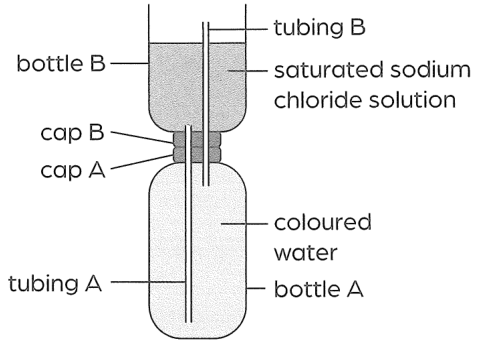
Tammy constructed a halite fountain as shown in the diagram below. There are two fluids in the fountain — coloured water and a solution containing the halite, sodium chloride.
What would you expect to happen when Tammy slowly filled bottle B with the saturated sodium chloride solution?
A lava lamp uses the difference in density between paraffin wax and a surrounding liquid. When heated, the wax becomes less dense and rises. As it cools, it becomes denser and sinks. This cycle causes the wax globules to continuously move up and down inside the lamp.
Tammy constructed a halite fountain as shown in the diagram below. There are two fluids in the fountain — coloured water and a solution containing the halite, sodium chloride.
What could be the reason Tammy used a saturated sodium chloride solution to fill bottle B?
A lava lamp uses the difference in density between paraffin wax and a surrounding liquid. When heated, the wax becomes less dense and rises. As it cools, it becomes denser and sinks. This cycle causes the wax globules to continuously move up and down inside the lamp.
Tammy constructed a halite fountain as shown in the diagram below. There are two fluids in the fountain — coloured water and a solution containing the halite, sodium chloride.
How did the density of the sodium chloride solution compare to that of the coloured water? Why was this important for the fountain to work?
A lava lamp uses the difference in density between paraffin wax and a surrounding liquid. When heated, the wax becomes less dense and rises. As it cools, it becomes denser and sinks. This cycle causes the wax globules to continuously move up and down inside the lamp.
Tammy constructed a halite fountain as shown in the diagram below. There are two fluids in the fountain — coloured water and a solution containing the halite, sodium chloride.
Why was it important to slowly fill bottle B with the sodium chloride solution? What might have happened if Tammy were to fill it too quickly?
A lava lamp uses the difference in density between paraffin wax and a surrounding liquid. When heated, the wax becomes less dense and rises. As it cools, it becomes denser and sinks. This cycle causes the wax globules to continuously move up and down inside the lamp.
Tammy constructed a halite fountain as shown in the diagram below. There are two fluids in the fountain — coloured water and a solution containing the halite, sodium chloride.
You are asked to advise Tammy on how she can improve her halite fountain. Would you use first-hand experience, secondary resources or both to provide your recommendations? Why?
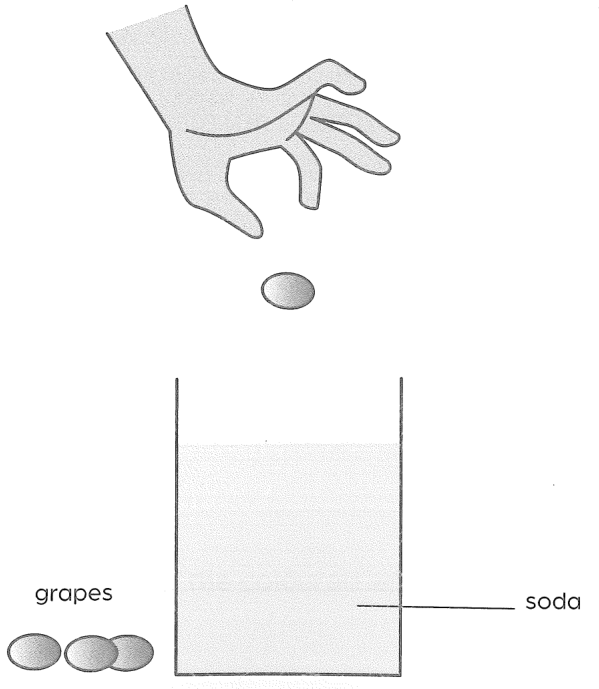
Materials: transparent glass container, four grapes, clear carbonated water (such as sparkling water or soda), stopwatch. Pour carbonated water or soda into the clear glass until it is about three-quarters full. Drop four grapes into the glass of carbonated liquid and start the stopwatch. Watch the grapes over three minutes.
Before you start, predict what will happen if you drop a few grapes into a glass of carbonated water or soda. Give your reason.
Materials: transparent glass container, four grapes, clear carbonated water (such as sparkling water or soda), stopwatch. Pour carbonated water or soda into the clear glass until it is about three-quarters full. Drop four grapes into the glass of carbonated liquid and start the stopwatch. Watch the grapes over three minutes.
Watch what happens to the grapes over three minutes. Record your observation known as the “dancing grapes” by describing what happens.
Materials: transparent glass container, four grapes, clear carbonated water (such as sparkling water or soda), stopwatch. Pour carbonated water or soda into the clear glass until it is about three-quarters full. Drop four grapes into the glass of carbonated liquid and start the stopwatch. Watch the grapes over three minutes.
Materials: transparent glass container, four grapes, clear carbonated water (such as sparkling water or soda), stopwatch. Pour carbonated water or soda into the clear glass until it is about three-quarters full. Drop four grapes into the glass of carbonated liquid and start the stopwatch. Watch the grapes over three minutes.