Magnetise a pin or needle by stroking a bar magnet along it in one direction, lifting the magnet before returning; repeat 50 times. Draw and cut out a wax-paper circle smaller than a bowl, mark N, E, S and W, and thread the needle through it in the N–S direction. Float the paper and needle on water. Work under adult supervision because the needle and scissors are sharp. What do the needle and paper do?
Magnetise a pin or needle by stroking a bar magnet along it in one direction, lifting the magnet before returning; repeat 50 times. Draw and cut out a wax-paper circle smaller than a bowl, mark N, E, S and W, and thread the needle through it in the N–S direction. Float the paper and needle on water. Work under adult supervision because the needle and scissors are sharp. Why did the needle move the way it did in question 6 (your observation of the floating needle and paper)?
Magnetise a pin or needle by stroking a bar magnet along it in one direction, lifting the magnet before returning; repeat 50 times. Draw and cut out a wax-paper circle smaller than a bowl, mark N, E, S and W, and thread the needle through it in the N–S direction. Float the paper and needle on water. Work under adult supervision because the needle and scissors are sharp. How does this prove that the Earth’s core acts like a giant magnet?
Make an electromagnet with insulated copper wire wrapped tightly around an iron nail, leaving a few centimetres free at each end and stripping the insulation from both ends. Connect the wire ends to the two terminals of a 9 V cell; an optional switch can turn the circuit on and off. Disconnect promptly after each test: the wire can get hot. Once the circuit is connected, your electromagnet should be ready to use. Test it by bringing it close to some small metal objects. What happens?
Make an electromagnet with insulated copper wire wrapped tightly around an iron nail, leaving a few centimetres free at each end and stripping the insulation from both ends. Connect the wire ends to the two terminals of a 9 V cell; an optional switch can turn the circuit on and off. Disconnect promptly after each test: the wire can get hot. How could you improve on the design of your electromagnet?
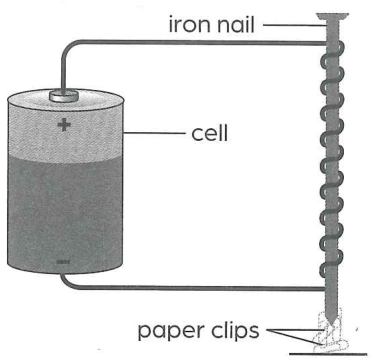
Aisha makes an electromagnet like the one shown in the diagram. She uses the electromagnet to pick up paper clips. Aisha predicts that if she adds more cells, the strength of the electromagnet will increase. She does an experiment to test her prediction. The table shows her results.
| Number of cells | Number of paper clips attracted |
|---|---|
| 1 | 5 |
| 2 | 7 |
| 3 | 9 |
| 4 | 10 |
| 5 | 11 |
How else could she increase the strength of the electromagnet?
Aisha makes an electromagnet like the one shown in the diagram. She uses the electromagnet to pick up paper clips. Aisha predicts that if she adds more cells, the strength of the electromagnet will increase. She does an experiment to test her prediction. The table shows her results.
| Number of cells | Number of paper clips attracted |
|---|---|
| 1 | 5 |
| 2 | 7 |
| 3 | 9 |
| 4 | 10 |
| 5 | 11 |
If Aisha used eight cells, how many paper clips would have been attracted? Explain your answer.