Investigate reflection using a torch, objects (e.g. a mirror, glossy magazine cover, metal spoon, aluminium foil, glossy white dinner plate, newspaper, wood, cardboard, T-shirt and mouse pad), and upright white paper or card behind each object on a flat desk. Shine the torch at an angle and try different angles. Predict which objects will reflect the most light and which will absorb the most light.
Investigate reflection using a torch, objects (e.g. a mirror, glossy magazine cover, metal spoon, aluminium foil, glossy white dinner plate, newspaper, wood, cardboard, T-shirt and mouse pad), and upright white paper or card behind each object on a flat desk. Shine the torch at an angle and try different angles. Look closely at the white paper behind the object. For each object, write down how well it reflects the light. State if the reflection is bright and clear, not very bright, or dim. Record a table: Object | Description of reflection.
Investigate reflection using a torch, objects (e.g. a mirror, glossy magazine cover, metal spoon, aluminium foil, glossy white dinner plate, newspaper, wood, cardboard, T-shirt and mouse pad), and upright white paper or card behind each object on a flat desk. Shine the torch at an angle and try different angles. Did the objects reflect light the way you expected? In pairs, discuss what you observed. Write your notes down.
Investigate reflection using a torch, objects (e.g. a mirror, glossy magazine cover, metal spoon, aluminium foil, glossy white dinner plate, newspaper, wood, cardboard, T-shirt and mouse pad), and upright white paper or card behind each object on a flat desk. Shine the torch at an angle and try different angles. Use the prompts below to write a report about the experiment.
**Investigating Reflective Surfaces**
- The materials that gave the best reflections were ...
- Examples of the objects that I used were ...
- When I shone the light at different angles, I noticed that the angle at which light hits a surface ...
- When I do the experiment again, I will try to improve it by ...
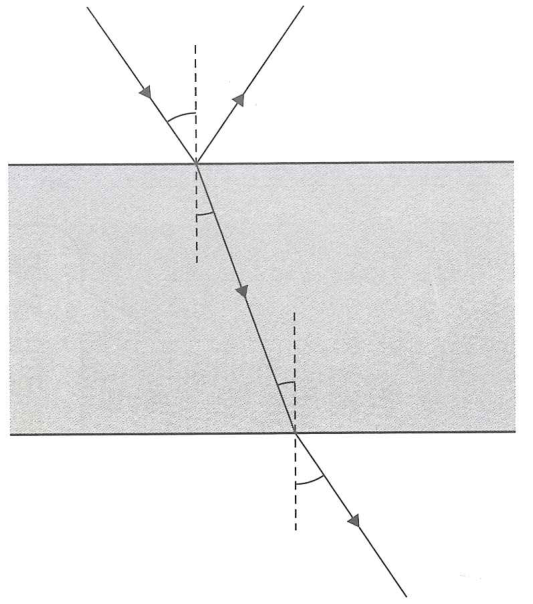
When a light ray travels from glass into air, its speed (decreases / increases) because the optical density of air is (lower / higher) than the optical density of glass. This change in speed causes the light to change (brightness / direction).
Refraction and our eyes: The cornea and lens bend light to focus an image on the retina, which sends signals to the brain. If the eyeball is too short, light may focus behind the retina (hyperopia, or farsightedness); if too long, it may focus in front of the retina (myopia, or near-sightedness), causing blurred vision. Spectacle lenses can converge or diverge incoming rays.
Use a darkened room, a torch, white paper, red, green and blue cellophane, elastic bands and objects of various colours (e.g. a red apple, a green leaf, a blue book and a black shoe).
Work in groups. Before you start, predict the observed colour of each object under white, red, blue and green light.
Use a darkened room, a torch, white paper, red, green and blue cellophane, elastic bands and objects of various colours (e.g. a red apple, a green leaf, a blue book and a black shoe).
Darken the room by switching off the lights and, if possible, covering the windows. Place the paper on a table or other suitable surface. Shine a standard torch (white light) onto the sheet of white paper and observe its colour. Record your observation in the table. Change the colour of the light by folding a piece of cellophane over the torch. Keep the cellophane in position with an elastic band. Shine the coloured light onto the white paper. Observe the colour of the paper. Record your observation in the table. Repeat the prediction, illumination and observation process for each object under white, red, blue and green light. Do this at least twice to make sure that your results are accurate. Record your observations in the table below.
| Object | Colour under white light | Colour under red light | Colour under blue light | Colour under green light |
|---|---|---|---|---|
| White paper | | | | |
| Other objects tested | | | | |
Use the information in your observation table and the words in the box to draw conclusions about the effect of light on objects with different colours. You may use words from the box more than once.
**blue; black; green; white; green; red; all wavelengths; reflect; absorb; red or green; red or blue**
A red apple appears red under ______ or ______ light because it reflects red light. Under blue and green lights, it appears very dark or black because it cannot ______ these colours.
Use the information in your observation table and the words in the box to draw conclusions about the effect of light on objects with different colours. You may use words from the box more than once.
**blue; black; green; white; green; red; all wavelengths; reflect; absorb; red or green; red or blue**
A leaf appears ______ under ______ or ______ light because it reflects green light. Under ______ light, it appears dark or black because green leaves ______ these colours.
Use the information in your observation table and the words in the box to draw conclusions about the effect of light on objects with different colours. You may use words from the box more than once.
**blue; black; green; white; green; red; all wavelengths; reflect; absorb; red or green; red or blue**
A blue book appears ______ under white or blue light as it reflects ______ light. It looks very dark or black under ______ light because those colours are absorbed.
Use the information in your observation table and the words in the box to draw conclusions about the effect of light on objects with different colours. You may use words from the box more than once.
**blue; black; green; white; green; red; all wavelengths; reflect; absorb; red or green; red or blue**
A black shoe appears ______ under all colours of light because it absorbs ______ and does not reflect any light back to our eyes.