Draw lines to match each phrase with its description.
Descriptions: an older way of measuring time; used to measure the speed of cars; total distance travelled divided by the total time taken to travel; total length of the path or route travelled; formula to calculate average speed.
Phrases or terms: average speed = total distance / total time; distance; radar; stopwatch; average speed.
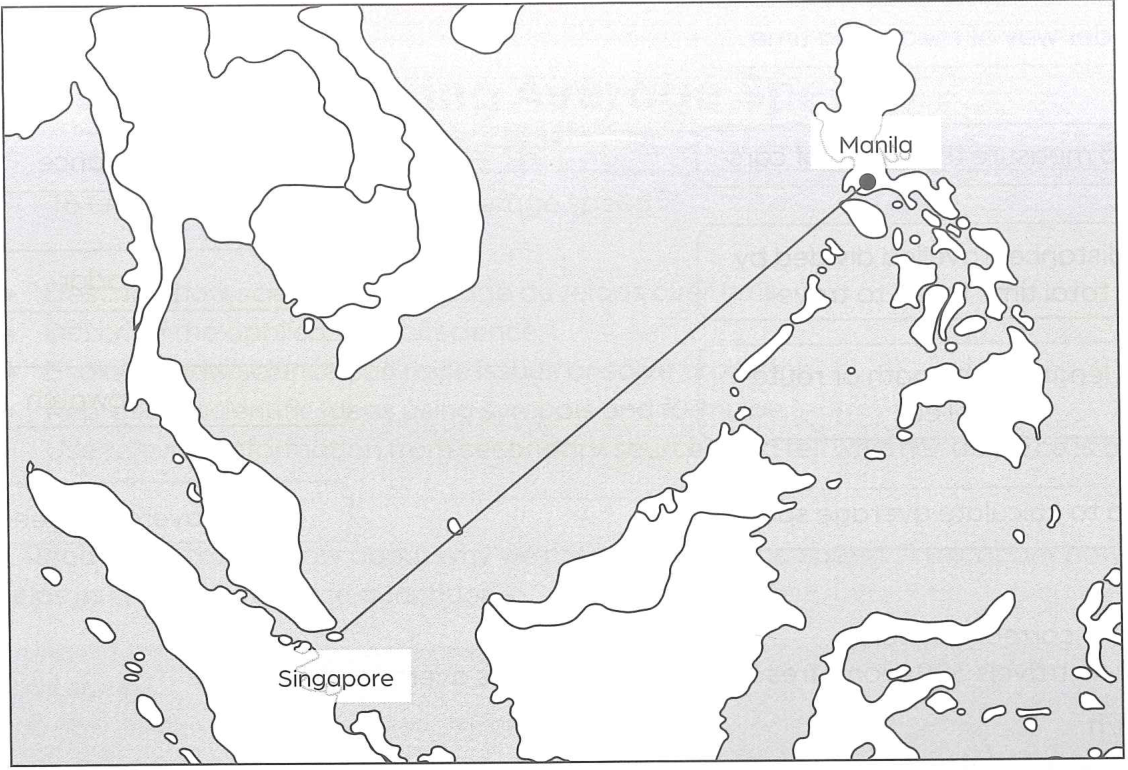
May lives in Singapore. She is travelling to the Philippines to visit her uncle and aunt. She knows that it will be a long journey and that she must plan ahead. She made the following summary.
- Leave home and walk to the nearest bus stop: 1 km in 15 minutes.
- Take the bus to Singapore Changi Airport: 20 km in 45 minutes.
- Fly from Singapore to Manila, Philippines: 2400 km in 3.5 hours.
- Take a taxi from Manila Airport to her uncle and aunt’s house: 30 km in 1 hour.
Do you think May needs to check the times and distances again after she has made her summary? Explain your answer.
May lives in Singapore. She is travelling to the Philippines to visit her uncle and aunt. She knows that it will be a long journey and that she must plan ahead. She made the following summary.
- Leave home and walk to the nearest bus stop: 1 km in 15 minutes.
- Take the bus to Singapore Changi Airport: 20 km in 45 minutes.
- Fly from Singapore to Manila, Philippines: 2400 km in 3.5 hours.
- Take a taxi from Manila Airport to her uncle and aunt’s house: 30 km in 1 hour.
How do you think May got all the information she needs to plan her journey?
May lives in Singapore. She is travelling to the Philippines to visit her uncle and aunt. She knows that it will be a long journey and that she must plan ahead. She made the following summary.
- Leave home and walk to the nearest bus stop: 1 km in 15 minutes.
- Take the bus to Singapore Changi Airport: 20 km in 45 minutes.
- Fly from Singapore to Manila, Philippines: 2400 km in 3.5 hours.
- Take a taxi from Manila Airport to her uncle and aunt’s house: 30 km in 1 hour.
Fill in the missing details to calculate May’s average speed in km/h when she walks to the bus stop.
May lives in Singapore. She is travelling to the Philippines to visit her uncle and aunt. She knows that it will be a long journey and that she must plan ahead. She made the following summary.
- Leave home and walk to the nearest bus stop: 1 km in 15 minutes.
- Take the bus to Singapore Changi Airport: 20 km in 45 minutes.
- Fly from Singapore to Manila, Philippines: 2400 km in 3.5 hours.
- Take a taxi from Manila Airport to her uncle and aunt’s house: 30 km in 1 hour.
Calculate the average speed in km/h of May’s flight to the Philippines.
May lives in Singapore. She is travelling to the Philippines to visit her uncle and aunt. She knows that it will be a long journey and that she must plan ahead. She made the following summary.
- Leave home and walk to the nearest bus stop: 1 km in 15 minutes.
- Take the bus to Singapore Changi Airport: 20 km in 45 minutes.
- Fly from Singapore to Manila, Philippines: 2400 km in 3.5 hours.
- Take a taxi from Manila Airport to her uncle and aunt’s house: 30 km in 1 hour.
Calculate May’s average speed as she travels from her home in Singapore to her uncle and aunt’s house in the Philippines. Use the steps below. First, use May’s travel summary to find the total distance May travelled. Include every part of her trip: walk, bus ride, flight and taxi ride. Next, calculate the total time May spent travelling. Finally, use the formula to find her average speed. Convert all times to hours; round all distances to the nearest kilometre.
Total distance: ___
Time walking: 15 minutes = 0.25 hours
Time on bus: 45 minutes = 0.75 hours
Flight time: 3.5 hours
Time in taxi: 1 hour
Irfan enjoys horse riding. Early one morning, he rode a horse through the woods. The horse trots for 18 minutes and covers a distance of 4 km. It then speeds up to a canter and covers 7 km in 10 minutes. Irfan takes a 20-minute break to rest and enjoy the scenery. Finally, he sets off again and the horse gallops back home, covering 6 km in 6 minutes.
Irfan enjoys horse riding. Early one morning, he rode a horse through the woods. The horse trots for 18 minutes and covers a distance of 4 km. It then speeds up to a canter and covers 7 km in 10 minutes. Irfan takes a 20-minute break to rest and enjoy the scenery. Finally, he sets off again and the horse gallops back home, covering 6 km in 6 minutes.
What is the speed during each phase of the ride? Fill in the missing parts of the calculations.
Irfan enjoys horse riding. Early one morning, he rode a horse through the woods. The horse trots for 18 minutes and covers a distance of 4 km. It then speeds up to a canter and covers 7 km in 10 minutes. Irfan takes a 20-minute break to rest and enjoy the scenery. Finally, he sets off again and the horse gallops back home, covering 6 km in 6 minutes.
Work out the total distance Irfan and his horse covered at each phase of their ride. Use the information in the text to complete the table below.
| Total time taken in minutes | Total distance travelled in km |
|---|---|
|0|___|
|18|___|
|28|___|
|48|___|
|54|___|
Irfan enjoys horse riding. Early one morning, he rode a horse through the woods. The horse trots for 18 minutes and covers a distance of 4 km. It then speeds up to a canter and covers 7 km in 10 minutes. Irfan takes a 20-minute break to rest and enjoy the scenery. Finally, he sets off again and the horse gallops back home, covering 6 km in 6 minutes.
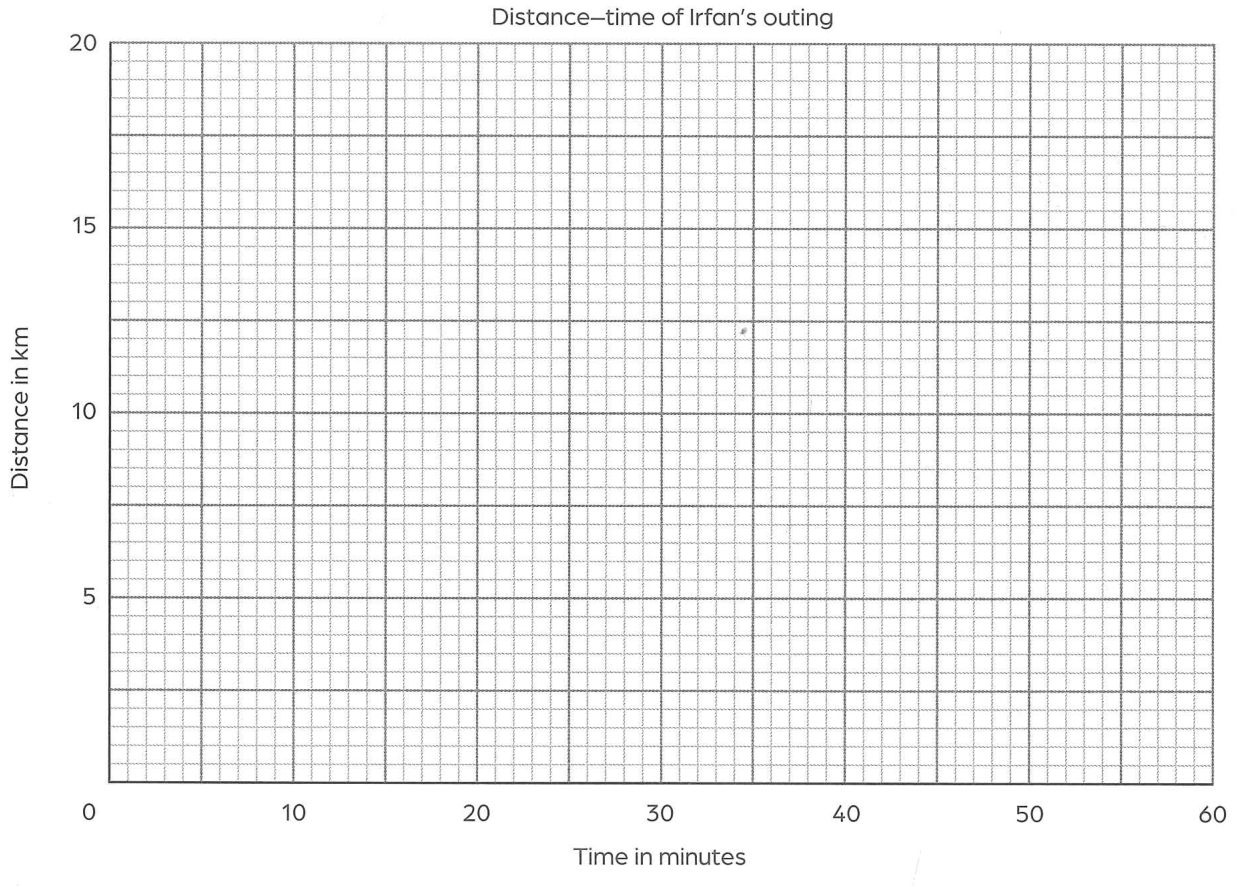
Use the data in the table to plot a distance–time graph of Irfan’s outing.
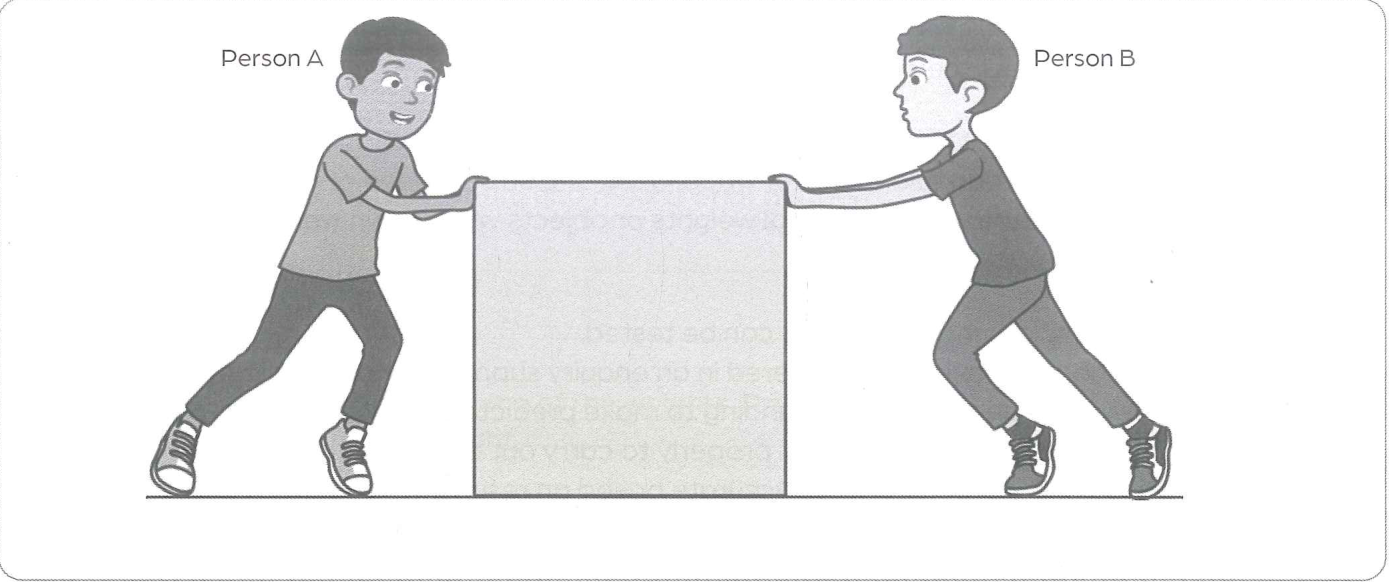
Look at the picture of person A on the left and person B on the right pushing a crate. Underline the correct word: When the crate is not moving, the magnitude of the force each person applies is equal / different.
Look at the picture of person A on the left and person B on the right pushing a crate. Underline the correct value: If the forces are balanced, the resultant (net) force acting on the crate is 10 N / 0 N.
Look at the picture of person A on the left and person B on the right pushing a crate. Person A pushes with a force of 50 N and person B pushes with a force of 40 N. What happens to the crate?
Look at the picture of person A on the left and person B on the right pushing a crate. Person A pushes with a force of 50 N and person B pushes with a force of 40 N. Draw arrows representing the forces on the picture. Label the magnitudes of the forces.
Look at the picture of person A on the left and person B on the right pushing a crate. Person A pushes with a force of 50 N and person B pushes with a force of 40 N. Draw an arrow representing the resultant force on the picture. Label the magnitude of the force.