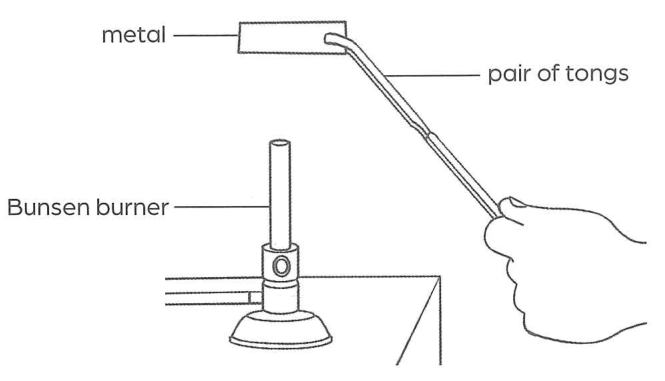
A group of learners placed copper, magnesium, silver and zinc in a Bunsen flame to see how they reacted with oxygen. Their notes were:
- Copper: Nothing really happened; there was a slight colour change after the metal was held in the flame for a long time.
- Magnesium: The metal burnt with a brilliant white light (too bright to look at). It produced white smoke that consisted of white particles.
- Silver: The metal was placed in the flame and we waited for a few minutes for something to happen, but it never did.
- Zinc: After a short while, we saw a light blue flame. After we removed the metal from the flame, we saw a white powder on the metal.
Present the group’s notes in step 2 in the table below. Write them in a more scientific way. Use the words in the box to complete the ‘Reactivity’ column. In the ‘Other observations’ column, write any comments that relate to colour changes and/or products formed.
Reacts readily; Does not react; Reacts vigorously; Reacts very slowly.
A group of learners placed copper, magnesium, silver and zinc in a Bunsen flame to see how they reacted with oxygen. Their notes were:
- Copper: Nothing really happened; there was a slight colour change after the metal was held in the flame for a long time.
- Magnesium: The metal burnt with a brilliant white light (too bright to look at). It produced white smoke that consisted of white particles.
- Silver: The metal was placed in the flame and we waited for a few minutes for something to happen, but it never did.
- Zinc: After a short while, we saw a light blue flame. After we removed the metal from the flame, we saw a white powder on the metal.
The information shows that one metal did not react with oxygen. Which metal is this?
A group of learners placed copper, magnesium, silver and zinc in a Bunsen flame to see how they reacted with oxygen. Their notes were:
- Copper: Nothing really happened; there was a slight colour change after the metal was held in the flame for a long time.
- Magnesium: The metal burnt with a brilliant white light (too bright to look at). It produced white smoke that consisted of white particles.
- Silver: The metal was placed in the flame and we waited for a few minutes for something to happen, but it never did.
- Zinc: After a short while, we saw a light blue flame. After we removed the metal from the flame, we saw a white powder on the metal.
When metals react with oxygen, they form a metal oxide. Write word equations that describe the reactions of the other three metals.
A group of learners placed copper, magnesium, silver and zinc in a Bunsen flame to see how they reacted with oxygen. Their notes were:
- Copper: Nothing really happened; there was a slight colour change after the metal was held in the flame for a long time.
- Magnesium: The metal burnt with a brilliant white light (too bright to look at). It produced white smoke that consisted of white particles.
- Silver: The metal was placed in the flame and we waited for a few minutes for something to happen, but it never did.
- Zinc: After a short while, we saw a light blue flame. After we removed the metal from the flame, we saw a white powder on the metal.
Based on the supplied observations, arrange the four metals from the least reactive to the most reactive.
Follow the instructions and record your observations in the table below. Work in pairs. Put on your safety goggles and gloves.
| Procedure | Observation(s) |
|---|---|
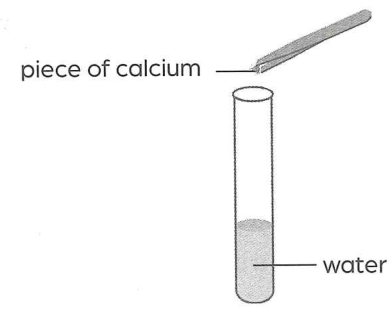
| 2. Fill a test tube with water until it is one-third full. Use the pair of tongs to place the piece of calcium in the water. | |
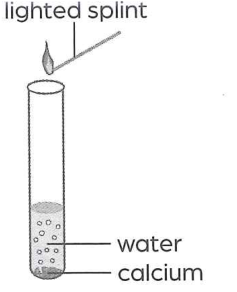
| 3. Light the wooden splint and place it near the mouth of the test tube. | |
| 4. Leave the test tube to stand for five minutes. | |
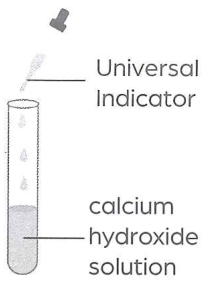
| 5. Add a few drops of Universal Indicator to the test tube. | |
Carry out the experiment only with your teacher’s supervision.
Repeat steps 2 and 4 with magnesium and copper. Record your observations below. Clean the piece of magnesium with the emery paper before putting it in the water.
For each metal, fill a test tube one-third full with cold water, add the metal using tongs and leave it for five minutes. Wear safety goggles and gloves.
| Observation on magnesium | Observation on copper |
|---|---|
| | |
In this investigation, calcium is placed in cold water using tongs. A lighted splint is held near the mouth of the test tube, the mixture is left for five minutes, and a few drops of Universal Indicator are added. Wear safety goggles and gloves; perform the gas test only under the teacher’s supervision.
Based on your observations, did the reaction between calcium and water produce one or two products? Give a reason for your answer.
Calcium, cleaned magnesium and copper were placed separately in cold water and observed for five minutes. What can you conclude about the reactivities of calcium, magnesium and copper, given your observations?
In this investigation, calcium is placed in cold water using tongs. A lighted splint is held near the mouth of the test tube, the mixture is left for five minutes, and a few drops of Universal Indicator are added. Wear safety goggles and gloves; perform the gas test only under the teacher’s supervision.
In this investigation, you did the lighted splint test in step 3. Which gas does this test identify? Circle the correct answer.
In this investigation, calcium is placed in cold water using tongs. A lighted splint is held near the mouth of the test tube, the mixture is left for five minutes, and a few drops of Universal Indicator are added. Wear safety goggles and gloves; perform the gas test only under the teacher’s supervision.
Some metals react with water to produce a metal hydroxide and the gas identified in question 9. Use this information to complete the word equation.
In this investigation, calcium is placed in cold water using tongs. A lighted splint is held near the mouth of the test tube, the mixture is left for five minutes, and a few drops of Universal Indicator are added. Wear safety goggles and gloves; perform the gas test only under the teacher’s supervision.
What does the Universal Indicator tell you about the nature of the metal hydroxide produced in this reaction? Tick (✓) the correct answer.
Your teacher demonstrates the reactions of calcium, copper, magnesium and zinc strips with dilute hydrochloric acid. What safety precautions should your teacher take in this experiment?
Your teacher demonstrates the reactions of calcium, copper, magnesium and zinc strips with dilute hydrochloric acid. Use your information and observations from other activities to predict the order of reactivity of the metals with the acid, from the most reactive to the least reactive.
Your teacher demonstrates the reactions of calcium, copper, magnesium and zinc strips with dilute hydrochloric acid. Use your information and observations from other activities to predict their reactivity order. Explain why you made this prediction.
Your teacher demonstrates the reactions of calcium, copper, magnesium and zinc strips with dilute hydrochloric acid. The acid is added into each test tube up to a depth of 4 cm. The metal strips are then dropped into their respective test tubes. Observe the reactions as your teacher carries out the experiment. Record your observations in the table below.
Your teacher demonstrates the reactions of calcium, copper, magnesium and zinc strips with dilute hydrochloric acid. From your observations, list the four metals in order of reactivity from the most to the least reactive. Was your prediction correct?
Your teacher demonstrates the reactions of calcium, copper, magnesium and zinc strips with dilute hydrochloric acid. This is a pattern-seeking investigation. Why did your teacher use the same volume of acid and metal strips of the same size for each test?
Your teacher demonstrates the reactions of calcium, copper, magnesium and zinc strips with dilute hydrochloric acid. The four metal strips are 2.5 cm long. Acid is added to each test tube to a depth of 4 cm, then the strips are added. Learners observe the reactions, including bubbling, and record observations; one test per metal is described. Evaluate the investigation. Is there anything you would do differently to improve the investigation if you were the one carrying it out? Explain why you would make these changes.
You have seen that the metals in the middle of the reactivity series — magnesium, iron and zinc — behave differently, depending on their reactions with cold or hot water.
Complete the word equations to remind yourself how these reactions differ from highly reactive metals when they react with water.
Expected reaction: metal + water → metal hydroxide + hydrogen
- magnesium + cold water → ____ + ____ (very slow reaction)
- magnesium + hot water → ____ + ____ (vigorous reaction)
- zinc + cold water → no reaction
- zinc + hot water → ____ + ____
- iron + cold water → no reaction
- iron + hot water → ____ + ____
Magnesium reacts with hot water (around 80°C) to form metal hydroxide and hydrogen gas. But the reaction is not as vigorous as the reaction with steam. What will happen if the temperature of the water is raised to 99°C? Tick (✓) the correct option.
- All the magnesium will react to form magnesium hydroxide.
- The magnesium will react to form both magnesium hydroxide and magnesium oxide.
- All the magnesium will react to form magnesium oxide.