In this activity, you are going to make a simple model of the early stages of the formation of a star. Materials: beaker, water, teaspoon, sand, stirring rod or spoon. Half-fill a beaker with water. Sprinkle in about half a teaspoon of sand. Look down into the beaker from above and draw what you can see in the space provided.
In this activity, you are going to make a simple model of the early stages of the formation of a star. Materials: beaker, water, teaspoon, sand, stirring rod or spoon. Half-fill the beaker with water and add about half a teaspoon of sand. Using a stirring rod or spoon, gently stir the mixture of sand and water in the beaker in a circular motion. From above, observe what happens to the sand. Draw what you see in the space provided.
In this activity, you are going to make a simple model of the early stages of the formation of a star. Materials: beaker, water, teaspoon, sand, stirring rod or spoon. After gently stirring the sand and water in a circular motion, carefully remove the stirring rod or spoon and allow the sand to settle. Draw what you see from above in the space provided.
In the sand-and-water model of star formation, a spoon stirs the sand and water. The force applied in this experiment is called a “push force”. What type of force is involved in creating a planet? What is it called?
In the model, sand is sprinkled into water, stirred with a spoon and allowed to gather. With reference to your drawings, draw a line to match each material/action to what it represents.
Material/action: the sand at the beginning of the investigation; the stirring spoon and stirring action; the sand that gathers together.
What it represents: gravity; the protostar that forms; the cloud of gas and dust (or nebula) that collects in space.
In step 1, sand was sprinkled into water, gently stirred in a circle, then allowed to settle. Do you think the model you made in step 1 is a good model of star formation? List three strengths and three limitations of this model.
The following diagram shows one of spring and neap tides. Complete the diagram: (a) draw the approximate positions of the Moon and the Sun; (b) add labels for the Moon and the Sun; (c) draw arrows to show the gravitational force from the Moon and the Sun (the size of each arrow should represent the size of the force); (d) add a label to say which type of tide it shows.
The following diagram shows one of spring and neap tides. Complete the diagram: (a) draw the approximate positions of the Moon and the Sun; (b) add labels for the Moon and the Sun; (c) draw arrows to show the gravitational force from the Moon and the Sun (the size of each arrow should represent the size of the force); (d) add a label to say which type of tide it shows.
Sea levels are rising each year due to climate change, causing glaciers and ice sheets to melt. Predict how this is likely to affect people living in a fishing village on the coast that currently experiences flooding on average once per year.
Sea levels are rising each year due to climate change, causing glaciers and ice sheets to melt. A coastal fishing village currently experiences flooding on average once per year. When will the villagers be most at risk? Explain your answer.
The effect of the tides can be used to generate electricity. Tidal power plants convert the kinetic energy of moving water during tidal changes into electricity. Turbines (similar to wind turbines) are placed on the ocean floor. As tidal currents flow, they turn the blades of the turbines.
State one way in which science can help the global environment.
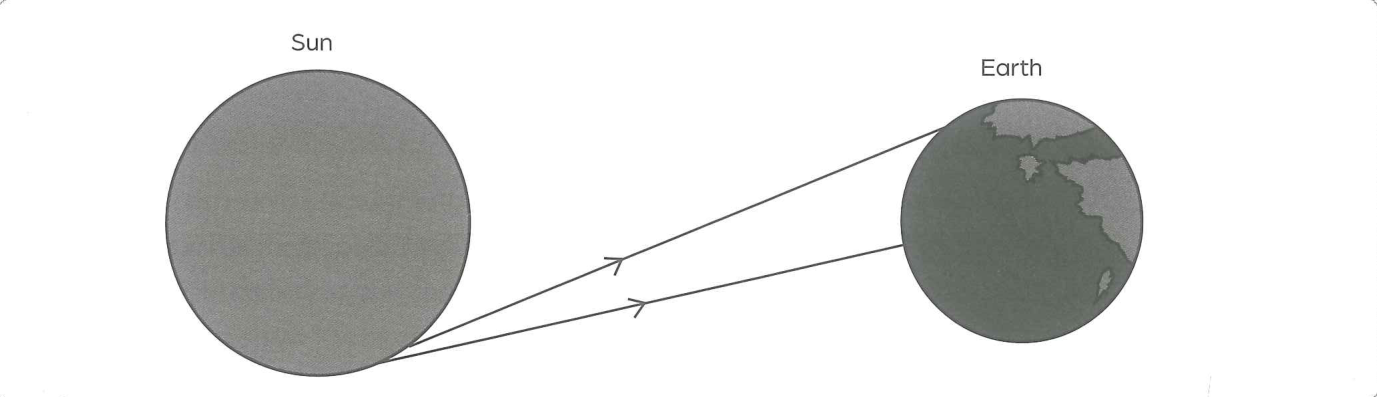
Complete the diagram showing a solar eclipse as follows:
a Draw in the Moon.
b Add two more light rays from the Sun.
c Add shading to show where a total and partial eclipse can be seen.
d Add labels for the shaded parts in c.