Draw five concentric circles on a sheet of plain white paper with these diameters: 100 mm, 80 mm, 60 mm, 40 mm, 20 mm. Colour them in according to this key: 100 mm circle: Green; 80 mm circle: Dark brown; 60 mm circle: Light brown; 40 mm circle: Orange; 20 mm circle: Yellow. Label the circles to represent the layers of the Earth. You could refer to page 289 in your Student’s Book if necessary.
In the model, five concentric circles have diameters 100, 80, 60, 40 and 20 mm and represent the crust, upper mantle, lower mantle, outer core and inner core from outside to centre. How does this model help you understand the internal structure of the Earth? What are its limitations?
Work in pairs. Carefully spread very soft icing in a thick layer on a large round plate. Place crackers on the icing to investigate how tectonic plates move at different plate boundaries. Never eat or drink anything in a science laboratory. Use what you know about tectonic plates to predict how the crackers will move on top of the icing. Tick (✓) the box next to the correct statement.
- The crackers will not be able to move.
- The crackers will move slowly but freely.
Work in pairs. Carefully spread very soft icing in a thick layer on a large round plate. Place crackers on the icing to investigate how tectonic plates move at different plate boundaries. Never eat or drink anything in a science laboratory. Make a model to represent a divergent boundary. Place two crackers on the icing. Make sure they touch gently. Pull the crackers apart slowly and carefully. Draw a diagram to represent a divergent boundary.
Work in pairs. Carefully spread very soft icing in a thick layer on a large round plate. Place crackers on the icing to investigate how tectonic plates move at different plate boundaries. Never eat or drink anything in a science laboratory. Make a model to represent a transform boundary. Place two more crackers carefully on the icing. Make sure they gently touch each other. Move the crackers in opposite directions slowly and carefully. Move one cracker towards the top of the plate and the other one towards the bottom of the plate. Draw a diagram to represent a transform boundary.
Work in pairs. Carefully spread very soft icing in a thick layer on a large round plate. Place crackers on the icing to investigate how tectonic plates move at different plate boundaries. Never eat or drink anything in a science laboratory. Make a model to represent a convergent boundary. Place the last two crackers carefully on the icing. Make sure they gently touch each other. Move the crackers towards each other slowly and carefully until one either pushes the other up or slides under the other, or they both crack into raised fragments. Draw a diagram to represent a convergent boundary.
State if this statement is true (T) or false (F). Fill in T or F.
When two plates slide together in the same direction, they form a transform boundary.
The sentences A–E describe how an earthquake happens. The sentences are in the wrong order. Complete the boxes to show the correct order. One has been done for you.
A. Stress builds up.
B. Sometimes, the plates get stuck. They still try to move, but the friction between them stops them.
C. The Earth’s tectonic plates slide past each other.
D. This causes vibrations called shock waves or seismic waves. The waves make the ground shake.
E. When the plates suddenly give way, portions of the rocks break. This releases huge amounts of energy.
Order: C → ___ → ___ → ___ → ___.
Work in pairs. Carefully spread very soft icing in a thick layer on a large round plate. Place crackers on the icing to investigate how tectonic plates move at different plate boundaries. Never eat or drink anything in a science laboratory. Explain how the crackers in your investigation move differently from the way tectonic plates move.
In your cracker-and-icing models, step 3 pulls two touching crackers apart (divergent boundary), step 4 slides them past each other in opposite directions (transform boundary), and step 5 pushes them towards each other (convergent boundary). Explain how the tectonic plates are moving in each of your models in steps 3, 4 and 5, and explain what effect this type of movement can have.
Work in pairs to investigate how clouds form and what they are made of. Materials: resealable plastic bag, water (about 1/4 cup), blue food colouring, permanent marker, tape. Consider the materials that you have been provided with. Design a model that demonstrates evaporation and condensation in the water cycle.
Work in pairs to investigate how clouds form and what they are made of. Materials: resealable plastic bag, water (about 1/4 cup), blue food colouring, permanent marker, tape. You have designed a model demonstrating evaporation and condensation. Evaluate your model. Use your observations to describe how clouds are formed.
You have used a sealed plastic bag containing water at a sunny window to model evaporation and condensation. The scientific model of the water cycle helps us to understand how water moves from one area to another in three different states of matter. However, the model has limitations. List some limitations.
Global warming causes changes to climate. In some areas, there is more rain and flooding. This is because warm temperatures can speed up evaporation. In other areas, the rate of evaporation is so high that it causes drought.
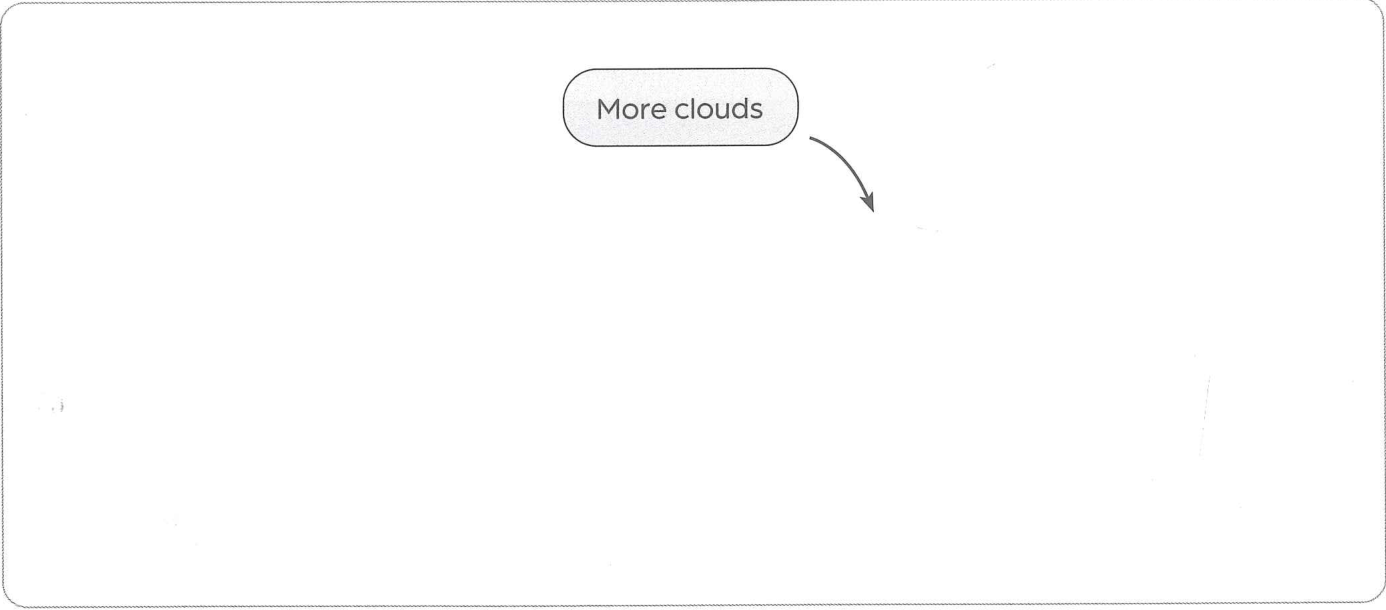
Complete the diagram to show how the water cycle is affected when an area gets more rain. Remember that the warmer atmosphere can hold more water vapour, and so in certain places (such as when clouds are naturally pushed over mountains) additional water vapour can cause more rainfall.