Work in pairs. Read the extract below and then answer the questions.
Electricity is generated in many ways:
- Fossil fuels such as coal, natural gas and oil are burnt to heat water. This creates steam that is passed through turbines, causing them to spin. The turbines are connected to a generator, and as the turbines spin, the generator produces electricity.
- Solar power comes from the Sun. Energy from the Sun is transferred by light waves to solar panels to generate electricity.
- Wind power captures the energy of wind. The wind rotates blades that are connected to generators to produce electricity.
- Hydropower uses the energy of flowing water, typically from rivers or dams. The movement of the water turns turbines to generate electricity.
- With nuclear power, atoms are split in a process called nuclear fission. This releases energy to heat water and produce steam for generating electricity.
- Other methods include geothermal energy, which uses heat from the Earth's core to generate electricity, and biomass energy, where organic materials such as wood are burnt to heat water and to create steam to drive turbines.
Name one source of energy from the extract that is suitable for generating electricity in your country, and one source of energy that is not. State why in each case.
Work in pairs. Read the extract below and then answer the questions.
Electricity is generated in many ways:
- Fossil fuels such as coal, natural gas and oil are burnt to heat water. This creates steam that is passed through turbines, causing them to spin. The turbines are connected to a generator, and as the turbines spin, the generator produces electricity.
- Solar power comes from the Sun. Energy from the Sun is transferred by light waves to solar panels to generate electricity.
- Wind power captures the energy of wind. The wind rotates blades that are connected to generators to produce electricity.
- Hydropower uses the energy of flowing water, typically from rivers or dams. The movement of the water turns turbines to generate electricity.
- With nuclear power, atoms are split in a process called nuclear fission. This releases energy to heat water and produce steam for generating electricity.
- Other methods include geothermal energy, which uses heat from the Earth's core to generate electricity, and biomass energy, where organic materials such as wood are burnt to heat water and to create steam to drive turbines.
A renewable source of energy is one that does not run out or get used up. Name any three sources of renewable energy from the extract.
Work in pairs. Read the extract below and then answer the questions.
Electricity is generated in many ways:
- Fossil fuels such as coal, natural gas and oil are burnt to heat water. This creates steam that is passed through turbines, causing them to spin. The turbines are connected to a generator, and as the turbines spin, the generator produces electricity.
- Solar power comes from the Sun. Energy from the Sun is transferred by light waves to solar panels to generate electricity.
- Wind power captures the energy of wind. The wind rotates blades that are connected to generators to produce electricity.
- Hydropower uses the energy of flowing water, typically from rivers or dams. The movement of the water turns turbines to generate electricity.
- With nuclear power, atoms are split in a process called nuclear fission. This releases energy to heat water and produce steam for generating electricity.
- Other methods include geothermal energy, which uses heat from the Earth's core to generate electricity, and biomass energy, where organic materials such as wood are burnt to heat water and to create steam to drive turbines.
A non-renewable source of energy is one that will be used up. Which type of energy do you think we should use more of: renewable or non-renewable? Give a reason why.
Fireworks are the result of several chemical reactions. When the fuse of a firework is lit, the fire travels along the fuse until it reaches the bottom. This ignites the lift charge, which is made from black powder, a type of gunpowder. The gunpowder explodes, creating heat and gas that cause pressure to build up beneath the shell. When the pressure is great enough, the shell shoots up into the sky.
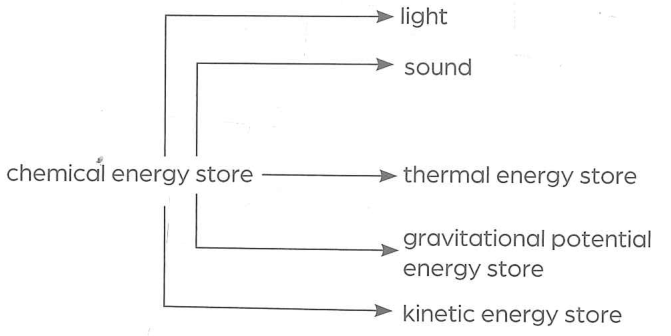
The diagram shows the energy transfers that are involved when fireworks are set off.
Complete the table to explain how you can tell these energy transfers are happening. The first one has been done as an example.
| Chemical energy store to: | How can you tell? |
|---|---|
| Light | There are bright lights in the sky. |
| Sound | ___ |
| Thermal energy store | ___ |
| Gravitational potential energy store | ___ |
| Kinetic energy store | ___ |
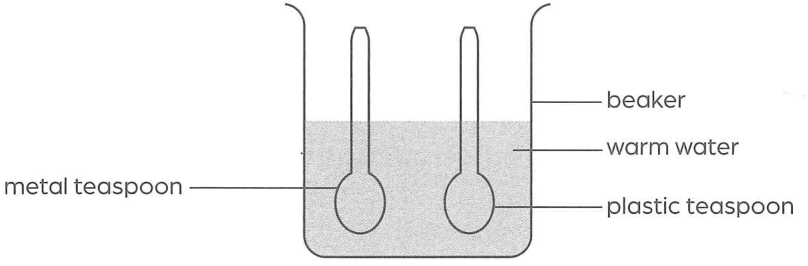
Work in pairs. Pour 100 cm³ of warm (not boiling) water into a beaker. Place a metal teaspoon and a plastic teaspoon into the beaker and leave them for three minutes.
Caution: Do not use water that is too hot. Use caution when testing the temperature of the spoons to avoid getting burns.
Diagram labels / Nhãn hình: beaker = cốc thủy tinh; warm water = nước ấm; metal teaspoon = thìa cà phê kim loại; plastic teaspoon = thìa cà phê nhựa.
Predict what will happen to the temperature of each spoon.
Work in pairs. Pour 100 cm³ of warm (not boiling) water into a beaker. Place a metal teaspoon and a plastic teaspoon into the beaker and leave them for three minutes.
Caution: Do not use water that is too hot. Use caution when testing the temperature of the spoons to avoid getting burns.
Diagram labels / Nhãn hình: beaker = cốc thủy tinh; warm water = nước ấm; metal teaspoon = thìa cà phê kim loại; plastic teaspoon = thìa cà phê nhựa.
After three minutes, carefully feel the temperature of the spoons. Do the spoons feel the same temperature as when you placed them in the beaker?
Work in pairs. Pour 100 cm³ of warm (not boiling) water into a beaker. Place a metal teaspoon and a plastic teaspoon into the beaker and leave them for three minutes.
Caution: Do not use water that is too hot. Use caution when testing the temperature of the spoons to avoid getting burns.
Diagram labels / Nhãn hình: beaker = cốc thủy tinh; warm water = nước ấm; metal teaspoon = thìa cà phê kim loại; plastic teaspoon = thìa cà phê nhựa.
In step 4, after three minutes, carefully feel the spoons and compare their temperatures with when you placed them in the beaker. Explain your observation in step 4. Why did this happen?
Work in pairs. Pour 100 cm³ of warm (not boiling) water into a beaker. Place a metal teaspoon and a plastic teaspoon into the beaker and leave them for three minutes.
Caution: Do not use water that is too hot. Use caution when testing the temperature of the spoons to avoid getting burns.
Diagram labels / Nhãn hình: beaker = cốc thủy tinh; warm water = nước ấm; metal teaspoon = thìa cà phê kim loại; plastic teaspoon = thìa cà phê nhựa.
Before waiting, predict what will happen to the temperature of each spoon. After three minutes, carefully feel each spoon and compare it with its starting temperature. Were your predictions accurate? Why did you predict this?
In a filament lamp, every 100 J of energy is transferred and released as 3 J of light and 97 J of heat. The percentage of energy released as light is 3%.
Why is the heat released by the lamp described as ‘wasted’?
Fluorescent lamps are alternatives to traditional filament lamps. Fluorescent lamps work by passing an electric current through a gas. This produces ultraviolet light (that most humans cannot see). This ultraviolet light then interacts with a coating inside the bulb to generate visible light.
In a filament lamp, every 100 J of energy is transferred and released as 3 J of light and 97 J of heat. The percentage of energy released as light is 3%.
In a fluorescent lamp, every 100 J of energy is transferred and released as 97 J of light and 3 J of heat. The percentage of energy released as light is 97%.
Which lamp is more efficient — the filament lamp or the fluorescent lamp?
Fluorescent lamps are alternatives to traditional filament lamps. Fluorescent lamps work by passing an electric current through a gas. This produces ultraviolet light (that most humans cannot see). This ultraviolet light then interacts with a coating inside the bulb to generate visible light.
In a filament lamp, every 100 J of energy is transferred and released as 3 J of light and 97 J of heat. The percentage of energy released as light is 3%.
In a fluorescent lamp, every 100 J of energy is transferred and released as 97 J of light and 3 J of heat. The percentage of energy released as light is 97%.
Which of these lamps would you use in your home? Explain your answer.
Some animals such as bats use echoes in a fascinating way known as echolocation. Bats make sounds, which travel outwards in waves and bounce off objects in their environment. By analysing the returning echoes, bats can create a mental map of their surroundings. This helps them to find their prey and avoid flying into objects in complete darkness.
Some animals such as bats use echoes in a fascinating way known as echolocation. Bats make sounds, which travel outwards in waves and bounce off objects in their environment. By analysing the returning echoes, bats can create a mental map of their surroundings. This helps them to find their prey and avoid flying into objects in complete darkness.
Why do you think some animals use echoes instead of sight to explore their surroundings?
Tick (✓) to show how confident you are of the concepts. Revise the relevant Student’s Book section(s) if needed.
| I can now | Yes / Not sure / No | Student’s Book section(s) |
|---|---|---|
| Describe how energy can be stored. | ___ | 11.1 |
| Describe energy transfers that are a result of an event or process. | ___ | 11.2 |
| Describe the different ways energy can be transferred. | ___ | 11.2 |
| Understand that when energy is transferred, some of it become less useful. | ___ | 11.2 |
| Describe how particles vibrate in a sound wave. | ___ | 11.3 |
| Explain why sound does not travel in a vacuum. | ___ | 11.3 |
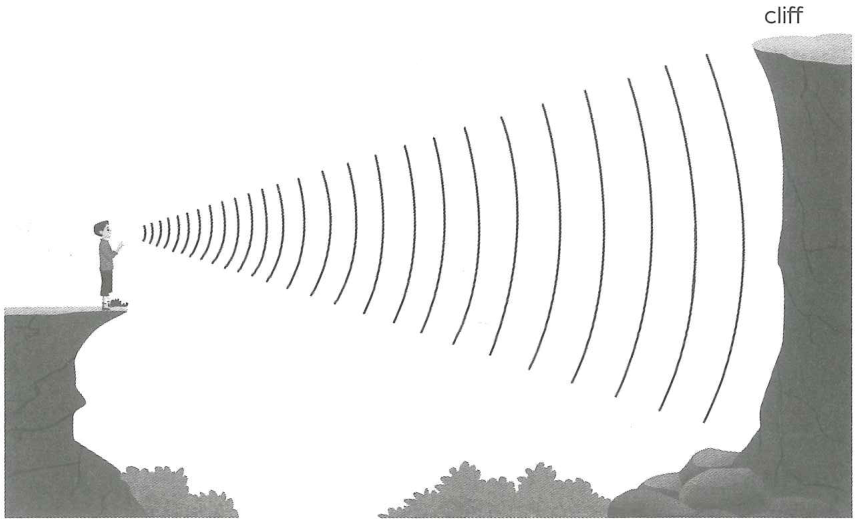
| Explain echoes as the reflection of sound waves. | ___ | 11.3 |
Energy is all around us. One type of energy store is called ______ energy. This is energy stored in the particles of a moving object. When you hold a book above your head, it has ______ energy. A stretched rubber band has ______ energy because it can bounce back when released. There is also ______ energy, which is stored in food and can give us the energy to run, jump and play. Lamps, the Sun and even fire have a lot of ______ energy. When you hear a bird chirping or music playing, you are experiencing ______.