Choose words from the list to complete the sentence.
friction · circle · gravitational · rotation · orbit
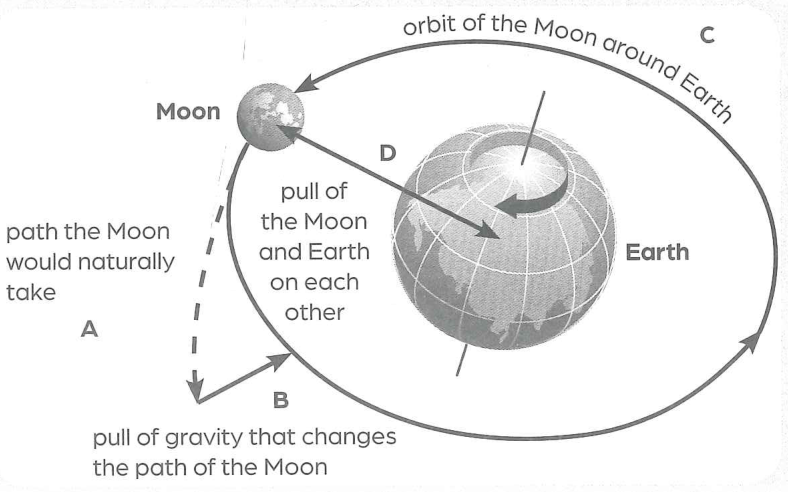
The straight arrows in the diagram (arrows B and D) point to how Earth’s ______ force pulls on the Moon, bending its path from a straight line into an ______.
Circle the correct word in brackets. You have two objects. If you increase the mass of one object, it will (increase / decrease) the gravitational force between the two objects.
Imagine you are holding hands with a classmate. Your arms are stretched out and you both are spinning around in a circle.
When you spin around really fast, it feels as if you are being pulled away from each other, but your hands keep you together. Even when you are spinning, the distance between you remains the same.
Now imagine that Earth and the Moon are two classmates holding hands across space. Instead of hands keeping them together, it is the force called gravity, or gravitational force. The strength of this force depends on two things: the mass of each object and how far apart they are.
The gravitational force between Earth and the Moon keeps the Moon in orbit around Earth. The Moon is not just floating in space; it is constantly being pulled towards the Earth and also moving sideways. Because the Moon is distant and moving fast, as it curves towards the Earth, the Earth’s round surface is curving away beneath it. So the Moon keeps missing the Earth. This balance between the pull of gravity and the Moon’s sideways motion keeps the Moon in its orbit around planet Earth.
Is the extract biased? How do you know?
Remember that “biased” is when something is prejudiced, one-sided or not impartial.
You are measuring the masses and weights of objects using a balance or digital scale and a force meter. How can you make sure your measurements are reliable?
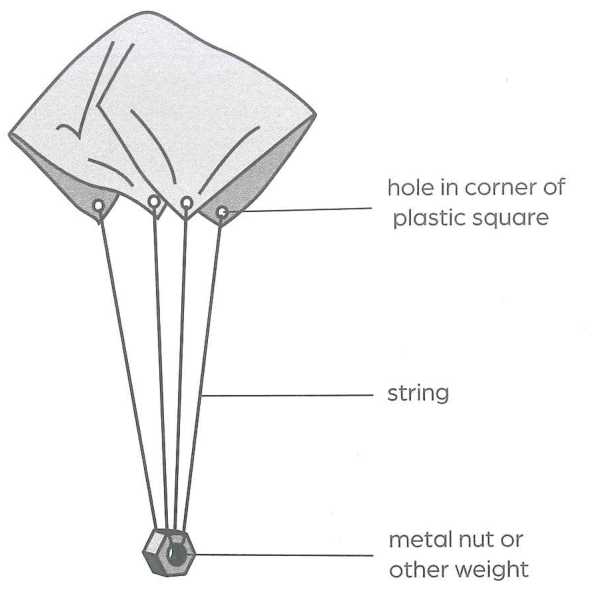
Investigate how parachute surface area affects air resistance. Use two plastic squares, 30 × 30 cm and 60 × 60 cm, with four 30 cm strings attached to the corners of each and an identical small weight attached to each set of strings. Hold the parachutes at the same height and release them at the same time without pushing. Observe which reaches the ground first; swap observer and releaser roles and repeat. Use a safe, teacher-approved release position; do not climb on unstable furniture.
Work in pairs. You are going to carry out an experiment that investigates how surface area affects air resistance. First, state a hypothesis, for example, “The size of a parachute will affect the speed at which it falls.”
Investigate how parachute surface area affects air resistance. Use two plastic squares, 30 × 30 cm and 60 × 60 cm, with four 30 cm strings attached to the corners of each and an identical small weight attached to each set of strings. Hold the parachutes at the same height and release them at the same time without pushing. Observe which reaches the ground first; swap observer and releaser roles and repeat. Use a safe, teacher-approved release position; do not climb on unstable furniture.
Predict what the outcome of this experiment will be.
Investigate how parachute surface area affects air resistance. Use two plastic squares, 30 × 30 cm and 60 × 60 cm, with four 30 cm strings attached to the corners of each and an identical small weight attached to each set of strings. Hold the parachutes at the same height and release them at the same time without pushing. Observe which reaches the ground first; swap observer and releaser roles and repeat. Use a safe, teacher-approved release position; do not climb on unstable furniture.
On the count of three, drop both parachutes at the same time. Your classmate observes which parachute reaches the ground first and records the results. Swap roles. Then repeat the experiment until you have recorded enough results to have a clear conclusion.
Investigate how parachute surface area affects air resistance. Use two plastic squares, 30 × 30 cm and 60 × 60 cm, with four 30 cm strings attached to the corners of each and an identical small weight attached to each set of strings. Hold the parachutes at the same height and release them at the same time without pushing. Observe which reaches the ground first; swap observer and releaser roles and repeat. Use a safe, teacher-approved release position; do not climb on unstable furniture.
Investigate how parachute surface area affects air resistance. Use two plastic squares, 30 × 30 cm and 60 × 60 cm, with four 30 cm strings attached to the corners of each and an identical small weight attached to each set of strings. Hold the parachutes at the same height and release them at the same time without pushing. Observe which reaches the ground first; swap observer and releaser roles and repeat. Use a safe, teacher-approved release position; do not climb on unstable furniture.
Investigate how parachute surface area affects air resistance. Use two plastic squares, 30 × 30 cm and 60 × 60 cm, with four 30 cm strings attached to the corners of each and an identical small weight attached to each set of strings. Hold the parachutes at the same height and release them at the same time without pushing. Observe which reaches the ground first; swap observer and releaser roles and repeat. Use a safe, teacher-approved release position; do not climb on unstable furniture.
What variables did you keep constant? List three of them.
Investigate how parachute surface area affects air resistance. Use two plastic squares, 30 × 30 cm and 60 × 60 cm, with four 30 cm strings attached to the corners of each and an identical small weight attached to each set of strings. Hold the parachutes at the same height and release them at the same time without pushing. Observe which reaches the ground first; swap observer and releaser roles and repeat. Use a safe, teacher-approved release position; do not climb on unstable furniture.
Study your recorded data. Tick (✓) the sentence that is true for your experiment.
- The larger parachute always reached the ground first.
- The larger parachute sometimes reached the ground first.
- The larger parachute never reached the ground first.
Investigate how parachute surface area affects air resistance. Use two plastic squares, 30 × 30 cm and 60 × 60 cm, with four 30 cm strings attached to the corners of each and an identical small weight attached to each set of strings. Hold the parachutes at the same height and release them at the same time without pushing. Observe which reaches the ground first; swap observer and releaser roles and repeat. Use a safe, teacher-approved release position; do not climb on unstable furniture.
How would you know if you need to repeat the experiment more times?
Investigate how parachute surface area affects air resistance. Use two plastic squares, 30 × 30 cm and 60 × 60 cm, with four 30 cm strings attached to the corners of each and an identical small weight attached to each set of strings. Hold the parachutes at the same height and release them at the same time without pushing. Observe which reaches the ground first; swap observer and releaser roles and repeat. Use a safe, teacher-approved release position; do not climb on unstable furniture.
Circle the correct answers in brackets to make the sentences true.
Gravitational pull on Earth is (the same / different) for all objects.