Work in pairs. Read the text below about a new material made by scientists.
Graphene, a two-dimensional (2D) form of carbon, is considered to be the strongest known material. However, scientists have found it challenging to find useful three-dimensional (3D) applications for graphene.
A team of researchers from Massachusetts Institute of Technology (MIT) has developed an extremely strong and lightweight material by combining flakes of graphene under high heat and pressure. This new material has a structure that is similar to that of some corals and microscopic organisms called diatoms. The material is sponge-like as it is filled with tiny spaces. It has a very low density and is ten times stronger than steel.
Tests done on the new material showed that it can withstand high tension and pressure. These properties, together with its porous nature, could make this material valuable for applications such as water filtration and chemical processing.
Researchers found that the strength of the 3D form comes from its unique shape, and not the material itself. This suggests that strong, lightweight materials could be made from different substances by using similar shapes.
*Adapted from MIT News*
List one advantage and one disadvantage of graphene in the table.
Work in pairs. Read the text below about a new material made by scientists.
Graphene, a two-dimensional (2D) form of carbon, is considered to be the strongest known material. However, scientists have found it challenging to find useful three-dimensional (3D) applications for graphene.
A team of researchers from Massachusetts Institute of Technology (MIT) has developed an extremely strong and lightweight material by combining flakes of graphene under high heat and pressure. This new material has a structure that is similar to that of some corals and microscopic organisms called diatoms. The material is sponge-like as it is filled with tiny spaces. It has a very low density and is ten times stronger than steel.
Tests done on the new material showed that it can withstand high tension and pressure. These properties, together with its porous nature, could make this material valuable for applications such as water filtration and chemical processing.
Researchers found that the strength of the 3D form comes from its unique shape, and not the material itself. This suggests that strong, lightweight materials could be made from different substances by using similar shapes.
*Adapted from MIT News*
Name an effect this new material could have on modern life. Do more research if you need more information. Write down your thoughts.
Work in pairs. Read the text below about a new material made by scientists.
Graphene, a two-dimensional (2D) form of carbon, is considered to be the strongest known material. However, scientists have found it challenging to find useful three-dimensional (3D) applications for graphene.
A team of researchers from Massachusetts Institute of Technology (MIT) has developed an extremely strong and lightweight material by combining flakes of graphene under high heat and pressure. This new material has a structure that is similar to that of some corals and microscopic organisms called diatoms. The material is sponge-like as it is filled with tiny spaces. It has a very low density and is ten times stronger than steel.
Tests done on the new material showed that it can withstand high tension and pressure. These properties, together with its porous nature, could make this material valuable for applications such as water filtration and chemical processing.
Researchers found that the strength of the 3D form comes from its unique shape, and not the material itself. This suggests that strong, lightweight materials could be made from different substances by using similar shapes.
*Adapted from MIT News*
According to the text provided, which properties of materials are often useful?
Investigate the strength of different paper samples. Materials: 5 strips each of 4 different types of paper (same size, approximately 20 cm × 5 cm), hole puncher, paper clip, yoghurt tub, string, marbles.
Work in groups. Plan and carry out a fair test using the given materials to answer this investigation question: Which type of paper is the strongest?
Investigate the strength of different paper samples. Materials: 5 strips each of 4 different types of paper (same size, approximately 20 cm × 5 cm), hole puncher, paper clip, yoghurt tub, string, marbles.
Identify the variables and controls in your investigation. The independent variable (what you will change) is:
Investigate the strength of different paper samples. Materials: 5 strips each of 4 different types of paper (same size, approximately 20 cm × 5 cm), hole puncher, paper clip, yoghurt tub, string, marbles.
Identify the variables and controls in your investigation. The dependent variable (what you will be measuring) is:
Investigate the strength of different paper samples. Materials: 5 strips each of 4 different types of paper (same size, approximately 20 cm × 5 cm), hole puncher, paper clip, yoghurt tub, string, marbles.
Identify the variables and controls in your investigation. The control variables (what you will keep the same) are:
Investigate the strength of different paper samples. Materials: 5 strips each of 4 different types of paper (same size, approximately 20 cm × 5 cm), hole puncher, paper clip, yoghurt tub, string, marbles.
Write the steps you will follow to carry out your investigation.
- How will you set up the equipment? What safety precautions will you take? Decide on your actions.
- What observations will you make? How many measurements do you need? See the table on the next page.
The results table has four paper-type rows and columns for first trial, last trial and average number of marbles.
Investigate the strength of different paper samples. Materials: 5 strips each of 4 different types of paper (same size, approximately 20 cm × 5 cm), hole puncher, paper clip, yoghurt tub, string, marbles.
Investigate the strength of different paper samples. Materials: 5 strips each of 4 different types of paper (same size, approximately 20 cm × 5 cm), hole puncher, paper clip, yoghurt tub, string, marbles.
Ask your teacher to check your plan. Then carry it out. Use the table to record your results.
| Type of paper | Number of marbles: First trial | Number of marbles: Last trial | Average number of marbles |
|---|---|---|---|
| | | | |
| | | | |
| | | | |
| | | | |
Investigate the strength of different paper samples. Materials: 5 strips each of 4 different types of paper (same size, approximately 20 cm × 5 cm), hole puncher, paper clip, yoghurt tub, string, marbles.
Write your conclusion. Which type of paper is the strongest and which is the weakest? Use the results of your paper-strength investigation.
Investigate the strength of different paper samples. Materials: 5 strips each of 4 different types of paper (same size, approximately 20 cm × 5 cm), hole puncher, paper clip, yoghurt tub, string, marbles.
Write your conclusion. How could you tell which type of paper is the strongest and which is the weakest in your investigation?
Investigate the strength of different paper samples. Materials: 5 strips each of 4 different types of paper (same size, approximately 20 cm × 5 cm), hole puncher, paper clip, yoghurt tub, string, marbles.
How did you decide how many times to repeat each measurement?
Investigate the strength of different paper samples. Materials: 5 strips each of 4 different types of paper (same size, approximately 20 cm × 5 cm), hole puncher, paper clip, yoghurt tub, string, marbles.
Evaluate your investigation and suggest improvements.
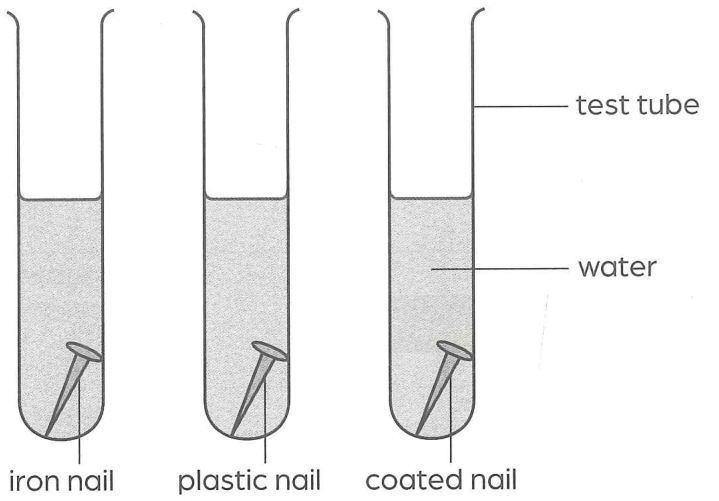
Materials: Three test tubes, water, iron nail, plastic nail, coated nail.
1. Work in pairs or small groups.
2. Half-fill three test tubes with water.
3. Put a different nail (an iron nail, a plastic nail and a coated nail) into each test tube.
4. Label each test tube.
5. Leave the nails in the water for 1 week.
6. Observe daily and note any changes.
Were there any results in your investigation that you did not expect? If yes, suggest an explanation for the unexpected results.