Skip to content / Đến nội dung
SachHeCam.com

Cambridge Secondary (7-9). Stage 9. MCE Science. Student Book - Unit 13: Earth and Climate Change

Question 1

What are some ways to slow down receding coastlines?

Question 2

How do you think tectonic plates moving away from each other or sliding underneath each other at the plate boundaries can form volcanoes?

Question 3

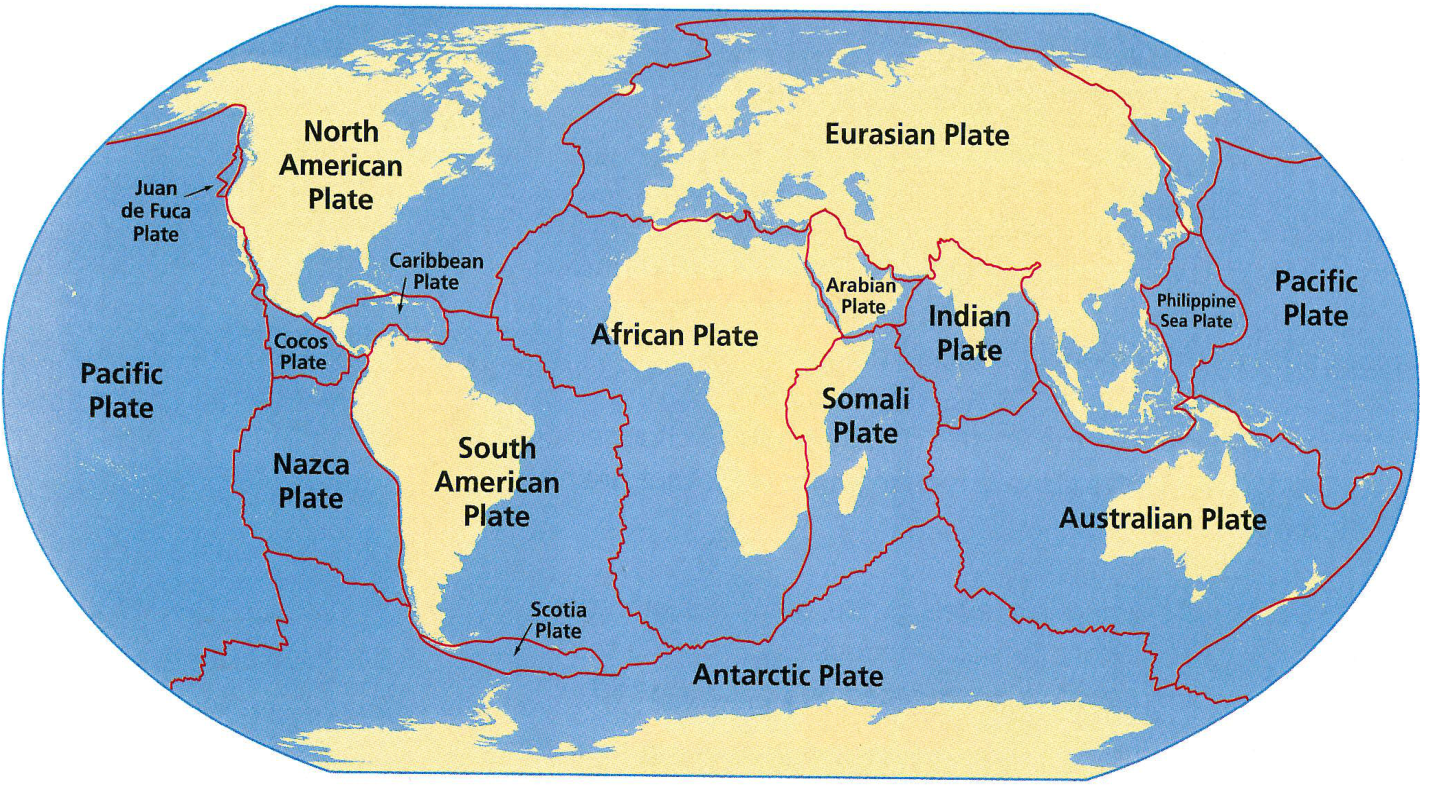
Work in groups. Make a simple model of the Earth’s tectonic plates using cardboard or any other suitable materials. Ensure the plates show the different land masses and oceans. You should have 17 pieces representing the 16 major plates. (See Figure 13.1. Note that you need two pieces for Pacific Plate to show the left and right sides as seen on a flat plane.)

Question illustration

Question 4

Fit the plates together like a jigsaw puzzle. Use a map and indicate the following locations on your model:
- Himalayan Mountain Range
- San Andreas Fault
- Mid-Atlantic Ridge

Question 5

Locations: Himalayan Mountain Range, San Andreas Fault and Mid-Atlantic Ridge.

Discuss these questions. Explain how each of the three locations above was formed. Look at the model you made and use what you have learnt about the effects of tectonic plate movements.

Question 6

Use the model of Earth’s tectonic plates made in the activity.

How might this model change in the future over millions of years?

Question 7

Use the model of Earth’s tectonic plates made in the activity.

What might cause this model to change?

Question 8

Explain how the movement of tectonic plates shapes the landscape.

Question 9

Discuss how convection currents in the mantle of Earth cause tectonic plates to move.

Question 10

Work in groups to convince the following audiences about the existence of tectonic plates and their movements: Students; Scientists; Public.

Research and make a list of possible first-hand experiences or experiments that can be conducted to gather evidence through direct observations and measurements.

Question 11

Work in groups to convince the following audiences about the existence of tectonic plates and their movements: Students; Scientists; Public.

Research and make a list of possible secondary sources that can be used to interpret or analyse based on primary sources.

Question 12

Work in groups to convince the following audiences about the existence of tectonic plates and their movements: Students; Scientists; Public.

From the two lists, decide on the type(s) of evidence your group would use to convince each audience about tectonic plates. Give your reasons.

Question 13

Work in groups to convince the following audiences about the existence of tectonic plates and their movements: Students; Scientists; Public.

Present your findings to the class.

Question 14

Explain what has happened to the continents over millions of years and what had caused these changes.

Question 15

Identify four types of evidence that support the existence of tectonic plates.

Question 16

The evidence types discussed are continental coasts, volcanoes and earthquakes, fossil records, and alignment of magnetic materials.

Explain how each type of evidence supports the theory of plate tectonics.

Question 17

In groups, research the Earth’s carbon budget using the Internet or other sources of information. Present your findings with a poster and discuss these questions.

What is the Earth’s carbon budget?

Question 18

In groups, research the Earth’s carbon budget using the Internet or other sources of information. Present your findings with a poster and discuss these questions.

What is the purpose of setting a carbon budget?

Question 19

In groups, research the Earth’s carbon budget using the Internet or other sources of information. Present your findings with a poster and discuss these questions.

How has the science behind the carbon budget affected the global environment?
Question 20

The carbon cycle should keep the Earth’s carbon in balance. What is causing the carbon cycle to change? How is it changing the carbon cycle?
0
0
GIỎ HÀNG
Empty CartGIỎ CHƯA CÓ GÌQUAY LẠI SHOP
