Close your eyes and listen carefully. What do you hear? Do you hear sounds that are soft, loud or high-pitched? Maybe you hear the loud sound of a car or another machine running. Maybe you hear a soft, high-pitched sound of a bird singing in a tree.
Open your eyes and share the sounds you heard with the rest of the class. Where do these sounds come from? How are they formed? Was it easy to describe the sounds to your classmates?
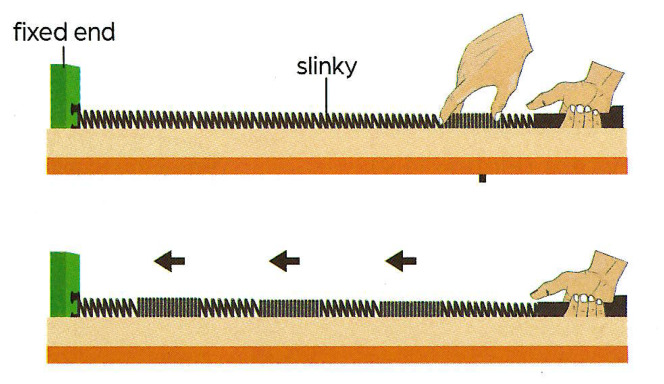
1 Work in groups. Stretch out a slinky (a spring toy) loosely on a horizontal surface. Fix or hold one end of the slinky steady (Figure 11.7, top).
2 Quickly compress and release a few coils at the other end. This will create a wave that travels along the length of the slinky (Figure 11.7, bottom).
3 How does this experiment show how a sound wave moves?
In groups, demonstrate sound vibrations. Work on a solid surface like a wooden block or a tabletop. Ask your teacher for a rubber pad, a tuning fork and a bowl with water.
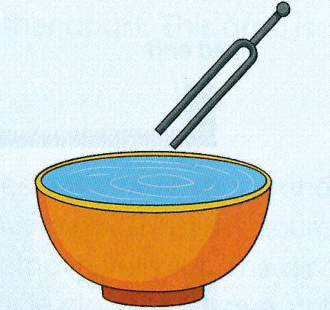
Strike the tuning fork against the rubber pad. Place the fork's prongs just above the surface of the water (Figure 11.9). What do you observe? Why does this occur?
Discuss in groups and share your findings with the class. You may use the Internet or other sources of information to help you.
In groups, demonstrate sound vibrations. Work on a solid surface like a wooden block or a tabletop. Ask your teacher for a rubber pad, a tuning fork and a bowl with water.
Watch how the vibrating tuning fork causes ripples in the water (Figure 11.10). What do the ripples represent?
Discuss in groups and share your findings with the class. You may use the Internet or other sources of information to help you.
In groups, demonstrate sound vibrations. Work on a solid surface like a wooden block or a tabletop. Ask your teacher for a rubber pad, a tuning fork and a bowl with water.
Repeat the experiment with the tuning fork in different positions. Hold it closer to or further from the water's surface, or next to the bowl. Record your observations.
Discuss in groups and share your findings with the class. You may use the Internet or other sources of information to help you.
In groups, demonstrate sound vibrations. Work on a solid surface like a wooden block or a tabletop. Ask your teacher for a rubber pad, a tuning fork and a bowl with water.
If this experiment took place in a vacuum where there are no air particles, what would happen? Would the water show ripples when the tuning fork is placed above its surface? Explain your answer.
Discuss in groups and share your findings with the class. You may use the Internet or other sources of information to help you.
In groups, demonstrate sound vibrations. Work on a solid surface like a wooden block or a tabletop. Ask your teacher for a rubber pad, a tuning fork and a bowl with water.
Why was the tuning fork held above the water instead of being placed in the water?
Discuss in groups and share your findings with the class. You may use the Internet or other sources of information to help you.
In groups, demonstrate sound vibrations. Work on a solid surface like a wooden block or a tabletop. Ask your teacher for a rubber pad, a tuning fork and a bowl with water.
Discuss what you could do to improve the experiment.
Discuss in groups and share your findings with the class. You may use the Internet or other sources of information to help you.