In the late 18th century, Count Rumford (Figure 10.4) whose real name was Benjamin Thompson, conducted a series of experiments, particularly during his work with cannons. He noticed that when metal was drilled, a lot of heat was released from the drill bits, enough to boil water. He observed that this heat was released continuously as the drill worked, regardless of how long it operated.
In pairs, find out how the unexpected results from Rumford’s experiments led to our understanding of heat as energy. Use the Internet to help you answer these questions. Share your answers with the class.
What was the prevailing understanding of heat during the late 18th century?
In the late 18th century, Count Rumford (Figure 10.4) whose real name was Benjamin Thompson, conducted a series of experiments, particularly during his work with cannons. He noticed that when metal was drilled, a lot of heat was released from the drill bits, enough to boil water. He observed that this heat was released continuously as the drill worked, regardless of how long it operated.
In pairs, find out how the unexpected results from Rumford’s experiments led to our understanding of heat as energy. Use the Internet to help you answer these questions. Share your answers with the class.
Suppose heat were truly what was suggested by the prevailing understanding then. What should Rumford have observed in his experiment with the cannon? Why didn’t this happen?
In the late 18th century, Count Rumford (Figure 10.4) whose real name was Benjamin Thompson, conducted a series of experiments, particularly during his work with cannons. He noticed that when metal was drilled, a lot of heat was released from the drill bits, enough to boil water. He observed that this heat was released continuously as the drill worked, regardless of how long it operated.
In pairs, find out how the unexpected results from Rumford’s experiments led to our understanding of heat as energy. Use the Internet to help you answer these questions. Share your answers with the class.
How did Rumford’s discovery about heat contribute to a new understanding of energy?
In the late 18th century, Count Rumford (Figure 10.4) whose real name was Benjamin Thompson, conducted a series of experiments, particularly during his work with cannons. He noticed that when metal was drilled, a lot of heat was released from the drill bits, enough to boil water. He observed that this heat was released continuously as the drill worked, regardless of how long it operated.
In pairs, find out how the unexpected results from Rumford’s experiments led to our understanding of heat as energy. Use the Internet to help you answer these questions. Share your answers with the class.
Why is it important for scientists to keep an open mind when their results contradict existing theories?
In pairs, carry out this experiment.
1. Fill two beakers with cold water until both are about three-quarters full.
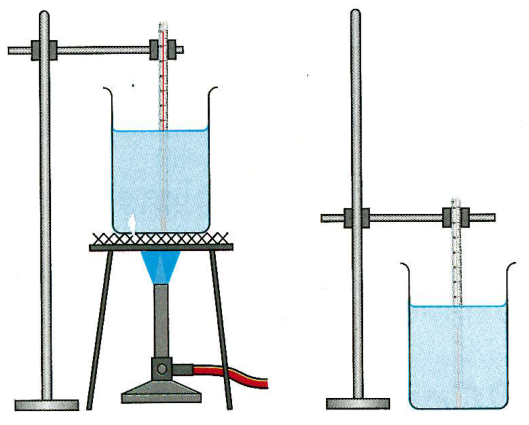
2. Place a thermometer into each beaker, as shown in Figure 10.8. Make sure the bulb of the thermometer is covered by water but does not touch the beaker. Measure and record the temperature of the water in both beakers. Decide if the measurements need to be repeated to ensure accuracy.
3. Place one of the beakers on a tripod and light the Bunsen burner, as shown in Figure 10.8. Leave the second beaker at room temperature as a control.
4. Measure the temperature of the water in each beaker every two minutes. Stir the water gently with the stirring rod before taking each measurement to ensure uniform temperature. Continue measuring until the water in the heated beaker boils. If any temperature readings seem inconsistent, repeat the measurement to ensure reliable results.
5. Record all measurements in a table, noting the time and temperature for each beaker. Ensure that the measurements are accurate and precise by double-checking the thermometer readings.
6. Plot line graphs to show the changes in temperature over time for both beakers.
Caution: When heating the water: Wear safety goggles. Do not touch the hot beaker or the tripod to prevent burns.