An iceberg is a piece of freshwater ice that is larger than 15 m long and is floating in open water. Some icebergs are as large as 100 m long! Most of an iceberg is below the surface of the water.
As the global temperature continues to rise, more and more icebergs are breaking away from the polar ice shelves. What risks do these floating icebergs pose to industry and the environment?
The amount of stuff that fits into a given space varies with different materials – that’s why a small rock feels much heavier than a big sponge! But how do we measure this fascinating property of a material precisely?
Work in pairs to calculate the density of five different objects.
1. Collect five different objects, such as a pencil, an eraser, a ruler, a glass and a stone.
2. Predict which object will have the highest density and which will have the lowest.
3. Weigh each object to find its mass using an electronic balance. Record the results in the table.
4. Find the volume of each object using a suitable method. Record the results in the table.
5. Calculate the density of each object. Record the results in the table.
| Object | Mass in g | Volume in cm³ | Density in g/cm³ |
|:-|:-:|:-:|:-:|
| 1 | | | |
| 2 | | | |
| 3 | | | |
| 4 | | | |
| 5 | | | |
In the investigation of five different objects, based on your results, which object has the highest density and which has the lowest? Share your answers with the class.
Object A has a volume of 8 cm³ and a mass of 62.8 g.
Object B has a volume of 2 cm³ and a mass of 15.7 g.
Is it true that both objects are made from the same material? Explain.
Work in groups to investigate the densities of coins of different denominations and analyse the relationship between coin denomination and density. 1. Write a hypothesis. Make sure your hypothesis is testable.
2. Identify the variables that must be kept the same, changed and measured.
3. Design an experiment to test your hypothesis.
4. Decide on the materials and equipment needed.
5. Write down the procedure for your investigation.
6. Carry out the experiment and record your observations and data in a suitable format. Ensure that you record multiple readings of each type of data.
Work in groups to investigate the densities of coins of different denominations and analyse the relationship between coin denomination and density. What factors might influence the density of coins?
Work in groups to investigate the densities of coins of different denominations and analyse the relationship between coin denomination and density. Which type of data would you take multiple readings of? Why?
Work in groups to investigate the densities of coins of different denominations and analyse the relationship between coin denomination and density. Is there a relationship between coin denomination and density?
Work in groups to investigate the densities of coins of different denominations and analyse the relationship between coin denomination and density. What are some potential sources of error in the experiment and how might they have affected your results?
Work in groups to investigate the densities of coins of different denominations and analyse the relationship between coin denomination and density. Suggest possible improvements to the experiment or further investigations.
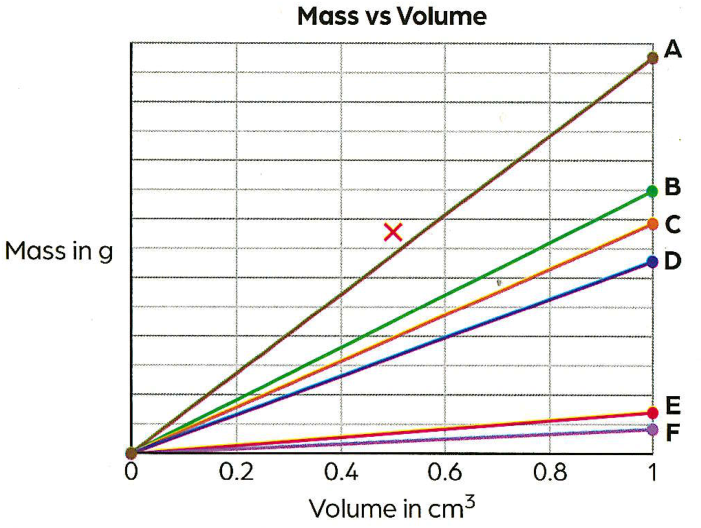
Gayathrie was presented with graphs of mass against volume for six substances, A to F (Figure 9.15). She was asked to sort the substances into three solids and three liquids based on the graphs. The values for mass are not provided, so Gayathrie could not identify the substances by calculating the density from the graphs. Work in pairs to answer the questions.
Based on Figure 9.15, arrange the substances in terms of their density, from lowest to highest.
Gayathrie was presented with graphs of mass against volume for six substances, A to F (Figure 9.15). She was asked to sort the substances into three solids and three liquids based on the graphs. The values for mass are not provided, so Gayathrie could not identify the substances by calculating the density from the graphs. Work in pairs to answer the questions.
Gayathrie predicted that E and F are liquids. Why is this prediction likely correct?