Heavy metal contamination in water poses risks to humans and ecosystems. Displacement reactions can remove less reactive toxic metals from solution using a more reactive metal. Besides cleaning water sources, what are the benefits of using displacement reactions to deal with heavy metal contamination?
Think of two objects. One is made of a shiny metal (such as silver jewellery) and the other rusts easily (such as iron nails). What do you think causes the bright metal to stay shiny and the other metal to rust? Think about the environmental factors and the nature of the metal itself.
Think of two objects. One is made of a shiny metal (such as silver jewellery) and the other rusts easily (such as iron nails). Is there a way to predict which metals will rust and which will stay shiny?
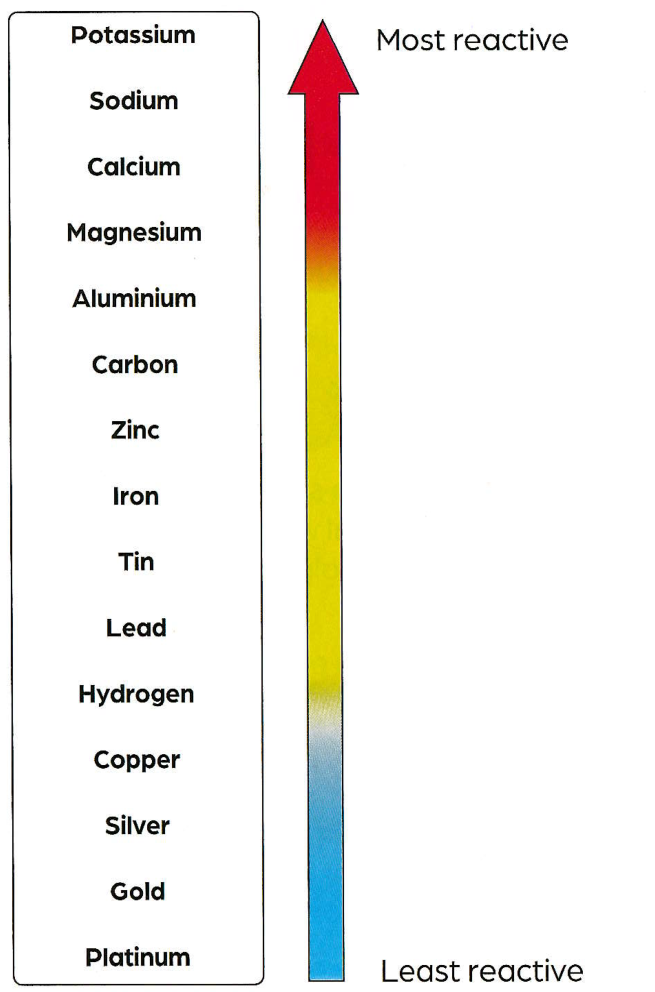
You have learnt that some metals react with water while others do not. Using the concept of displacement and the reactivity series below, explain why magnesium reacts with steam but copper does not.
Understanding how reactive an element is helps you choose safe experiment materials. It also helps you predict the reaction intensity to avoid hazardous situations. Can you think of another reason why understanding reactivity is important for safety? In pairs, discuss your ideas.
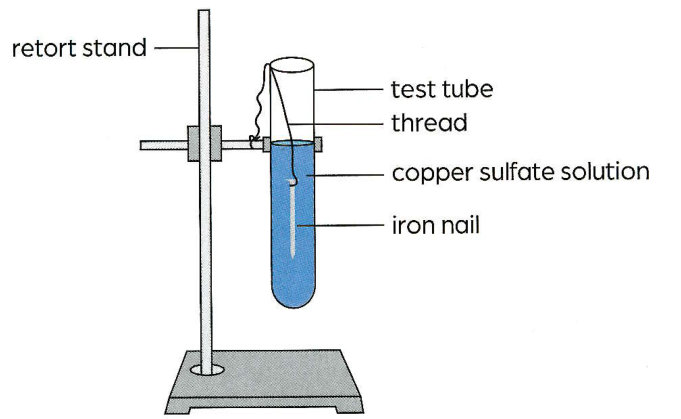
Your teacher demonstrates the following investigation. Two test tubes A and B each contain 10 ml of freshly prepared copper sulfate solution. A cleaned grey iron nail is immersed in B; a second nail is kept on white paper for comparison. After 20 minutes the immersed nail is removed and placed beside the other nail. Wear suitable gloves and safety goggles; do not touch or ingest chemicals.
Your teacher demonstrates the following investigation. Two test tubes A and B each contain 10 ml of freshly prepared copper sulfate solution. A cleaned grey iron nail is immersed in B; a second nail is kept on white paper for comparison. After 20 minutes the immersed nail is removed and placed beside the other nail. Wear suitable gloves and safety goggles; do not touch or ingest chemicals.
What does the brown coating on the iron nail tell you about the reaction?
Your teacher demonstrates the following investigation. Two test tubes A and B each contain 10 ml of freshly prepared copper sulfate solution. A cleaned grey iron nail is immersed in B; a second nail is kept on white paper for comparison. After 20 minutes the immersed nail is removed and placed beside the other nail. Wear suitable gloves and safety goggles; do not touch or ingest chemicals.
What colour change do you observe in the copper sulfate solution?