Skip to content / Đến nội dung
SachHeCam.com

Cambridge Secondary (7-9). Stage 9. MCE Science. Student Book - Unit 4: The Structure of the Atom and the Periodic Table

Question 1

The uses of hydrogen are related to its properties. What are the advantages and disadvantages of using hydrogen as a fuel source?

Question 2

Other than hydrogen, there are many useful elements in our everyday life. How do Scientists study these elements systematically?

Question 3

Work in pairs. Draw a diagram to show the arrangement of electrons in a calcium atom. You do not need to show the protons and neutrons.

Question 4

What is the electronic structure of calcium?

Question 5

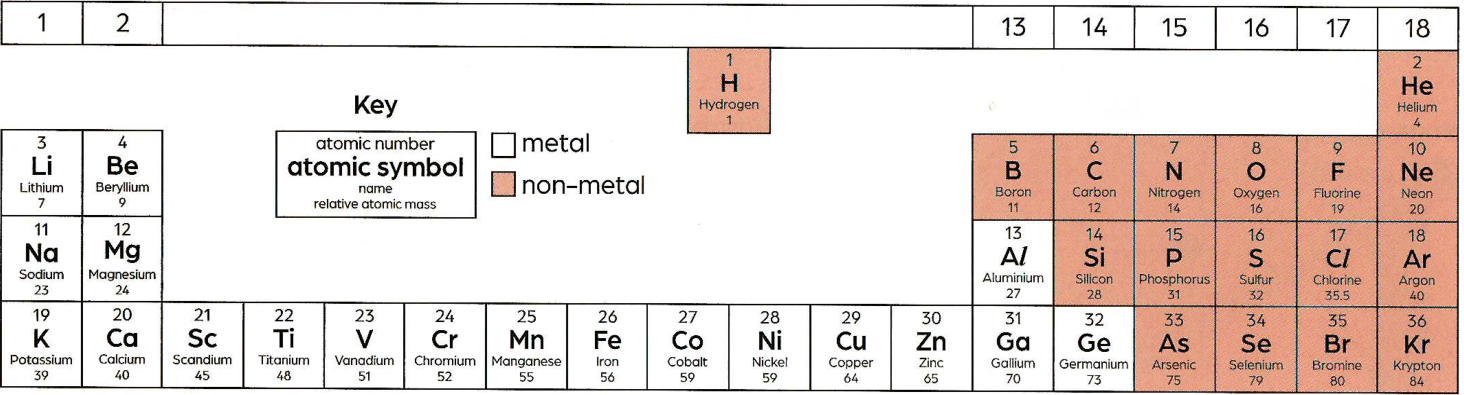
What is the mass number of calcium? Use the value in the Periodic Table on page 80.

Question illustration

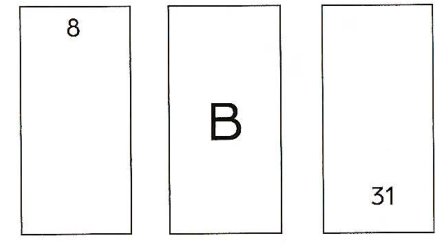
Question 7

Complete the diagrams to show the atomic number, symbol and mass number of three elements. Use the Periodic Table on page 80 to help you.

Question illustration

Question illustration

Question 8

Draw a diagram to show the arrangement of electrons in a boron atom.

Question 9

Use the Periodic Table on page 80 to answer this question.

Question illustration

What is the electronic structure of aluminium?

Question 10

Use the Periodic Table on page 80 to answer this question.

Question illustration

Which element has the electronic structure 2, 8, 4?

Question 11

Use the Periodic Table on page 80 to answer this question.

Question illustration

How many protons are there in a lithium atom?

Question 12

Use the Periodic Table on page 80 to answer this question.

Question illustration

How many electrons are there in an oxygen atom?

Question 13

Use the Periodic Table on page 80 to answer this question.

Question illustration

What is the mass number of neon?

Question 14

Give the name for protons and neutrons grouped together.

Question 15

Work in small groups. Draw a Periodic Table showing only the first 20 elements. Label the groups and periods.

Question 16

Find out some information about the first 20 elements. This can include: when the element was discovered; what properties and uses it has; atomic and mass numbers.

Question 17

Are the elements in the same group similar? Share your answers with the class.

Question 18

Table 4.1: lithium (Li): density 0.53 g/cm³, melting point 180°C, boiling point 1342°C; sodium (Na): 0.97 g/cm³, 98°C, 883°C; potassium (K): 0.89 g/cm³, 63°C, 759°C. Look at Table 4.1. Can you see a trend as you look at the table? In pairs, discuss your answer.

Question 19

Does the atomic number and mass number increase or decrease? Context: compare lithium, sodium and potassium, whose atomic numbers are 3, 11, 19 and whose isotope-model mass numbers in the book are 7, 23, 39. In pairs, discuss your answer.

Question 20

Table 4.1: lithium (Li): density 0.53 g/cm³, melting point 180°C, boiling point 1342°C; sodium (Na): 0.97 g/cm³, 98°C, 883°C; potassium (K): 0.89 g/cm³, 63°C, 759°C. Does the boiling point increase or decrease down the group? In pairs, discuss your answer.
0
0
GIỎ HÀNG
Empty CartGIỎ CHƯA CÓ GÌQUAY LẠI SHOP