Skip to content / Đến nội dung
SachHeCam.com

Cambridge Secondary (7-9). Stage 9. MCE Science. Student Book - Unit 3: Variation and Inheritance

Question 1

More than half a million people, mostly children, die from malaria each year. Many of the deaths occur in Africa, but the disease also affects Asian countries such as Indonesia, India and Pakistan.

Malaria is caused by a parasite that is spread by mosquitoes. While malaria can be treated with drugs, it is best to avoid contracting it by preventing mosquito bites.

Mosquitoes are mainly active at night, so organisations such as the World Health Organisation (WHO) seek to supply people in poorer countries with insecticide-treated bed nets (ITNs). The insecticide in the ITN repels or kills mosquitoes, protecting the person sleeping underneath. However, these nets have become less effective over time. The mosquitoes are able to stay around the net longer, increasing the chances of a bite through any small opening in the net. The nets must now be treated with new chemicals to better repel mosquitoes.

Why did the insecticide become less effective against mosquitoes?

Question 2

Look into the mirror and observe some of the features you have. What causes you to have brown eyes or curly hair, or be right-handed?

Question 3

Do all human cells have 46 chromosomes? If not, which cells do not, and why?

Question 4

Are all DNA molecules the same? Why or why not?

Question 5

The discovery of the DNA double helix was made possible by the contributions of earlier scientists. Work in groups to answer the questions. You may use the Internet or other sources of information to help you.

Find out more about Rosalind Franklin (Figure 3.10) and her work. How did her contributions help Watson and Crick to make their discovery?

Question 6

The discovery of the DNA double helix was made possible by the contributions of earlier scientists. Work in groups to answer the questions. You may use the Internet or other sources of information to help you.

Rosalind Franklin died of cancer in 1958. If she was still alive, should she have also been awarded a Nobel Prize? Explain your reasons.

Question 7

The discovery of the DNA double helix was made possible by the contributions of earlier scientists. Work in groups to answer the questions. You may use the Internet or other sources of information to help you.

Recombinant DNA technology, also called genetic engineering, is used to alter the DNA for specific traits of an organism. Suggest how this can be useful and how the technology could be misused or abused.

Question 8

Choose the three true statements.
  1. Chromosomes are made of DNA.
  2. All species have the same number of chromosomes.
  3. DNA is a section of a gene.
  4. Genes are found on chromosomes.
  5. Genes determine characteristics such as eye colour.

Question 9

State the difference between a gene and a trait.

Question 10

Have you been told you look like your parents? Do you have the same hair or eye colour as another member of your family? Are there any differences?

Question 11

Gametes are produced by the human reproductive system. Can you recall the parts of the human reproductive system and their functions?

Question 12

Think of three differences between male and female gametes. What do they have in common?

Question 13

Think about the following:
a skin cell
b muscle cell
c egg cell (ovum)
d sperm cell
e zygote

Which of these have 23 chromosomes and which have 46 chromosomes? Make a key to show your answers.

Question 14

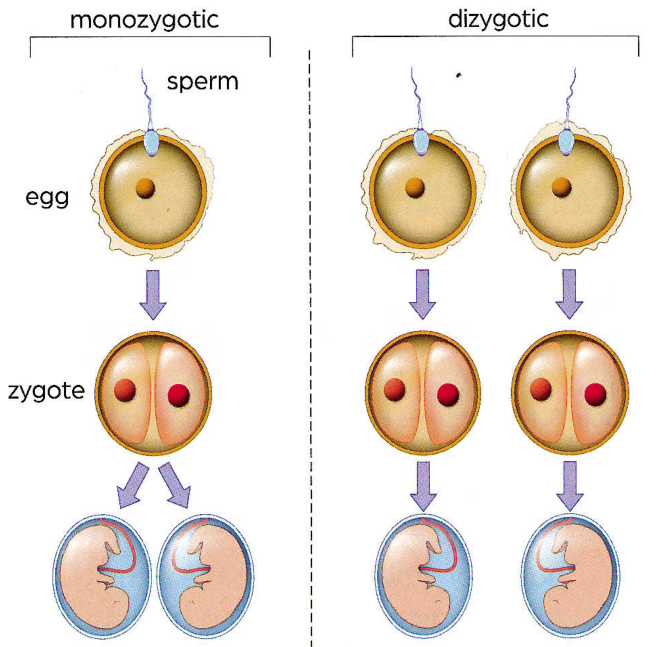
Figure 3.14 shows the development of monozygotic (identical) and dizygotic (non-identical or fraternal) twins.

Based on the diagrams, determine which embryos have the same combination of chromosomes and which embryos have different combinations.

Question illustration

Question 15

Figure 3.14 shows the development of monozygotic (identical) and dizygotic (non-identical or fraternal) twins.

What are some characteristics of monozygotic twins and dizygotic twins?

Question illustration

Question 16

In groups, design a three-day meal plan for a pregnant woman. Include foods rich in nutrients such as folic acid, iron, calcium, proteins and vitamins for the healthy growth and development of the fetus.

You may use the Internet or other sources of information to help you.

Question 17

Work in groups.

List some key health advice relating to the effects of smoking, diet and drugs on fetal development.

Question 18

Work in groups.

Context: List some key health advice relating to the effects of smoking, diet and drugs on fetal development.

Discuss the possible methods for communicating this health advice to reach as many prospective parents as possible. Some methods include public health campaigns, workshops or online resources (websites or social media).

Question 19

Work in groups.

Context: List some key health advice relating to the effects of smoking, diet and drugs on fetal development.

Choose a communication method such as a public health campaign, workshop or online resource.

For one of the methods, create materials to communicate the health advice effectively.

Question 20

Work in groups.

Context: List some key health advice relating to the effects of smoking, diet and drugs on fetal development.

Choose a communication method such as a public health campaign, workshop or online resource.

Create materials for your chosen method to communicate the health advice.

Present your materials to the class. Highlight the advantages or challenges of the method you have chosen.
0
0
GIỎ HÀNG
Empty CartGIỎ CHƯA CÓ GÌQUAY LẠI SHOP