We see the objects around us because of the light that they emit or reflect. Have you ever noticed that when light shines on soap bubbles, every bubble shines with many colours? Why do we see these colours in bubbles?
Modern lamps use reflection and refraction to maximise the amount of light they emit. This makes them more efficient than traditional lamps. How can we reduce light pollution and avoid wasting energy?
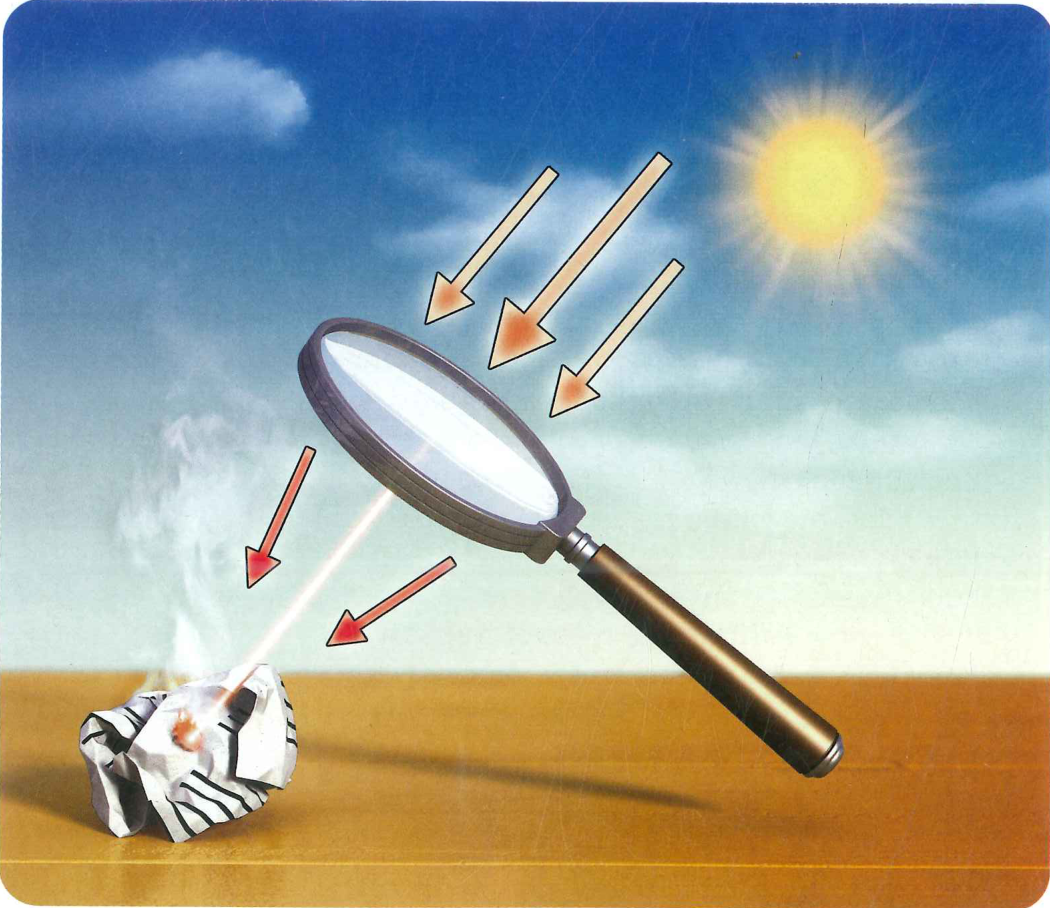
Imagine you are playing with a magnifying glass outdoors on a sunny day. You notice that the magnifying glass can focus the sunlight into a tiny bright spot (Figure 10.6). Suggest why you can start a fire by concentrating light on a piece of paper using a magnifying glass. In pairs, share your answers.
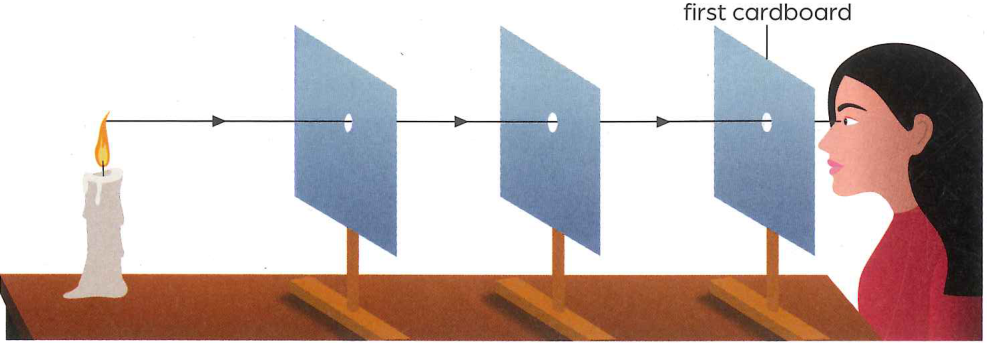
Work in pairs to carry out this experiment to find out how light travels (Figure 10.8). You will need three identical pieces of cardboard with a hole in the centre, a candle and matches.
1. Place the candle on a table and light it.
2. Arrange the three pieces of cardboard in a line between you and the candle. You can use stands or get friends to hold them. Make sure that the holes in the pieces of cardboard are aligned.
3. Look through the hole in the first piece of cardboard.
4. Now move the middle piece of cardboard so that the hole is not in line with the others. Look through the first hole again. Do the same with the third piece of cardboard.
Caution: Be careful when you work with an open flame. Keep all other objects away from it so that they do not catch fire.
Note: Instead of using a candle, you could use any well-lit object. All light travels in straight lines. It does not matter if the light is coming directly from a source or has been reflected from an object.
What did you see the first time you looked through the hole?
Work in pairs to carry out this experiment to find out how light travels (Figure 10.8). You will need three identical pieces of cardboard with a hole in the centre, a candle and matches.
1. Place the candle on a table and light it.
2. Arrange the three pieces of cardboard in a line between you and the candle. You can use stands or get friends to hold them. Make sure that the holes in the pieces of cardboard are aligned.
3. Look through the hole in the first piece of cardboard.
4. Now move the middle piece of cardboard so that the hole is not in line with the others. Look through the first hole again. Do the same with the third piece of cardboard.
Caution: Be careful when you work with an open flame. Keep all other objects away from it so that they do not catch fire.
Note: Instead of using a candle, you could use any well-lit object. All light travels in straight lines. It does not matter if the light is coming directly from a source or has been reflected from an object.
What did you see the second and third times you looked through the hole?
Work in pairs to carry out this experiment to find out how light travels (Figure 10.8). You will need three identical pieces of cardboard with a hole in the centre, a candle and matches.
1. Place the candle on a table and light it.
2. Arrange the three pieces of cardboard in a line between you and the candle. You can use stands or get friends to hold them. Make sure that the holes in the pieces of cardboard are aligned.
3. Look through the hole in the first piece of cardboard.
4. Now move the middle piece of cardboard so that the hole is not in line with the others. Look through the first hole again. Do the same with the third piece of cardboard.
Caution: Be careful when you work with an open flame. Keep all other objects away from it so that they do not catch fire.
Note: Instead of using a candle, you could use any well-lit object. All light travels in straight lines. It does not matter if the light is coming directly from a source or has been reflected from an object.
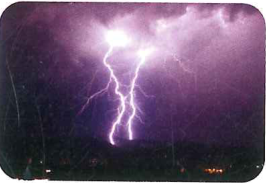
Look at Figure 10.10. Why do we see lightning before we hear thunder during a thunderstorm? Remember that sound travels at a speed of about 343 m/s in air.
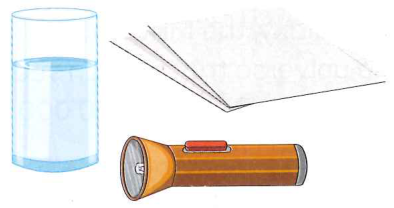
Work in pairs to do this experiment about how light travels through different media (materials). You will need a container made of clear glass or clear plastic, a laser pointer or flashlight, a piece of white paper or cardboard and water (Figure 10.12). You may also use a few drops of milk. Work in a dimly lit room. Shine the laser pointer or flashlight across the room onto a piece of white paper or cardboard. Observe the path the light takes through the air.
Work in pairs to do this experiment about how light travels through different media (materials). You will need a container made of clear glass or clear plastic, a laser pointer or flashlight, a piece of white paper or cardboard and water (Figure 10.12). You may also use a few drops of milk. Work in a dimly lit room. Place the container in the path of the light beam. Observe how the light passes through the glass and continues to the paper. Notice if there is any change in the direction of the light as it enters and leaves the glass.
Work in pairs to do this experiment about how light travels through different media (materials). You will need a container made of clear glass or clear plastic, a laser pointer or flashlight, a piece of white paper or cardboard and water (Figure 10.12). You may also use a few drops of milk. Work in a dimly lit room. Fill the container with water. You can add a few drops of milk to the water to make the light beam more visible. Shine the light through the side of the container so that the beam passes through the water before hitting the paper. Observe how the light beam bends when it enters the water, travels in a straight line through the water, and then bends again as it goes back into the air.
Work in pairs to do this experiment about how light travels through different media (materials). You will need a container made of clear glass or clear plastic, a laser pointer or flashlight, a piece of white paper or cardboard and water (Figure 10.12). You may also use a few drops of milk. Work in a dimly lit room. Compare the path of the light in air, glass and water. Notice how the light travels in a straight line through each medium, but the direction changes when it moves from one medium to another.
Work in pairs to do this experiment about how light travels through different media (materials). You will need a container made of clear glass or clear plastic, a laser pointer or flashlight, a piece of white paper or cardboard and water (Figure 10.12). You may also use a few drops of milk. Work in a dimly lit room. Shine the light at the paper or cardboard and look at the other side. Does the light travel through the paper or cardboard? Share your answer with the class.
Work in small groups to investigate how light behaves when it hits five different materials: mirror, aluminium foil, cardboard, black cloth and white paper. Make a hypothesis. Your hypothesis must be testable.
Work in small groups to investigate how light behaves when it hits five different materials: mirror, aluminium foil, cardboard, black cloth and white paper. Design an experiment to test your hypothesis, listing the materials needed and how you will carry out the experiment.
Work in small groups to investigate how light behaves when it hits five different materials: mirror, aluminium foil, cardboard, black cloth and white paper. Record the data collected in a suitable format.
Work in small groups to investigate how light behaves when it hits five different materials: mirror, aluminium foil, cardboard, black cloth and white paper. State whether the results support or contradict your hypothesis.
Work in small groups to investigate how light behaves when it hits five different materials: mirror, aluminium foil, cardboard, black cloth and white paper. How do you ensure that the experiment is a fair test?